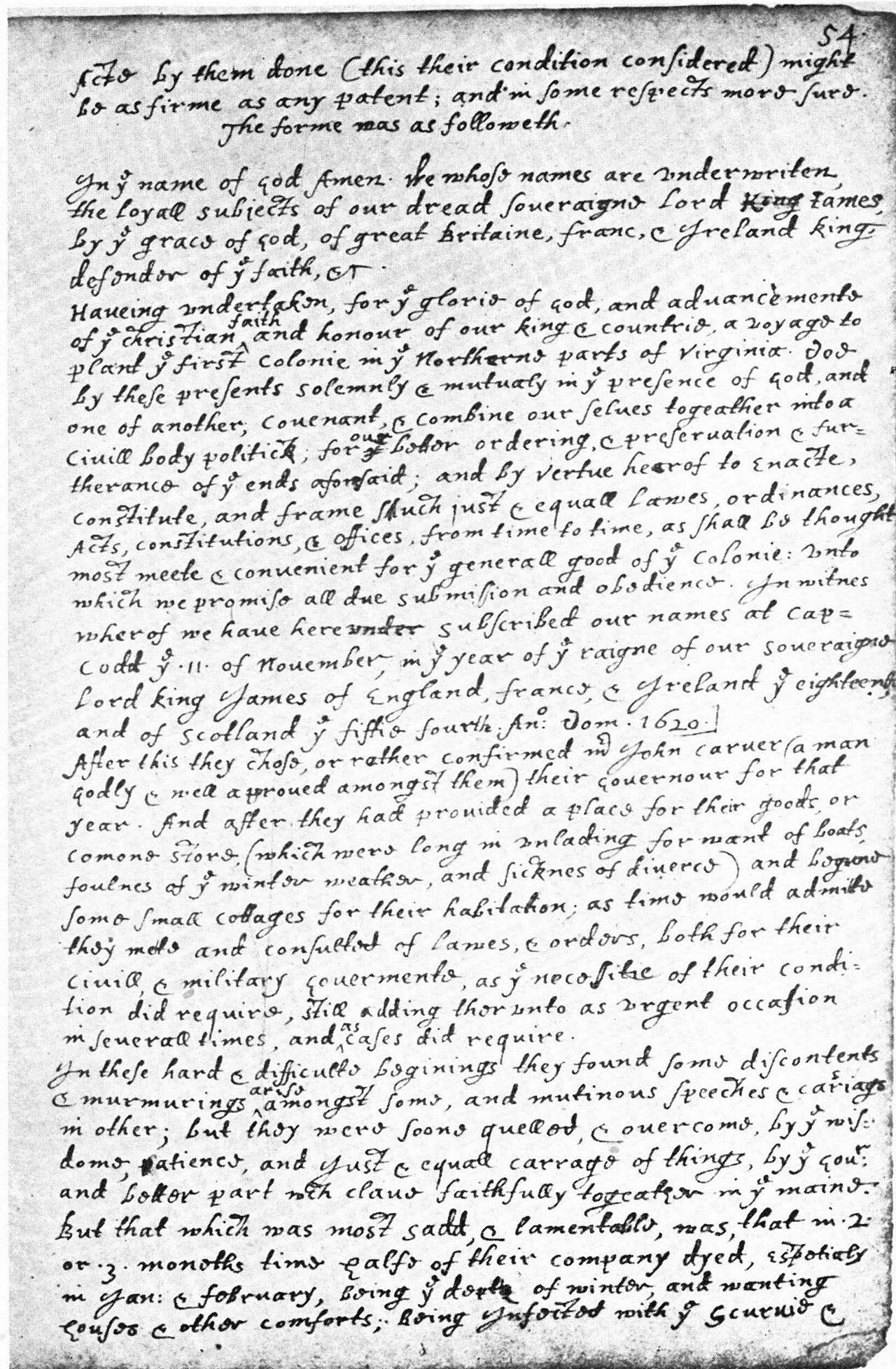
 Public domain
The Covenant Chain: Four Links from Religious Covenant to Self-Government
In the winter of 1620, a ship called the Mayflower lay at anchor off Cape Cod. In her cabin, forty-one grown men signed their names, one by one, to a document of fewer than two hundred words. For four centuries the Mayflower Compact has been told as "the beginning of American self-government." The real story is finer, more honest, and in the end more powerful than the slogan. It is a chain of grammar: the same people used the same covenanting language first to make a church, then to make order aboard a ship, and finally to make a colony. This page walks that chain across four links — and at every step, it says plainly what can be proved and what cannot.
A Note on Honesty
This site marks every claim with one of three honesty states. It contains no fabricated quotations, page numbers, or links.
| Marker | Meaning |
|---|---|
| ✅ VERIFIED | Confirmed by at least two independent sources |
| ⚠️ DISPUTED | Scholars disagree or sources conflict; we present the sides and do not adjudicate |
| ❓ UNAUDITABLE | First-hand evidence is thin or single-sourced; unverifiable |
The shape of the chain:
RING 1  Religious Covenant
        Scrooby (c. 1606) → Leiden (1609–1620)
        A congregation "covenants with God and one another"
               ↓
RING 2  Political Covenant
        Mayflower Compact (1620)
        The grammar of church covenant carried into secular governance
               ↓
RING 3  Institutionalization
        General Court · annually elected governor · town meeting
        1636 code → 1691 end of the colony
               ↓
RING 4  Trust Among Neighbors
        Small scale · face-to-face accountability · mutual watch
Ring 1 · The Source: Religious Covenant
Scrooby (c. 1606) → Leiden (1609–1620)
✅ The Scrooby congregation and the record of "covenanting"
Around 1605–1606, a group of Separatists — people who wanted to leave the Church of England entirely rather than reform it from within — gathered at Scrooby in Nottinghamshire, meeting in the home of William Brewster (Scrooby Manor). William Bradford later recalled their founding in Of Plymouth Plantation:
"…the Lord's free people joined themselves (by a covenant of the Lord) into a church estate, in the fellowship of the gospel, to walk in all his ways made known, or to be made known unto them, according to their best endeavours, whatsoever it should cost them, the Lord assisting them."
Three words carry the whole story: free people (voluntary), joined themselves (not appointed from above), and by a covenant (the bond itself is the source of authority). These three words are the grammatical prototype of the Mayflower Compact fourteen years later.
Sources
- William Bradford, Of Plymouth Plantation, 1620–1647 (manuscript 1630–1650; standard transcription)
- Congregational Library & Archives, "Plymouth's Pilgrims" — congregationallibrary.org/plymouths-pilgrims
- Plimoth Patuxet Museums, "Scrooby, Amsterdam, and Leiden"
❓ No original text of the Scrooby covenant exists
This is the single most important subtraction on the page. The Congregational Library & Archives in Boston — one of the leading authorities on Congregational church records — states plainly:
"no extant copy of the Scrooby congregation's founding covenant; indeed, there is no evidence that it was committed to writing."
The same source quotes the contemporary John Murton on how it happened: "There was first one stood up and made a covenant, and then another, and these two joined together."
This weakens any claim of a documentary lineage — there is no Scrooby paper to be copied — but it strengthens the claim of a lineage of action: people rising in turn and pledging themselves aloud, which is exactly what the forty-one did in the cabin in 1620. What can be proved is the act, not the document. (Single authoritative source, hence ❓ rather than ✅.)
Sources
- Congregational Library & Archives, "Plymouth's Pilgrims"
✅ Migration route and timeline
- 1607–1608: the congregation flees to Amsterdam
- 1609: moves to Leiden, staying about twelve years
- 1620: a portion sails for New England; their pastor, John Robinson, does not go and remains in Leiden
- 1625: Robinson dies in Leiden
Sources
- Plimoth Patuxet Museums, "Scrooby, Amsterdam, and Leiden"
- Encyclopædia Britannica, "John Robinson (English minister)"
⚠️ The size of the Leiden congregation
Two accounts side by side. The congregation is usually said to have begun at about 100 and grown to about 300. But those numbers come from later compilations and biographical tradition; no membership roll survives for first-hand checking, and the suspicious unanimity on "300" suggests a common origin. The safe statement: "The congregation is usually said to have grown to around three hundred — but that figure comes from later compilations, not from a surviving membership roll."
Sources
- Multiple secondary sources (Britannica; Pilgrim Hall Museum; Wikipedia) agree on 100→300, none citing a first-hand roll.
✅ The office structure at Leiden
- John Robinson — pastor (a teaching elder), publicly ordained at Leiden
- William Brewster — ruling elder, taking office soon after the move to Leiden
- deacons, handling poor-relief and church finances
- form of government: congregational — authority rests with the local congregation, not a higher body
A distinction often blurred: a ruling elder is not merely an "elder" in age but an office. In Plymouth, without Robinson, Brewster became the congregation's de facto religious head — yet he was not a pastor and could not administer the sacraments.
Sources
- Pilgrim Hall Museum, "William Brewster"
- Encyclopædia Britannica, "John Robinson"
✅ The content of the church covenant (confirmable in reverse)
In a passage by Edward Winslow lies a sentence often overlooked but crucial:
"Here also he put us in mind of our Church Covenant; at least that part of it whereby we promise and covenant with God and one with another, to receive whatsoever light or truth shall be made known to us from his written Word…"
This proves that the Leiden congregation had a "Church Covenant" whose structure was two-directional: a covenant with God, and a covenant with one another. It corroborates Bradford's "covenant of the Lord" at Scrooby (two independent texts → ✅). And it is the direct grammatical prototype of the Compact's "in the presence of God and one of another, covenant and combine ourselves together" — the firmest nail in the whole chain.
Sources
- Edward Winslow, Hypocrisie Unmasked (London, 1646)
- Congregational Library & Archives, "Plymouth's Pilgrims"
- Bradford, Of Plymouth Plantation
✅⚠️ A famous "ten principles" — genuine, but not verbatim
A famous list of "ten principles" of the Plymouth church is often quoted as Robinson's own words. Look closely: it is genuine but second-hand. The clauses most relevant here:
1. That no particular church ought to consist of more members than can conveniently watch over one another, and usually meet and worship in one congregation. 4. That this embodying is by some certain contract or covenant, either expressed or implied. 5. That being embodied, they have a right of choosing all their officers. 7. That these officers … have no lordly, arbitrary, or imposing power, but can only rule and minister with the consent of the brethren.
The chain of transmission has been checked page by page. The source is Thomas Prince's Chronological History of New-England (1736), who says before listing them: "I shall here give a summary of their main principles from their published writings." Cheever (1848) recast it as a list, and Ashton reprinted it in The Works of John Robinson (1851, vol. 3, pp. 490–491).
The verdict: these are Prince's 1736 digest of the Leiden church's published writings, not verbatim words. Not a forgery — but not a quotation either. Reliable in substance, zero as "their own words." The beautiful idea that a church should never outgrow the number who can "watch over one another" may be cited — but with its true attribution attached.
Sources
- Thomas Prince, A Chronological History of New-England (Boston, 1736; the ten principles at pp. 176–178) — Internet Archive
- Robert Ashton (ed.), The Works of John Robinson (London: John Snow, 1851), vol. 3, pp. 490–491 — Internet Archive
worksofjohnrobin03robi - George B. Cheever, The Pilgrim Fathers (New York: Wiley, 1848)
⚠️ Robinson's "Farewell Address": the most famous, and the most fragile
The most-quoted line attributed to Robinson: "the Lord had more truth and light yet to break forth out of his holy Word." It is also the most fragile in the evidentiary chain. Three views, side by side:
- Provenance: the only source is Edward Winslow's Hypocrisie Unmasked (1646), written 26 years after the fact; Winslow himself writes "or to the same purpose," conceding it is not verbatim. Bradford and Nathaniel Morton mention the address not at all.
- Doubt: George Sumner (1846) noted the silence of other accounts and how conveniently the words served Winslow's 1646 polemical purpose.
- Defense: William Wallace Fenn of Harvard Divinity School (1920) rebutted point by point and judged it "substantially authentic."
It is the most famous line in the spiritual history of Plymouth and the one on the thinnest evidence: a single recollection, 26 years later, whose author says only "or to the same purpose." We leave the uncertainty on the table rather than smoothing it away.
Sources
- Edward Winslow, Hypocrisie Unmasked (London, 1646)
- William Wallace Fenn, "John Robinson's Farewell Address," Harvard Theological Review, 1920
- Pilgrim Hall Museum, "John Robinson's Farewell Sermon, 1620"
Ring 2 · The Political Covenant: The Mayflower Compact
11 Nov 1620 (Old Style) / 21 Nov 1620 (New Style)
✅ Basic facts
| Item | Detail |
|---|---|
| Signed | 11 November 1620 (Old Style) = 21 November 1620 (New Style) |
| Place | aboard the Mayflower, at anchor off Cape Cod |
| Signatories | 41 adult men (9 of about 50 adult men aboard did not sign) |
| On board | 102 people (about a third were children) |
| First to sign | John Carver (subsequently elected first governor) |
| Length | about 195 words |
Sources
- Nathan Dorn, "The 400th Anniversary of the Mayflower Compact," In Custodia Legis (Law Library of Congress), 2020-11
- General Society of Mayflower Descendants, "The Mayflower Compact"
✅ Full text
The original is lost (see below). Below is the standard modernized-spelling text (from Bradford's manuscript, ed. Samuel Eliot Morison); seventeenth-century spellings differ in orthography but not in substance.
In the Name of God, Amen. We whose names are underwritten, the loyal subjects of our dread Sovereign Lord King James, by the Grace of God of Great Britain, France, and Ireland King, Defender of the Faith, etc.
Having undertaken, for the Glory of God, and advancement of the Christian Faith, and Honour of our King and Country, a Voyage to plant the First Colony in the Northern Parts of Virginia, do by these presents solemnly and mutually in the presence of God and one of another, Covenant and Combine ourselves together into a Civil Body Politic, for our better ordering and preservation and furtherance of the ends aforesaid;
and by virtue hereof to enact, constitute and frame such just and equal Laws, Ordinances, Acts, Constitutions and Offices, from time to time, as shall be thought most meet and convenient for the general good of the Colony, unto which we promise all due submission and obedience.
In witness whereof we have hereunder subscribed our names at Cape Cod, the 11th of November … Anno Domini 1620.
A few words repay a pause:
- covenant and combine — two verbs, not to be collapsed into one. "Covenant" is a theological word (a bond made before God); "combine" is a secular one (to join together). Their pairing is itself the evidence of the chain.
- civil body politic — not "a democracy" or "a republic," but a term of art in the law of the day (see Track B).
- due submission and obedience — often skipped, yet the other half of the document: a covenant grants not only rights but duties.
Sources
- Bradford, Of Plymouth Plantation, ed. S. E. Morison, via The Founders' Constitution (Univ. of Chicago Press)
- Records of the Colony of New Plymouth (PCR) 11: vi, via Plymouth Colony Archive Project (Univ. of Illinois)
- Nathan Dorn, In Custodia Legis (LOC), 2020-11
✅ The original is lost; the text survives through three lines
The original Compact has long been lost (one account holds it was stolen during the Revolutionary War). The text we have descends through three independent lines:
- Mourt's Relation (London, 1622) — the earliest surviving printed text, by Edward Winslow and William Bradford
- Purchas his Pilgrimes (Samuel Purchas, London, 1625) — another independent printing
- William Bradford, Of Plymouth Plantation (manuscript, 1630–1650) — Bradford says he copied it from the original
There is a telling irony here: the "first American social contract" survives in no original at all. The force of a covenant lies not in the paper but in whether people keep invoking it.
Sources
- Nathan Dorn, In Custodia Legis (LOC), 2020-11 (lists Mourt's Relation 1622 as the earliest surviving text)
- General Society of Mayflower Descendants
✅ The context of signing: a "no one has power to command us" crisis
Why draw up the Compact at all? Bradford is blunt about it:
"…occasioned partly by the discontented and mutinous speeches that some of the strangers amongst them had let fall from them in the ship — That when they came ashore they would use their own liberty; for none had power to command them, the patent they had being for Virginia and not for New England…"
Two words to get right: Strangers does not mean "unknown persons" but the congregation's term for passengers who were not members of their church (the members called themselves "Saints") — and the Strangers were the majority aboard. Patent here is not a "patent" in the modern sense but a colonial land grant.
The Strangers' argument was jurisdictional: no jurisdiction, no command. The Pilgrims answered not by claiming authority over them but by manufacturing a source of authority on the spot — out of mutual consent. This is "government by consent" caught in the act of being born: not theory first, but crisis-driven. Mourt's Relation (1622) tells the same story — sensing "some appearance of faction," they resolved to "combine together in one body, and to submit to such government and governors as we should by common consent agree to make and choose." Two independent texts → ✅.
Sources
- William Bradford, Of Plymouth Plantation
- Mourt's Relation (London, 1622), pp. 5–6, via Nathan Dorn, In Custodia Legis (LOC), 2020-11
The Compact's Status: Two Tracks, Side by Side
What the Compact means has two rival tellings. They are not "right versus wrong" but two true layers of the same document. We set them side by side and do not adjudicate.
Track A · The National Narrative: A Founding Document of Self-Government
Track A holds that the Mayflower Compact is a founding document of American self-government — the first practice on the continent of "government by consent of the governed," a herald of American constitutional democracy. Its milestones are all verifiable:
- 1802: John Quincy Adams (later the sixth president), in a Forefathers' Day oration at Plymouth, called it "the only instance in human history of that positive, original social compact… a unanimous and personal assent by all individuals of the community to the association by which they became a nation."
- 1789–1791: James Wilson, a framer of the Constitution and an early Supreme Court justice, described the Compact in his Philadelphia law lectures as an original transplanting of the best of English common-law tradition.
- Today the Library of Congress exhibition "Join In: Voluntary Associations in America" still treats it as a founding text of America's tradition of voluntary association.
Track A is not "wrong." It is a real narrative with immense historical force. Track B revises its factual footing, not its cultural weight.
Sources
- Nathan Dorn, In Custodia Legis (LOC), 2020-11
- Mark L. Sargent, "The Conservative Covenant: The Rise of the Mayflower Compact in American Myth," The New England Quarterly 61:2 (1988), 233–251 (as summarized by LOC)
- Library of Congress, "Join In: Voluntary Associations in America"
Track B · The Legal-History Revision: A Narrow Immediate Purpose, a Later-Awarded Myth
Legal historians (notably Mary Sarah Bilder and others) offer three corrections.
(1) "civil body politic" was a common legal term of the day
This was not an invented declaration of political ideals. In seventeenth-century English law, "body politic" was the standard term for a corporation. England's first treatise on corporate law — William Sheppard's Of Corporations, Fraternities and Guilds (London, 1659) — states that "our law doth take notice of a body natural, and a body politic," defining a corporation as "a body in fiction of law." The same phrase runs through the colonial charters of the era: the Charter of New England (1620) erects its company as "one body politic and corporate," as do the charters of Massachusetts Bay (1629) and Harvard (1650). A "corporation" then covered far more than today — hospitals, charities, colleges, guilds, and towns all qualified.
As the Law Library of Congress summarizes Bilder's argument: the language "was likely chosen to present New Plymouth Colony's exercise of self-government in a light reminiscent of the Virginia Company's exercise of self-government, that is, as authority delegated to the corporation." Yet, the same source notes, "lacking the authority of the Crown and the formalities that royal charters or parliamentary acts of incorporation required, the Compact did not create a corporation that was valid in England. It looks in retrospect like a founding of a different sort."
(2) Its mythic status is a retrospective construction of the late eighteenth century
The sharpest correction: before 1776 the document was neither called "the Mayflower Compact" nor thought to carry any great social or political meaning. Its rise has a clear timeline:
- 1780: the Loyalist George Chalmers cast the covenant as a statement of loyalist principle — the first political mobilization of the text was royalist, not revolutionary.
- 1789–1791: James Wilson answered back, reading it as the beginning of an American law superior to England's.
- 1802: John Quincy Adams elevated it to "the only … original social compact" in human history.
- Thereafter it became a fixed piece of the national story.
In other words, the document's greatness is half the gift of the forty-one men of 1620 and half the gift of a handful of orators between 1780 and 1802. This is not debunking — it is the point: a covenant's force depends on whether later generations keep invoking it.
(3) The boundary of "consent": who was excluded
The sober facts: the signatories were 41 adult men; zero women; indentured servants were not entitled to sign; about a third of those aboard were children. And the Wampanoag were wholly absent and never consulted — the "governed" whose "consent" this government rested on did not include the people who had lived on this land for thousands of years.
Sources
- Nathan Dorn, In Custodia Legis (LOC), 2020-11 & 2021-11
- Mary Sarah Bilder, "English Settlement and Local Governance," in The Cambridge History of Law in America, eds. Grossberg & Tomlins (Cambridge UP, 2008), pp. 63–103 (via LOC)
- Mark L. Sargent, The New England Quarterly 61:2 (1988) (via LOC)
- William Sheppard, Of Corporations, Fraternities and Guilds (London, 1659)
⚠️ An open legal question: did the 1621 Peirce Patent "supersede" the Compact?
Here the sources genuinely conflict. What is not in dispute: on 1 June 1621 the Council for New England (a Crown-chartered private corporation) issued the Peirce Patent to John Peirce and associates, chiefly a grant of land; and Plymouth Colony never obtained a royal charter in its entire life (1620–1691). What is disputed is the Compact's legal standing thereafter:
- One view (superseded): Caleb Johnson calls the Compact a "quick fix," and holds that the 1621 Peirce Patent "in a sense supersedes" it.
- One view (never superseded — repeatedly cited): the legal historian Christopher Fennell, working from the first-hand Plymouth Colony Records, shows the colony's government simultaneously invoked three grounds of authority in later enactments: this "combination" (the Compact), the land patent from the New England Council, and the colonists' pursuit of God's glory. Moreover the New England Council, itself a private corporation, had no power to grant the colonists any right of self-government. The patent gave them land but not the right to govern — which is why the Compact had to be cited again and again for seventy years.
There is a third perspective that cannot be omitted. The historian Linda Coombs (Aquinnah Wampanoag, published via Pilgrim Hall Museum) writes that the Wampanoag and other Indigenous people "question the authority of the Council for New England or the King to assign our territories and homelands to the Pilgrims without any negotiation with Wampanoag leadership." Neither document had any authority to give away land that was already theirs.
Sources
- Caleb Johnson, "The Pierce Patent, 1621," Plymouth Colony Archive Project
- Christopher Fennell, "Plymouth Colony Legal Structure," Plymouth Colony Archive Project (PCR 11: 6, 74)
- Pilgrim Hall Museum, "The Plymouth Patent" (Linda Coombs statement)
Ring 3 · Institutionalization
General Court · Annual Elections · Town Meeting (1620–1691)
A caution: below, keep separate what was Plymouth's own and what was borrowed from Massachusetts Bay — the two are often conflated.
✅ The key to the link: Plymouth had no royal charter
As Christopher Fennell writes: "The legal and governmental structure for Plymouth Colony was not set forth in a royal charter from the Monarchy in England… Plymouth was fairly unique in its time for lacking such a charter." By contrast, John Winthrop obtained a royal charter from Charles I in 1630 that "served as the legal foundation for the government of the Massachusetts Bay Colony for more than half a century."
This is the key to the whole link: Plymouth had to generate its authority to govern from "we agree among ourselves," because it had nothing else to lean on. Its institutions were forced into being, not designed.
Sources
- Christopher Fennell, "Plymouth Colony Legal Structure" (Langdon 1966: 40; Chafee 1969: 56–57)
✅ General Court: legislative and judicial in one, governor re-elected every year
| Body | Composition | Function |
|---|---|---|
| General Court | Governor + Assistants + all freemen | legislative + judicial (unusual for its time) |
| Governor | one, elected annually | presided over the Court; cast the deciding vote on a tie; held magisterial power |
| Court of Assistants | Governor + Assistants | could not make general law; later mainly judicial |
| freemen | enfranchised male citizens | held the legislative power |
The key clause of the 1636 code (PCR 11: 11) calls the colony "the Corporation" — echoing Track B's "corporate language" reading:
"That the lawes [and] ordnanc[s] of the Colony [and] for the Governm[ent] of the same be made onely by the ffremen of the Corporation [and] no other."
John Carver was chosen first governor in 1620; on his death in 1621, William Bradford was elected and re-elected for decades. These offices were re-elected annually by the General Court, which met on a fixed calendar each year (in the early period in March, June, October, and December).
Sources
- Christopher Fennell, "Plymouth Colony Legal Structure" (PCR 11: 6, 7, 11)
- Wikipedia, "Plymouth General Court"
✅ The 1636 code: America's first "constitution" and first embryonic "bill of rights"
In 1636 the Plymouth General Court completed its first codification of law. The legal historian George L. Haskins judged (as quoted by Fennell):
"…the code sets forth the general scheme or frame of government of the colony… Second, it contains a rudimentary bill of rights, certainly the first in America, antedating by five years that adopted by Massachusetts Bay in the Body of Liberties of 1641… the 1636 code established a constitution of the type that was to become familiar in America after the Revolution."
A timeline worth remembering: Plymouth 1636 precedes Massachusetts Bay 1641 by a full five years. Here the credit really does belong to Plymouth.
Sources
- George L. Haskins, "The Legal Heritage of Plymouth Colony" (1969: 123), via Fennell
✅ The General Fundamentals: one of North America's earliest declarations of "no legislation without consent"
From Plymouth's 1672 Book of Laws (composed sometime between 1636 and 1671), in period spelling:
"Wee the Associates of New-Plimouth, comeing hither as Freeborn Subjects of the State of England… Do enact, Ordain and Constitute; That no Act, Imposition, Law or Ordinance, be made or imposed upon us, at present or to come; but such as shall be made or imposed by consent of the Body of Freemen or Associates, or their Representatives legally assembled…"
"by consent of the Body of Freemen" is the institutional sequel to the Compact's "by common consent." The seam between Ring 2 and Ring 3 runs right through this sentence.
Sources
- The Book of the General Laws of New Plimouth (1672), via Powers 1966: 97 & Fennell
⚠️ Town meeting and representation: what can and cannot be proved
What can be proved (two independent sources agree):
- Plymouth did hold town meetings, and attendance was compulsory — towns often had to threaten fines against freemen who failed to attend (Fennell, from PCR 6: 265; also History of Massachusetts: "attendance… was made virtually obligatory by assessing fines for absence").
- Towns' power to make local law was granted step by step by the General Court: in 1636 it first authorized Scituate and Plymouth to make by-laws (provided they did not contradict the colony's general ordinances), extending the power to all towns some years later.
- Representation by "deputies" was introduced in the late 1630s. The reason was distinctly unromantic: the freemen found the burden of attendance too heavy and chose to send deputies instead. Self-government here was not lyrical; it was a duty enforced by fines.
What cannot be proved (an honest admission): whether the origin of the town-meeting institution belongs to Plymouth or to Massachusetts Bay has no settled scholarly consensus. Plymouth's early direct democracy is sometimes said to resemble today's open town meeting — but that is an analogy, not an origin claim. Even the exact year deputies were introduced (1638 vs. 1639) remains unsettled.
A short "don't misattribute" table:
| Institution | Belongs to | Evidence |
|---|---|---|
| 1636 code / embryonic bill of rights | ✅ Plymouth (5 years before the Bay Colony) | Haskins 1969: 123 |
| All General Court officers directly elected by freemen | ✅ Plymouth (unlike the Bay Colony's representative system) | Wikipedia, Plymouth General Court |
| County courts | ❌ borrowed from Massachusetts Bay (Plymouth adopted them only in 1685) | Fennell (Langdon 1966: 205) |
| Body of Liberties (1641) | ❌ Massachusetts Bay's | Haskins |
| Royal charter | ❌ Massachusetts Bay had one (1629/1630); Plymouth never did | Fennell |
Sources
- Christopher Fennell, "Plymouth Colony Legal Structure" (PCR 6: 265; 11: 11, 16, 18, 32)
- Rebecca Beatrice Brooks, "The Government of Plymouth Colony," History of Massachusetts Blog
- Wikipedia, "Plymouth General Court"
✅ Who counted as a "freeman": the second boundary of consent
Trust among neighbors had a price: you first had to be admitted as a neighbor. The threshold to become a freeman tightened over time:
- Women and servants could not become freemen.
- Procedure: approval by the town's existing freemen → acceptance by the General Court.
- Tightened in 1658: a candidate had to wait a year after his name was submitted; the law refused freemanship to "opposers of the good and wholesome lawes of the Collonie," to "manifest opposers of the true worship of God," and to "such as refuse to doe the Countrey seruice"; and it specifically excluded Quakers — no Quaker could be a freeman; a freeman who became one lost his standing; a freeman who assisted one lost his too.
- 1659: twelve men were convicted for refusing the oath of fidelity and fined £5 each.
This is the economics of communal trust: the price of low enforcement cost is a high cost of entry and a high cost of exclusion. The same mechanism reads inward as "trust" and outward as "exclusion."
Sources
- Christopher Fennell, "Plymouth Colony Legal Structure" (PCR 11: 65, 79, 101; PCR 3: 70, 162, 189)
✅ The end: 1691 / 1692
- 7 Oct 1691: William III and Mary II approve the Charter of the Province of Massachusetts Bay, folding Plymouth Colony and Massachusetts Bay into a new Province of Massachusetts Bay and recasting it as a royal province — governor appointed by the Crown.
- 14 May 1692: Sir William Phips arrives in Boston with the new charter; it takes effect.
- Plymouth Colony thus lost its self-governance after 71 years (1620–1691).
Fennell's closing note: Bradford, Isaac Allerton, and others "attempted repeatedly over the years… to obtain a charter from the Crown. They failed to do so," and Plymouth ultimately "lost its self-governance" and was annexed in 1691.
The chain ends not in triumph but in annexation. Seventy-one years of local self-government rested never on legal grant but on mutual agreement; when an outside power finally arrived, it could not hold. And yet — its grammar survived, resurfacing in Philadelphia a century and a half later. Perhaps that is the truest thing about the "covenant ethic": it is not an institution that can protect you, but a grammar that can be inherited.
Sources
- Avalon Project (Yale Law School), "The Charter of Massachusetts Bay — 1691"
- Wikipedia, "Massachusetts Charter"
- Christopher Fennell, "Plymouth Colony Legal Structure"
Ring 4 · Trust Among Neighbors
Small Scale · Face-to-Face Accountability · Mutual Watch
✅ Scale: this really was a "face-to-face society," provable in numbers
| Date | Population |
|---|---|
| 11 Nov 1620 (reaching Cape Cod) | 102 aboard |
| Dec 1620 – Mar 1621 | Bradford records 44 deaths |
| Apr 1621 (after the Mayflower sailed home) | about 50 survivors |
| mid-1623 | about 180 |
| 1624 (Capt. John Smith) | "about 180 persons… 32 dwelling houses… the Town is impaled about half a mile in compass" |
| 1627 (cattle division) | 156 people in the allotment |
In the spring of 1621 the whole colony was down to about fifty souls. By 1624 it was 180 people, thirty-two houses, a palisade half a mile around — a village you could walk across in ten minutes. In such a place you could not be anonymous. Trust among neighbors here was not a virtue but a physical fact. (Later population figures diverge by scope: for 1690, one source gives 3,055 for Plymouth County and another about 7,000 for the whole Colony — different denominators, not a contradiction, but not to be mixed; hence ⚠️.)
Sources
- Patricia Scott Deetz & James Deetz, "Population of Plymouth Town, Colony & County, 1620–1690," Plymouth Colony Archive Project (Bradford, ed. Morison, pp. 443–448; PCR 12: 9–13)
- Capt. John Smith, Generall Historie (London, 1624)
✅ "Face-to-face accountability" in the civil sphere: three provable mechanisms
- First · compulsory attendance: miss a town meeting → the town fines you; miss the General Court, or be chosen for the Grand Enquest and fail to serve → heavier fines. No absence, no free-riding.
- Second · trial by peers: from 1623, criminal, trespass, and debt cases were tried by a jury of twelve freemen. The people who judged you were the people who would work the next field over from you tomorrow.
- Third · collective town liability: each town was collectively responsible for its jail, pound, stocks, whipping post, and poor-relief; a town that failed was itself prosecuted and fined. Responsibility was communal, not individual.
This is among the firmest evidence for "trust among neighbors" — and also its most unsettling face: judgment, oversight, and discipline all took place under one another's gaze.
Sources
- Christopher Fennell, "Plymouth Colony Legal Structure" (PCR 6: 265; 11: 3, 11, 16, 38, 41)
✅❓ Church discipline: the principle is clear, but no 1620s case records survive
The Separatist/Congregational ladder of church discipline (from clause 9 of the circulating "ten principles" and from Congregational archival study): private admonition → formal summons → public hearing before the congregation → suspension from communion → public confession → excommunication. The crucial limit: the church and its officers "have no authority to inflict any penalties of a temporal nature; excommunication being wholly spiritual." Its warrant is Matthew 18:17 — "tell it to the church." Note: the church, not the bishop. Authority lies with the congregation, not a hierarchy.
Here an honesty note is owed. The rich archive of "mutual watch" — churches covenanting in writing to "watch over one another's Souls faithfully," the Natick covenant of 1729 that gives the Congregational Library exhibit its title, "We do Give up ourselves to one another… freely Covenanting & Binding" — is largely eighteenth-century (the Natick church records run 1721–1794). To project it back onto 1620s Plymouth would be a faulty inference.
And it can be put more firmly: this is not merely "not found" but "did not then exist." The First Church of Plymouth's own record book was not begun until January 1680, by the clerk Nathaniel Morton. He opens by explaining that he undertakes to commit the church's beginnings to writing "forasmuch as I can not understand That there is any thing particularly extant concerning it." That is the church's own clerk, in 1680, saying nothing survives. Systematic contemporaneous recording began only after John Cotton took office in 1669.
But keep two statements apart: "no case records" is not "no practice." Bradford's own narrative contains instances of church discipline (such as the John Lyford affair of 1624). So the honest conclusion of this link is: the principle is provable; the practice is not — and no 1620s case records survive to prove it.
Sources
- "Principles of the Plymouth Church," clause 9 — Prince 1736 → Cheever 1848 → Ashton 1851, vol. 3, pp. 490–491
- Congregational Library & Archives, "We do Give up ourselves to one another" (online exhibit)
- Colonial Society of Massachusetts, Plymouth Church Records, 1620–1859 (editor's introduction & Morton's 1680 preface) — colonialsociety.org
✅ The Wampanoag / Patuxet Perspective: This Is Where "Trust Among Neighbors" Meets Its Limit
This is not an addendum but a necessary part of the link. The moment "trust among neighbors" steps outside the small circle of English settlers, it meets its boundary: the Wampanoag were not "neighbors" in that system, so its trust mechanisms did not extend to them — and that was not an accident but a structure. Two tracks, side by side.
The contemporary institutional stance: since 1973 — when few American museums included Indigenous voices — Plimoth Patuxet Museums has worked directly with local Native people to bring Indigenous perspectives into its exhibits and programs; its Wampanoag Indigenous Program has now reached its fiftieth year. The Historic Patuxet Homesite introduces visitors to Native people who have lived here "for more than 12,000 years." Malissa Costa (Mashpee Wampanoag Tribe), manager of the Homesite, says: "I have the opportunity to share insights of the past and present, clarify common misperceptions, dispel stereotypes, and provide a more balanced history."
The revisionist scholarship: David J. Silverman, This Land Is Their Land: The Wampanoag Indians, Plymouth Colony, and the Troubled History of Thanksgiving (Bloomsbury, 2019). Its core claims: the land Plymouth claimed was already Wampanoag land, neither empty nor uncultivated; the linking of Thanksgiving to the 1621 harvest gathering arose only in the twentieth century — which is why some Native people today observe a Day of Mourning on Thanksgiving. The book drew serious reviews (including in the American Historical Review) for placing "Native diplomacy and action at the center of the narrative."
On the name: Patuxet was this place's own name, and the name of the Wampanoag community here. The museum's change from "Plimoth Plantation" to "Plimoth Patuxet" was made precisely to restore that erased name to its own ground.
Sources
- Plimoth Patuxet Museums, "Historic Patuxet Homesite"; "The Wampanoag Indigenous Program" (50th-anniversary release, with Malissa Costa)
- David J. Silverman, This Land Is Their Land (Bloomsbury, 2019); review in American Historical Review 126:1 (2021), p. 308
- Pilgrim Hall Museum, "The Plymouth Patent" (Linda Coombs statement)
Coda: Where a Covenant's Power Really Lies
Looking back across the four links, the most honest summary is not "American self-government was born in 1620," but this: a group of people used one covenanting language to make first a church, then order aboard a ship, then a colony — and that language could make things only because three very concrete, very worldly conditions held: how costly it was to get in, how visible everyone was, and how hard it was to get out. Plymouth had all three, and so it lasted seventy-one years; and the day it could no longer last was the day an outside power it could not touch rewrote the rules of entry.
But the same mechanism reads inward as "trust" and outward as "exclusion": its efficiency comes from the sharpness of its boundary. In 1658 it placed Quakers outside that boundary; and from 1620 it had placed the Wampanoag outside it from the very start — without even registering that a boundary was being drawn. Whenever we admire "trust among neighbors," it is worth asking in the same breath: who counts as a neighbor, and who does not? Unasked, the lesson is merely a more elegant art of exclusion.
Key Terms
| Term | Note |
|---|---|
| covenant | No consideration, cannot be unilaterally dissolved, its force grounded in God's presence; ≠ contract (which has consideration, is enforceable and dissolvable) |
| congregational polity | authority rests with the local congregation, not a higher body |
| Separatist | favored leaving the Church of England (unlike Puritans, who sought reform from within) |
| ruling elder / pastor | both are offices; only a pastor may administer the sacraments |
| Strangers / Saints | Strangers = non-congregation passengers (the majority aboard); Saints = what congregation members called themselves |
| patent / royal charter | a land / colonial grant; Plymouth never obtained a royal charter |
| civil body politic | a seventeenth-century legal term, close to "corporation," not "a democracy" |
| freeman | an enfranchised male citizen with the right to vote and hold office |
| General Court | both legislative and judicial, not a "supreme court" |
| town meeting | attendance compulsory, absence fined |
| excommunication | nominally "wholly spiritual," involving no temporal penalty |
| Wampanoag / Patuxet | Patuxet was this place's original name and the name of the local Wampanoag community |
Source Register
Primary sources (via authoritative reprints)
- William Bradford, Of Plymouth Plantation, 1620–1647 (ed. S. E. Morison)
- Mourt's Relation (Winslow & Bradford, London, 1622) — earliest surviving text of the Compact
- Purchas his Pilgrimes (Samuel Purchas, London, 1625)
- Edward Winslow, Hypocrisie Unmasked (London, 1646)
- Records of the Colony of New Plymouth (PCR), eds. Shurtleff & Pulsifer
- The Peirce Patent (1621); The Book of the General Laws of New Plimouth (1672)
- Capt. John Smith, Generall Historie (London, 1624)
- Charter of the Province of Massachusetts Bay (1691) — Avalon Project
Institutions
- Law Library of Congress, In Custodia Legis (Nathan Dorn, 2020-11 & 2021-11)
- Library of Congress, "Join In: Voluntary Associations in America"
- Plimoth Patuxet Museums; Pilgrim Hall Museum
- Congregational Library & Archives (Boston); State Library of Massachusetts
- Avalon Project, Yale Law School
Scholarship
- Christopher Fennell, "Plymouth Colony Legal Structure," Plymouth Colony Archive Project (Univ. of Illinois)
- Patricia Scott Deetz & James Deetz, "Population of Plymouth Town, Colony & County, 1620–1690"
- William Wallace Fenn, "John Robinson's Farewell Address," Harvard Theological Review (1920)
- George L. Haskins, "The Legal Heritage of Plymouth Colony" (1969), via Fennell
- George D. Langdon, Jr., Pilgrim Colony: A History of New Plymouth, 1620–1691 (1966), via Fennell
- Mary Sarah Bilder, "English Settlement and Local Governance," in The Cambridge History of Law in America, eds. Grossberg & Tomlins (Cambridge UP, 2008), pp. 63–103 (via LOC)
- Mark L. Sargent, "The Conservative Covenant: The Rise of the Mayflower Compact in American Myth," The New England Quarterly 61:2 (1988), 233–251 (via LOC)
- David J. Silverman, This Land Is Their Land (Bloomsbury, 2019)
- Thomas Prince, A Chronological History of New-England (1736); Robert Ashton (ed.), The Works of John Robinson (1851); George B. Cheever, The Pilgrim Fathers (1848)
- Colonial Society of Massachusetts, Plymouth Church Records, 1620–1859