 Public domain
A Letter to the Whole Company, Read Aloud to All
Leiden, July 1620
How evidence is marked on this page Block quotations are primary text, with a source. Boxed passages are modern paraphrase, not source quotations. The two are set differently on purpose.
He could not go
In the summer of 1620 John Robinson was pastor to the Separatist congregation at Leiden. Part of that congregation was leaving — first on the Speedwell to England, then on the Mayflower across the Atlantic.
He did not sail with them. The congregation divided, the greater number stayed at Leiden, and he stayed with the greater number.
So he did the other thing available to him. He wrote.
One short letter to John Carver. One long letter to everyone.
I have written a large letter to ye whole, and am sorry, yt I shall not rather speak then write to them, & the more considering ye wants of a preacher, which I shall also make some spurr, to my hastening after you.
Three words repay a second look. wants means lack, not desire. then is the old spelling of than. after you means following on once you have gone ahead — not chasing anyone down.
The letter was read aloud
This was not private correspondence. Before they sailed it was read out to the whole company — which is the most important single fact about it, and the only firm link between the letter and what happened later: the same people, on one occasion, heard the same words together.
What the letter discusses is how to live alongside one another, how to weigh the common good, how to choose those who govern, and why one owes obedience to those one has chosen.
Four months later, on another coast
In November 1620, off Cape Cod, the men aboard signed a document later called the Mayflower Compact. It opens:
In the name of God, Amen. We whose names are underwritten, the loyal subjects of our dread Sovereign Lord King James…
…for the glory of God, and advancement of the Christian faith, and honour of our King and Country, a voyage to plant the first colony in the northern parts of Virginia…
⛔ These lines are often dropped, and dropping them changes what the document is. In its first sentence the signers call themselves loyal subjects of the King, and they list the honour of King and Country among the purposes of the voyage. The Compact is not a declaration of independence. Any version that removes the subjecthood and the crown, keeping only the community and the self-government, reads as more of a founding charter than the thing itself ever was.
So did the Compact come from the letter?
This is the easiest question to answer quickly and the hardest to answer honestly.
Three things are known:
| Parallel | Both texts speak of the common good, of choosing governors, and of obedience to those one has chosen |
| Prior | The letter came first; the Compact was signed afterwards |
| Not demonstrable | No evidence shows that the Compact was drafted with this letter in view |
There is evidence pointing the other way, too. Body politic, common good and due obedience were shared public vocabulary around 1620, not any one writer's property — and where the letter has comone good, the Compact has general good. The difference in wording is itself a sign that nothing was copied.
The honest statement is the narrow one: the two are parallel, the letter is earlier, and direct borrowing cannot be shown.
🅲 Modern paraphrase, not a source quotation
The Mayflower story is not a ship that suddenly produced self-government. It is a body of people who first learned, in a congregation, how to live together — who then wrote common good, chosen governors and lawful obedience into the ordering of a voyage — and who, under pressure, turned those principles into a covenant and then into institutions.
Before they covenanted on paper, they had already been taught how to live, choose, govern, and obey together.
What this page deliberately does not say
- How many signed, and how many sailed. The familiar figures differ between accounts; no fixed number is given here.
- That the letter caused the Compact. See above: no evidence.
- That Robinson followed. He did not. He died at Leiden in 1625, having never crossed.
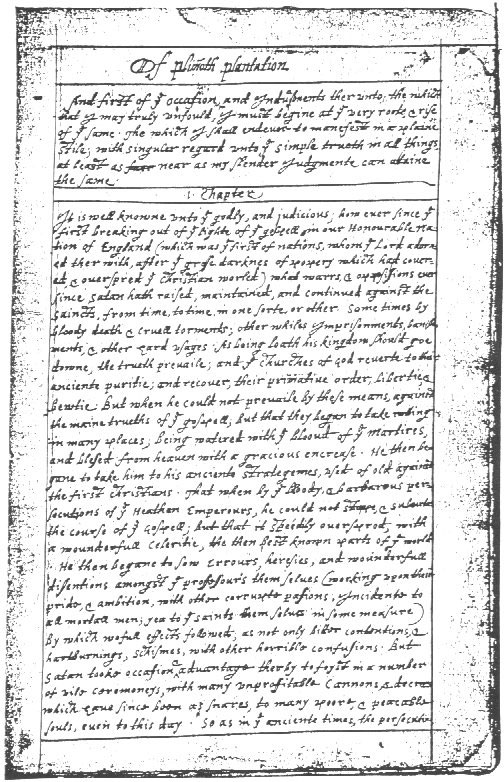
Primary text quoted here is from the manuscript transcription of William Bradford's Of Plimoth Plantation. The modernised spelling and the translations are editorial, not the manuscript itself, and are marked as such in the text.