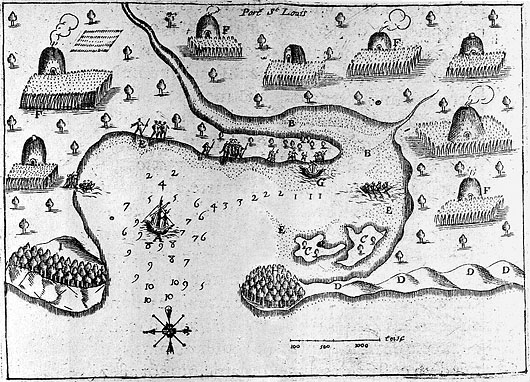
 Public domain
One Timeline: 1614 → 1691
The Plymouth story does not begin in 1620.
This timeline starts in 1614. That year a Patuxet man named Tisquantum was seized and sold into slavery.
By the time he came home, his village stood empty.
The tag on each entry is how strong the evidence is:
VERIFIEDsources agree |DISPUTEDscholars differ |UNAUDITABLEno traceable source found
Before 1620 — this place was already inhabited
1614 Kidnapping of Tisquantum (1614) VERIFIED
Thomas Hunt's 1614 seizure of Tisquantum and 20+ others, shipped to Málaga to be sold as slaves.
1614 Málaga Deed (22 Oct 1614) VERIFIED
Deed in the Provincial Historical Archive of Málaga recording transfer of 25+ men held by Thomas Hunt; found 2024.
1616 The Great Dying (1616-1619) DISPUTED
The epidemics that swept coastal Native communities in New England, 1616–1619. The museum's panels give 70–90% of the region's population; the journal literature gives a wider range (one third to as high as 90%) and says plainly that reliable data are lacking. The cause remains undetermined, which is why it is not called a plague.
1620–1621 — arrival and the first year
1620 Corn Hill Corn-Taking (1620) DISPUTED
November 1620 removal of stored Native corn and disturbance of graves at Corn Hill.
1620 Mayflower Compact VERIFIED
~195-word 1620 agreement to 'covenant and combine' into a civil body politic; original lost.
1620 Signing of the Mayflower Compact VERIFIED
The Compact was signed aboard ship in November 1620 while the Mayflower lay at anchor in Provincetown Harbour, at the tip of Cape Cod — not at Plymouth. Accounts differ on how many signed; no fixed number is asserted here.
1620 Charter of New England (1620) VERIFIED
1620 charter erecting its company as 'one body politic and corporate', illustrating the era's legal usage.
1620 Plymouth Church Records, 1620-1859 UNAUDITABLE
First Church of Plymouth record book, begun only in Jan 1680 by clerk Nathaniel Morton.
1620 Plymouth's First Winter Deaths VERIFIED
Between Dec 1620 and Mar 1621 Bradford records 44 deaths, leaving about 50 survivors.
1620 The First Winter (1620-21) DISPUTED
Winter in which about half the settlers (~45-50) died, buried at Cole's Hill.
1620 Robinson's Farewell Address DISPUTED
Robinson's much-quoted 1620 farewell ('more truth and light'); attested only by Winslow 26 years later.
1621 1621 Plymouth-Pokanoket Agreement VERIFIED
Six-clause reciprocal security pact between Carver and Ousamequin, holding until 1675.
1621 1621 Harvest Celebration VERIFIED
Three-day autumn 1621 harvest feast of English colonists and ~90 Wampanoag men; later mythologized.
1621 Chronicles of the Pilgrim Fathers VERIFIED
Alexander Young's 1841 work whose annotation first labeled the 1621 harvest 'the first Thanksgiving.'
1621 Nine Sachems' Allegiance (Sept 1621) DISPUTED
September 1621 document by which nine sachems signed allegiance to King James I.
1621 Plymouth/Pokanoket Agreement (1621) VERIFIED
Six-article agreement of 22 March 1621 between Carver and Ousamequin; original text does not survive.
1621 Peirce Patent (1621) VERIFIED
Land grant of 1 June 1621 from the Council for New England to John Peirce; conferred land but not self-government.
The 1620s–1630s — from covenant to code
1622 Mourt's Relation VERIFIED
London 1622 account by Winslow and Bradford; earliest surviving printed text of the Compact.
1623 Day of Thanksgiving, Summer 1623 VERIFIED
Religious day of thanks after rain broke a drought; first event primary sources call a 'thanksgiving.'
1623 Winslow's Visit to Ousamequin (1623) VERIFIED
March 1623 visit in which Winslow nursed the ailing Ousamequin; recorded in Good Newes from New England.
1623 Wessagusset Killings (1623) VERIFIED
Standish's 1623 killings of Massachusett men, following Ousamequin's warning to Winslow.
1624 1624 land division of Plymouth Colony VERIFIED
The colony's completed division of land in 1624, which helps historians know its population, shape, and acreage by 1627.
1624 Good Newes from New England VERIFIED
Edward Winslow's 1624 account, source for his 1623 visit to the ailing Ousamequin.
1624 John Lyford Affair VERIFIED
A 1624 instance of church discipline at Plymouth recorded in Bradford's narrative.
1624 Generall Historie (John Smith, 1624)
John Smith's 1624 work recording Plymouth's ~180 persons, 32 houses and half-mile palisade.
1625 Purchas his Pilgrimes VERIFIED
Samuel Purchas's 1625 compilation, an independent early printing of the Compact.
1629 Massachusetts Bay Charter (1629) VERIFIED
Royal charter for Massachusetts Bay using 'body politic' language; legal basis of that colony's government.
1630 Of Plymouth Plantation VERIFIED
Bradford's manuscript history (1630-1650), a chief source for the covenant chain and Compact text.
1636 Plymouth 1636 Code VERIFIED
Plymouth's first codified laws; frames the government and contains a rudimentary bill of rights.
1638 Millners Tolle statute (1638) VERIFIED
1638 Plymouth statute capping the miller's toll at 1/16 with quality liability.
After 1640 — expansion, war, and the end
1641 Massachusetts Body of Liberties (1641) VERIFIED
Massachusetts Bay's 1641 bill of rights, five years after Plymouth's 1636 code.
1646 Hypocrisie Unmasked
Edward Winslow's 1646 polemic; sole source for Robinson's farewell and a witness to the Leiden church covenant.
1659 Of Corporations, Fraternities and Guilds VERIFIED
William Sheppard's 1659 treatise, England's first on corporate law, defining a 'body politic'.
1669 New England's Memorial DISPUTED
Morton's 1669 book, sole source of the full list of 41 Compact signers.
1672 Book of the General Laws of New Plimouth (1672) VERIFIED
Plymouth's 1672 law book barring any law imposed without consent of the freemen or their representatives.
1675 John Sassamon Case (1675) VERIFIED
Sassamon's death and the Plymouth trial and June 1675 hanging of three Wampanoag that triggered the war.
1675 King Philip's War (1675-76) VERIFIED
War led by Metacomet against the New England colonies; among the bloodiest in American history by ratio.
1683 1683 Stockbridge Mill Contract VERIFIED
Town contract binding a sufficient mill, competent miller, and herring fish passage.
1691 Annexation of Plymouth Colony (1691) VERIFIED
The 1691 charter folded Plymouth into the royal Province of Massachusetts Bay, ending its self-governance.
1691 Charter of the Province of Massachusetts Bay (1691) VERIFIED
Charter approved by William III and Mary II folding Plymouth into a royal province.
Why the line stops in 1691
In 1691 Plymouth Colony was absorbed into Massachusetts Bay.
It had lasted seventy-one years and never held a royal charter.
Its warrant to govern itself rested, the whole time, on an agreement its members had made with one another — not on a grant from the Crown.