The Story
From the Mayflower to Plymouth in seven acts — a story told for four hundred years, and worth telling again.
 AI concept art
Listen
Press play to hear the whole story, act by act
Narration is AI-synthesized speech (OpenAI TTS).
The Story — From the Mayflower to Plymouth
This is a story that has been told for four hundred years. Told so often, it wears down into a slogan: a shipful of Pilgrims, a rock, one dinner shared with the Indians, the beginning of a nation. The true version is slower, colder, more painful — and stronger for it. It is not a legend about whom God chose. It is an account of how a group of people, in a place where every external authority had fallen away, made order out of nothing but their promises to one another — and of who that order left outside the door from the very first day.
We tell it in seven acts. Each opens with its time, place, and dramatic core, then the story itself. Wherever the sources conflict, or a later myth diverges from the record, we set out a boxed "⚠️ Two Ways of Telling It," and say so plainly — we adjudicate for no one, and leave the judgment to you.
One word, chosen with care. Throughout, for the 1621 agreement between the English colonists and the Wampanoag, we say alliance, not friendship — not from coldness but for accuracy: it was a six-article security pact between two peoples, each acting on its own reckoning. The Wampanoag and Patuxet are real nations with living descendants, and they continue to thrive today.
Act One — The Choice at Leiden
When: about 1606–1620 Where: Scrooby, Nottinghamshire → Leiden, Holland
Dramatic core: a group of people had already left their homeland once for their faith; now, settled and safe in a foreign country for twelve years, they chose to stake everything again and cross a sea from which no one came back. Why?
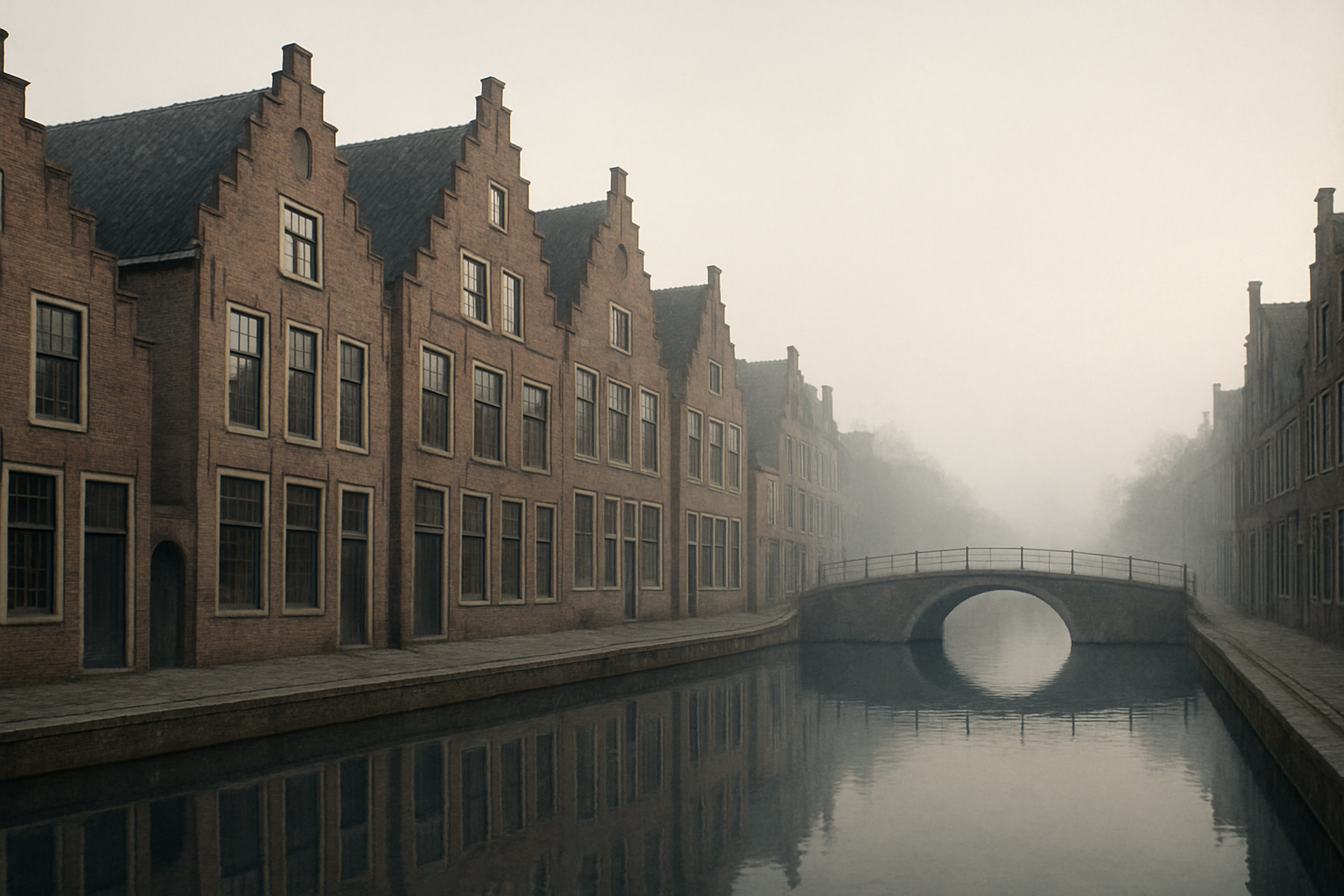
The story does not begin at sea. It begins in a room. Around 1606, in Scrooby, Nottinghamshire, a band of Separatists gathered in the home of William Brewster. They did not want to reform the Church of England; they wanted to leave it entirely — which, in that age, was itself a crime. The way they organized themselves would set the grammar of everything that followed: no one appointed from above; instead, people rose in turn and pledged themselves to one another. Years later William Bradford recalled their founding in these words:
"…the Lord's free people joined themselves (by a covenant of the Lord) into a church estate… to walk in all his ways made known, or to be made known unto them, according to their best endeavours, whatsoever it should cost them."
Three words are the seed of everything: free people — voluntary; joined themselves — not appointed from above; by a covenant — the bond itself is the source of authority. Hold onto those three words, because fourteen years later they will reappear, unchanged, in the cabin of a ship.
Persecution drove them into exile. In 1607–1608 the congregation fled to Amsterdam; in 1609 it moved to Leiden and stayed about twelve years. There John Robinson was publicly ordained pastor and Brewster became ruling elder. Their polity was congregational — authority rested with the local congregation, not with any higher body. It was a small community that could elect all its own officers and govern itself. They could have stayed, and been safe.
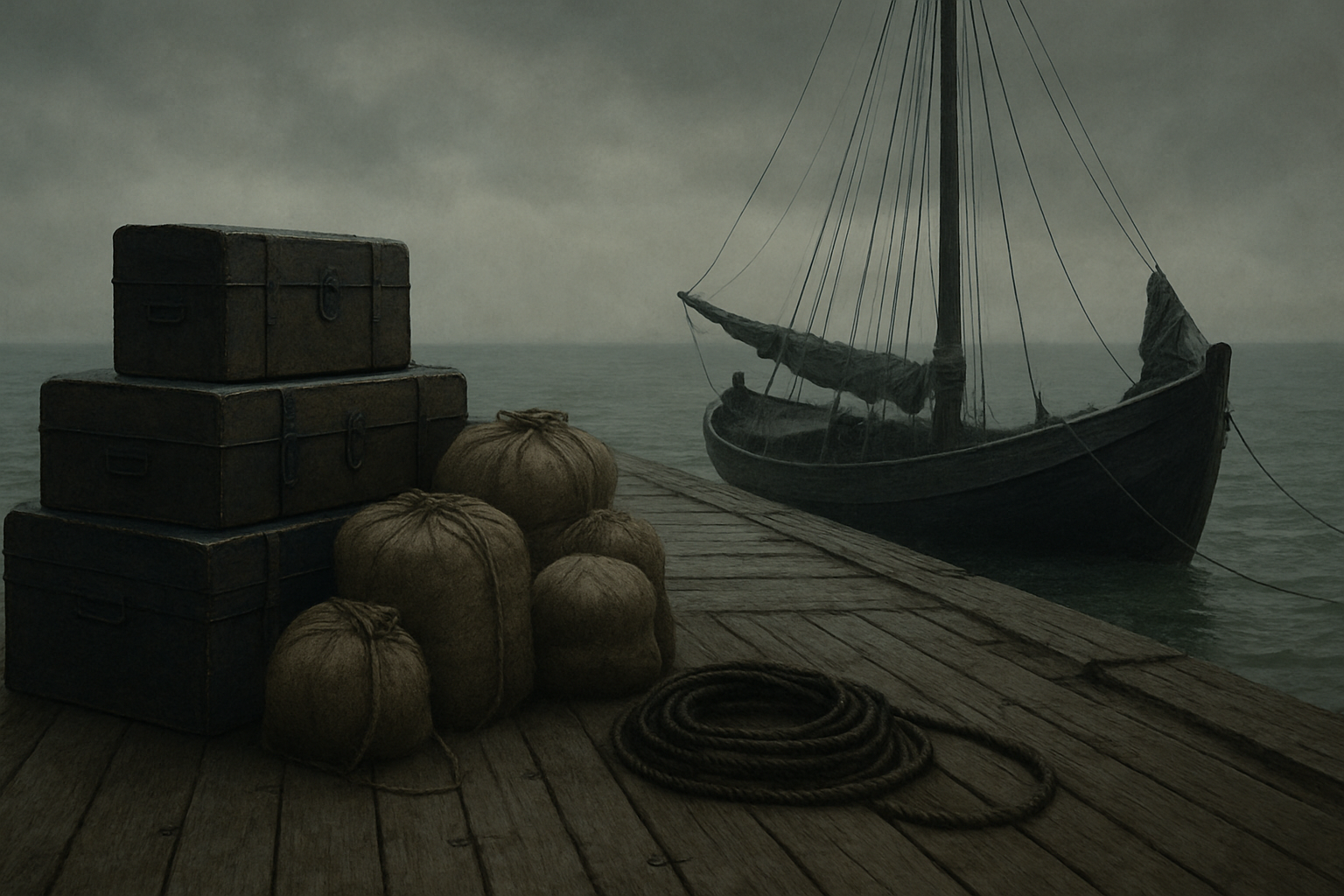
Yet in 1620 a portion of them chose to gamble again — to cross the Atlantic and plant a colony in the northern parts of Virginia. Bradford later named their choice with an image from Hebrews: they were like the people of scripture who were "strangers and pilgrims on the earth," who could have returned home but "longed for a better country." They wanted not merely to survive but to remain themselves, and to hand their covenant whole to their children. Their pastor, Robinson, did not board; he stayed in Leiden and died there in 1625. For about 150 years afterward, almost no one called those who left "Pilgrims" — the name now so loud was pinned on only in the late 1700s and early 1800s. When they set out, they were simply people who would not turn back.
⚠️ Two Ways of Telling It — Robinson's Farewell
The most-quoted parting line, attributed to Robinson, is that the Lord had "more truth and light yet to break forth out of his holy Word." It is beautiful, and it captures these people's spirit exactly. It is also the most fragile link in the whole chain of evidence. Its only source is a polemical pamphlet Edward Winslow wrote 26 years later (1646), in which Winslow himself says the pastor "used these expressions, or to the same purpose" — conceding it is not verbatim. Bradford and Nathaniel Morton mention the address not at all. George Sumner doubted it in the nineteenth century; the Harvard theologian Fenn defended it point by point in the twentieth and judged it "substantially authentic." We give you the line — and we leave its fragility on the table, rather than smoothing it away.
Act Two — The Crossing
When: autumn 1620, about 66 days Where: the Atlantic
Dramatic core: one hundred and two people, packed into the dark belly of a wooden ship built to carry cargo rather than passengers, sailing toward a coast none of them had ever seen and no one could promise they would reach alive. Some aboard died, and one was born.
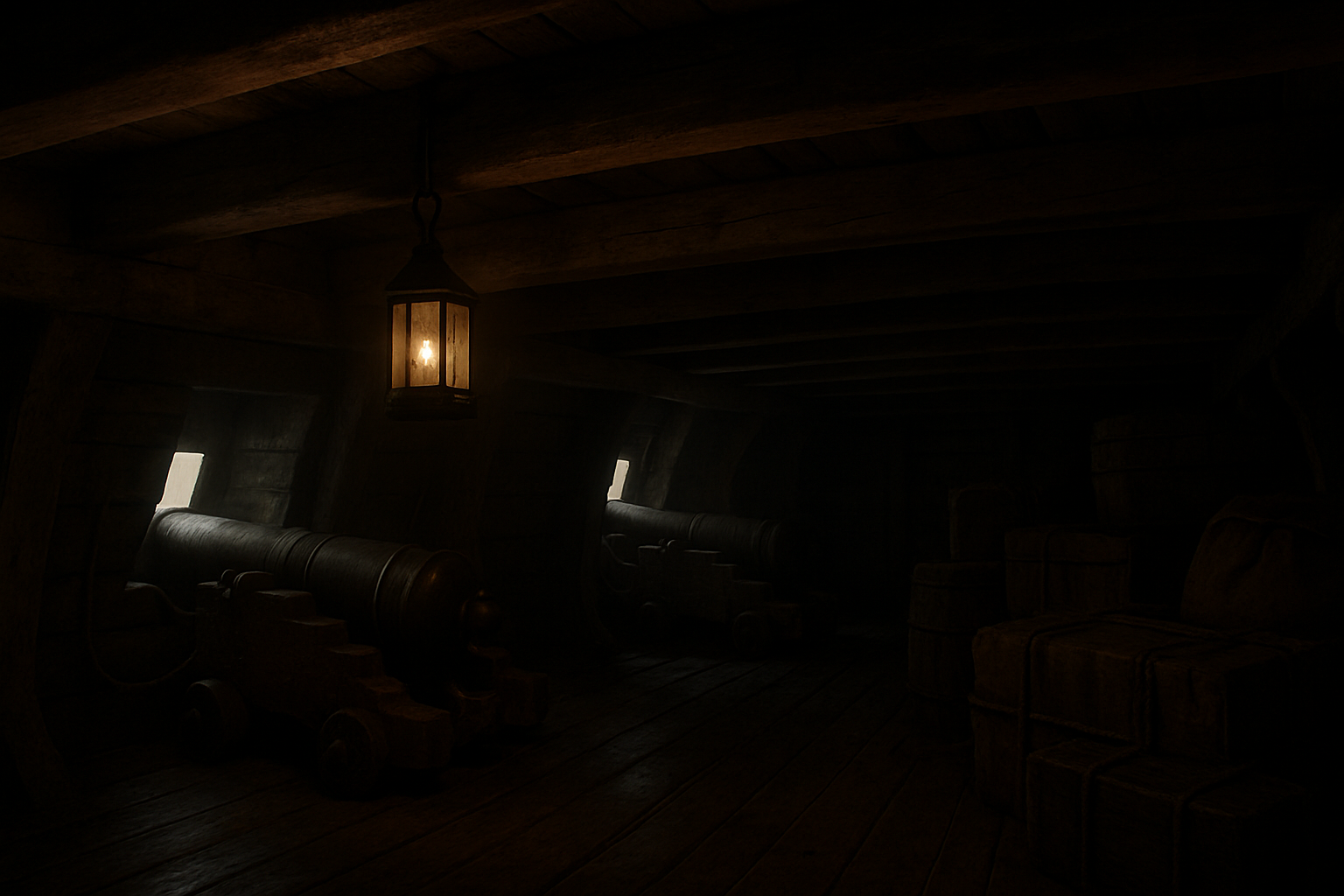
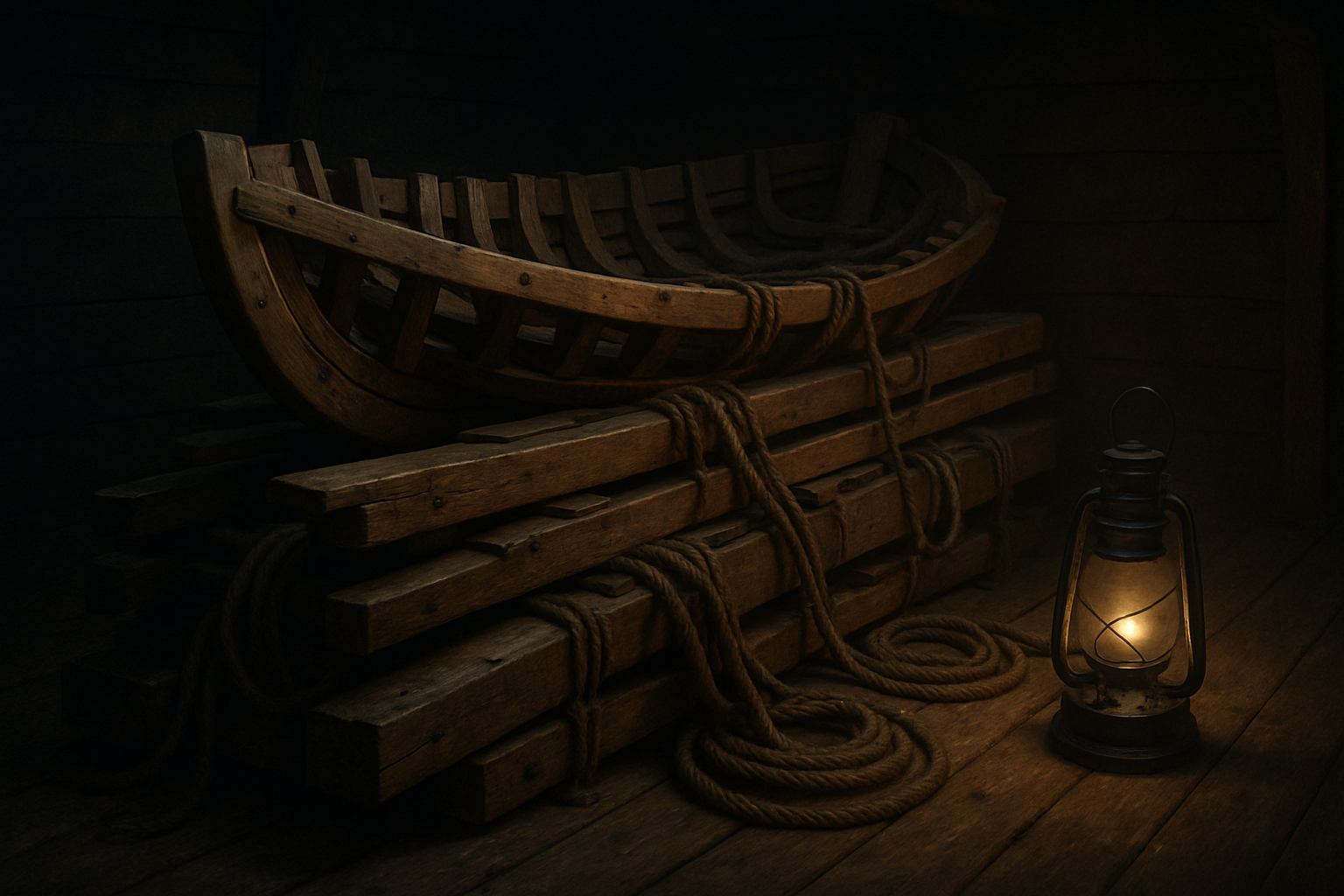
The Mayflower was a merchant ship, not a passenger vessel. The roughly 102 people aboard — about a third of them children — lived below the main deck on the gun deck, which they called the "'tween deck": no windows, headroom of about five feet so a grown adult could not stand straight, no latrines, no private rooms. A thirty-foot single-masted shallop was carried knocked-down among them, to be reassembled over weeks after arrival — and it was that boat which later scouted the coast and chose the site.
She was square-rigged: good downwind, poor upwind. That technical fact explains both why the crossing took some 66 days and, later, one thing that changed everything — on arrival she could not simply turn south. The days at sea were not lyrical. When storms came, the crew had no recourse but the tactic Bradford would later record: strike all sail and let the ship drift beam-on to the waves (in sailors' terms, lying ahull), trusting the hull and the sea.
Two events nailed this dark passage to the story of actual human beings: a passenger, William Butten, died at sea; and a baby was born at sea, whom his parents named Oceanus — "of the ocean." One death, one birth. This is also why the figures for "how many people, how many days" wobble between 101, 102, 65, 66, 67 across sources: depending on which moment you count as the end, and on which side of the ledger you place the one who died and the one who was born, the answer shifts. This is not a contradiction but a difference in when you close the books. We follow the museum's count — 102 people, about 66 days — while telling you why it is not a number that can be fixed to the last digit.
Act Three — The Compact in the Cabin
When: 11 November 1620 (Old Style) Where: aboard the Mayflower, anchored in Provincetown Harbor
Dramatic core: the ship reached land, but the wrong land. The patent in hand was worthless here, and so someone spoke the dangerous words — "no one has the right to command us." The next hour decided whether these people would scatter or become a self-governing whole.
They were meant to land in the northern parts of Virginia (near today's Hudson River), where their patent was valid. But the ship that sailed so badly to windward had been carried to Cape Cod — outside the patent's reach. With that, the legal ground fell away. Bradford wrote of it without flinching: some of the non-congregation "Strangers" aboard — who were in fact the majority — let fall "discontented and mutinous speeches":
"…That when they came ashore they would use their own liberty; for none had power to command them, the patent they had being for Virginia and not for New England."
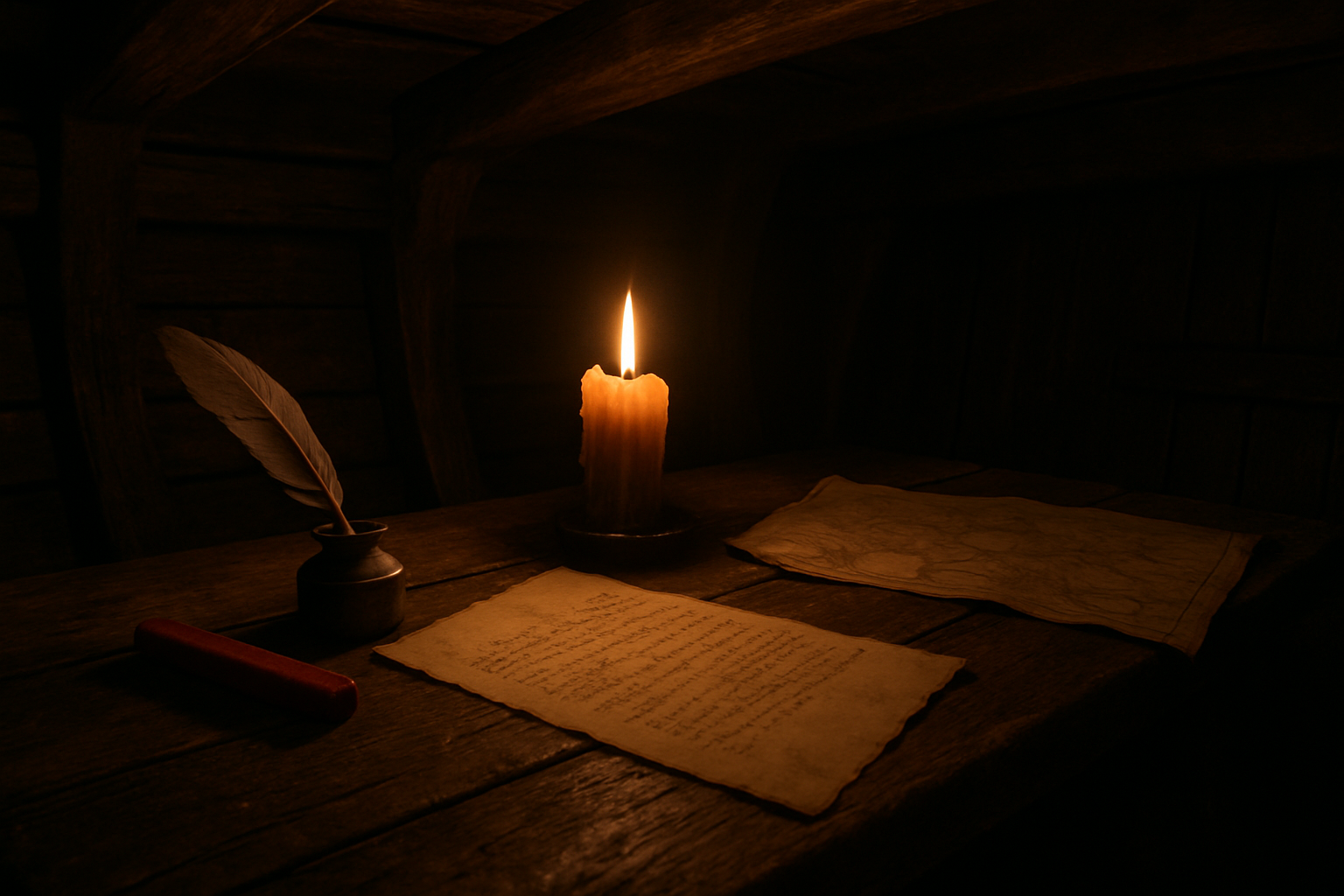
It was a legal argument, cool and lethal: no jurisdiction, no command; you cannot govern me. The congregation's leaders answered with the most decisive move in the whole story — not by claiming authority over the Strangers, but by manufacturing a source of authority on the spot, out of mutual consent. Forty-one adult men signed, one by one, a document of fewer than two hundred words. The first to sign was John Carver, at once chosen first governor. At its heart, the document lifted the covenanting grammar of Scrooby and Leiden, unchanged, into civil government:
"…do by these presents solemnly and mutually in the presence of God and one of another, Covenant and Combine ourselves together into a Civil Body Politic… unto which we promise all due submission and obedience."
Two verbs stand side by side: covenant (a theological word, a bond made before God) and combine (a secular word, to join together). Their pairing is itself the evidence of this story — a church's grammar turning, right here, into a politics. It is also "government by consent" caught in the act of being born: not theory first, but crisis-driven. The crisis was "none had power to command them"; the answer was "then we will agree among ourselves and make a government together."
⚠️ Two Ways of Telling It — What the Compact Really Was
Track A (the national narrative): the Mayflower Compact is a founding document of American self-government, the first practice on the continent of "government by consent," a source of the Declaration and the Constitution. This telling has real historical force: in 1802 John Quincy Adams, later the sixth president, elevated it in an oration to "the only instance in human history of that positive, original social compact." Track B (the legal-history revision): legal historians (such as Mary Sarah Bilder) offer three corrections. First, "civil body politic" was no invented ideal but the standard legal term of the day for a corporation, used throughout the colonial charters. Second, before 1776 the document was neither called "the Mayflower Compact" nor thought to carry any great political meaning — its mythic status was awarded retroactively by a handful of orators between 1780 and 1802 (the first to mobilize it was, in fact, a Loyalist). Third, at about 200 words it prescribes no structure of government at all; it is essentially a temporary transplant of the church covenant into a civil setting. These are not "right versus wrong" but two true layers of one document. Track B revises its factual footing, not its cultural weight. And it points to the deepest truth in this story: a covenant's force lies not in the paper — the original was long ago lost — but in whether later generations keep invoking it.
One sentence cannot be omitted. This "government by consent" — whose consent? The signatories were 41 adult men; zero women; indentured servants could not sign; about a third aboard were children. And the Wampanoag, who had lived on this land for thousands of years, were wholly absent and never consulted. The consent was real, but it had a boundary drawn from the very first day — drawn by people who did not register that they were drawing it. That boundary becomes, in the acts to come, the hinge on which the whole story turns.
Act Four — The First Winter
When: December 1620 – March 1621 Where: the site of Patuxet, about to become Plymouth
Dramatic core: at last they came ashore. But this "empty land God had prepared for them" was in fact the scene of a disaster; and over the next hundred days, one of every two of them died. The hands that signed the compact went into the ground, pair by pair.
They came to rest at Plymouth not for a rock but for real things: a spring-fed brook (Town Brook) gave them drinking water and a run of river herring, beside a stretch of already-cleared fields. Why fields ready-made, but no people? Because there had been a village here, called Patuxet — and in the years just before their arrival, a catastrophe had emptied it (a thread we hold until Acts Five and Eight).
The first winter nearly killed them all. Bradford recorded 44 deaths; by the time the Mayflower sailed home in April 1621, only about fifty of the 102 were still alive. Of every two people, one did not survive that winter. Cole's Hill by the shore is identified as the earliest burial ground of that season — some forty to fifty buried there. A community of fifty souls, in a village you could walk across in ten minutes, cannot be anonymous. And now the compact from the cabin was no longer a political ideal on paper but the only reason a band of dying people did not scatter.
⚠️ Two Ways of Telling It — The Graves in the Night
A moving image circulates widely: the settlers buried their dead by night and levelled the graves, lest the Wampanoag see how many had died and how weak they had become. The 1920s sarcophagus inscription on Cole's Hill says exactly this. But keep it straight: the "secret night burials" are a tradition that took shape only in the eighteenth and nineteenth centuries, with no support in the primary record of Bradford or Mourt's Relation. The dying is documented (Bradford gives the numbers); whether they "secretly levelled the graves by night" is a silence in the record. We can tell you how terrible that winter was; we cannot vouch for its most cinematic detail — so we mark it, rather than treat it as fact.
⚠️ Two Ways of Telling It — The Most Famous Stone
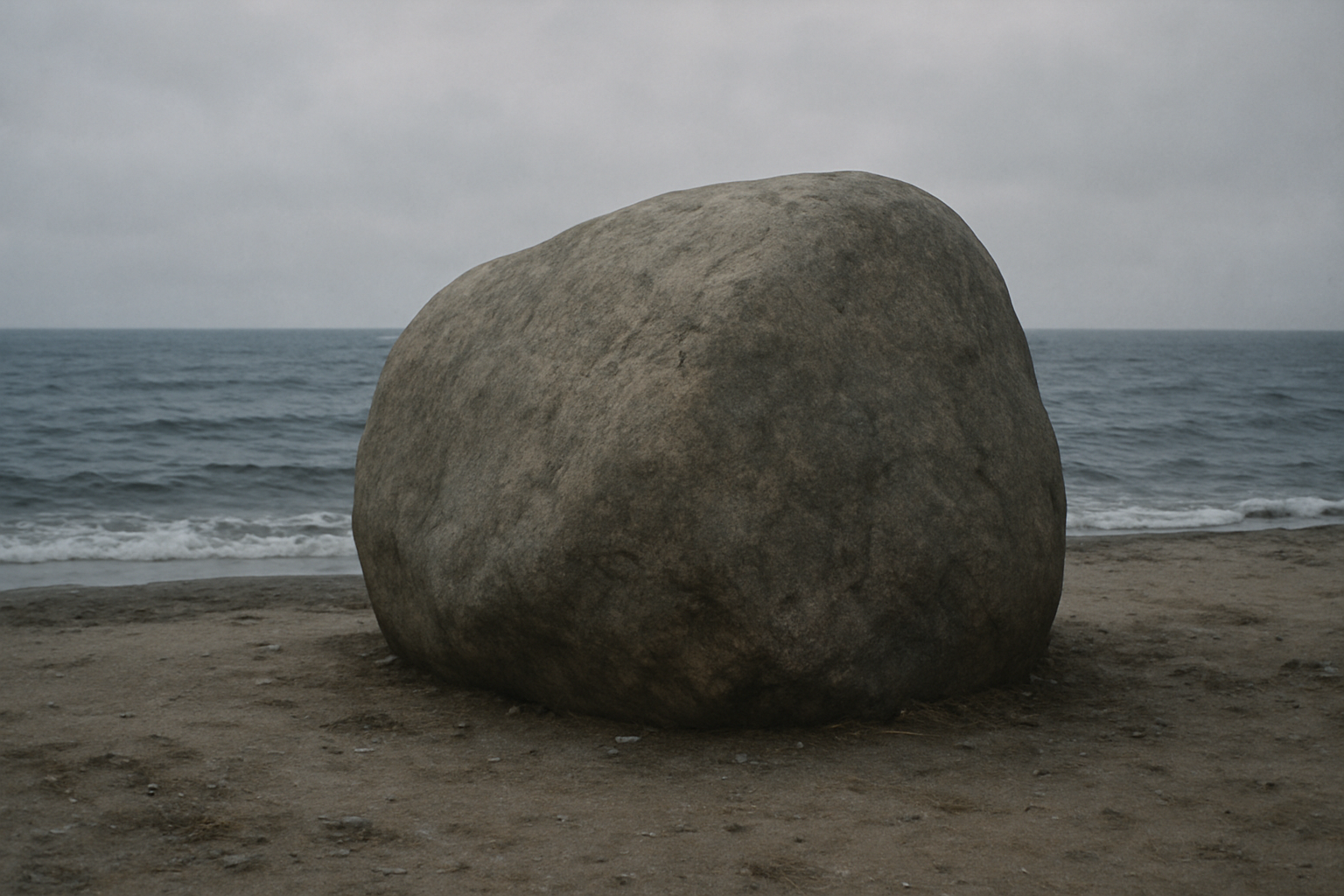
You might expect this act to feature Plymouth Rock. The truth: neither primary source — Bradford nor Mourt's Relation — mentions any landing rock at all. The rock's link to the landing first appears in 1741, in the oral testimony of a church elder, Thomas Faunce, aged about 94 — 121 years after 1620, and he was not a witness. The "1620" on its face was carved only in 1880. Pilgrim Hall Museum's own conclusion is that, given the gaps in the evidence, the disputes about the rock can never be definitively settled. It is a perfect specimen: the most famous stone has almost no evidence; the most important document, the Compact, has a text. How a symbol gets manufactured — this stone tells it plainly.
Act Five — Tisquantum and the Alliance of 1621
When: spring 1621 Where: Plymouth and Pokanoket
Dramatic core: a colony down to fifty people, hanging by a thread. In walks a Native man who speaks English — and he speaks English because he had been kidnapped, sold into slavery, and lost his whole village. His "help" was a survivor's political struggle to stay alive amid ruins; and the alliance that let the colony live was one in which each side was making its own calculation.
In March 1621, a Native man walked into these English people's camp and spoke to them in English. His name was Tisquantum (English sources usually call him Squanto). The traditional story casts him as "a special instrument sent of God" for the Pilgrims — and Bradford's own words are indeed "a special instrument sent of God for their good beyond their expectation." He showed them how to plant corn and where to fish. But before he was an asset to the colony, Tisquantum was first a victim.
He spoke English because in 1614 the English captain Thomas Hunt had seized him, along with more than twenty other Patuxet and Nauset people, and shipped them to Málaga in Spain to be sold as slaves. He made his way to England and returned home around 1619 — to find the whole village of Patuxet emptied. The Great Dying of 1616–19 had taken nearly everyone; he was among the last of the Patuxet. In 2024 researchers found in the Provincial Historical Archive of Málaga a deed dated 22 October 1614, recording in black and white the transfer of "more than twenty-five indigenous men held by Thomas Hunt." This history of kidnapping and enslavement is trauma, not legend. His later "help," then, is better read as a survivor who had lost everything, improvising to stay alive amid ruins.
That same spring, on 22 March 1621, Plymouth's governor John Carver reached an agreement with Ousamequin (whose title was Massasoit — "great sachem," a title, not a name). Note what the agreement actually contains: six articles, and not one word about friendship. No injury on either side; offenders surrendered and punished; stolen goods returned both ways; mutual military defense; neighboring allies brought into the peace; weapons set aside when visiting — all executable, reciprocal security terms. This was an alliance, not a friendship.
⚠️ Two Ways of Telling It — What the Alliance Really Was
Track A (traditional): out of goodwill and hospitality, Ousamequin made "the first peace treaty on American soil," which held for over fifty years — a model of covenant-keeping. Track B (revisionist): the historian David J. Silverman (This Land Is Their Land, 2019) argues this was a cool geopolitical move. Ousamequin's people had just been devastated by the epidemic of 1616–19, while their rivals the Narragansett pressed them for tribute. He sought the English to counterbalance the Narragansett and preserve both Wampanoag independence and his own position. In Silverman's words: "It's not because he was innately friendly. It's because his people have been decimated by an epidemic disease, and Ousamequin sees the English as an opportunity to fend off his tribal rivals." The Wampanoag scholar Nanepashemet likewise showed the alliance to be a defensive move initiated by the Wampanoag — to put English guns on their side. And from the very start, a sizable number of Wampanoag opposed the alliance. And a further asymmetry: no original survives; every word we read today comes from English works. The negotiations passed through interpreters (Tisquantum, Samoset), and no primary evidence confirms the six articles were rendered accurately to Ousamequin. The pact so often called a "model covenant" was itself cross-cultural, asymmetric, and recorded by only one side.
And here even the figure of "the survivor" resists being simplified. According to Winslow and Bradford, around 1622 Tisquantum spread rumors and intrigued to undermine Ousamequin and supplant him, even claiming he could unleash the English "plague" at will. Ousamequin demanded he be handed over for execution; Bradford, valuing him as interpreter, refused — itself a breach of the second article of the 1621 pact. But in honesty: these charges all come from English texts, and both the English and Ousamequin had motives to discredit him, with no independent Wampanoag record. That the episode was recorded is certain; that it happened as recorded is not. (As for the famous detail that "Squanto taught them to fertilize corn with fish" — its source and truth have long been questioned, and we neither affirm nor deny it here.)
Act Six — The Harvest and the "First Thanksgiving"
When: autumn 1621 Where: Plymouth
Dramatic core: a colony down to fifty people, having just survived a winter that nearly finished it, brought in its first harvest and laid on a three-day feast. This is the meal all America knows best — but the version you know has nearly every detail added later.
In the autumn of 1621 there was indeed a three-day harvest celebration. The English colonists and roughly ninety Wampanoag (Pokanoket) men were present. This is the core fact, verified — the primary record is a letter by Edward Winslow dated 11 December 1621, printed in Mourt's Relation (London, 1622). A people who had just lost half their number gathered around their first real harvest, alongside a people newly allied with them, and ate together for three days. The picture needs no myth to move you.
But the "Thanksgiving" you have known since childhood is almost entirely a later accretion.
⚠️ Two Ways of Telling It — Myth and Record
Track A (traditional): in 1621 the Pilgrims and the Indians shared a harvest — America's "First Thanksgiving," a symbol of friendship and coexistence. Track B (revisionist): at the time, the gathering was not called a "thanksgiving." A seventeenth-century English "day of thanksgiving" was a religious occasion — sermons, prayer, often fasting — a wholly different thing from the feasting and games of 1621. The label "First Thanksgiving" is a nineteenth-century invention: only in 1841 did a minister, Alexander Young, annotating Winslow's passage, first call it "the first Thanksgiving" (✅ verified). The first event the primary sources actually call a "thanksgiving" was a religious day of thanks in the summer of 1623, after rain broke a drought. The turkey, the pumpkin pie, the "hand in hand" imagery we know are almost all nineteenth- and twentieth-century additions; it was Lincoln, in 1863, who made it a national holiday. An honest silence: were the Wampanoag actually "invited"? The sources do not say. The Smithsonian's National Museum of the American Indian notes that the ninety-odd Wampanoag men came to investigate after hearing the English fire their guns, and were then included. This is a gap in the record; both "invited" and "came at the sound of gunfire" are inferences (❓ unresolved).
This act cannot be only the feast, because on the same hill, four hundred years on, there is another voice. The National Day of Mourning: since 1970, Native Americans have gathered at noon each Thanksgiving on Cole's Hill in Plymouth. Its origin: that year — the 350th anniversary — the organizers invited the Wampanoag man Frank "Wamsutta" James to speak, then, on seeing his text, asked him to cut passages (one contested point was his account of the settlers taking corn the Wampanoag had stored). James refused, and spoke instead beside the statue of Massasoit. In 1998 the Town of Plymouth set a plaque on Cole's Hill formally recognizing the observance; it reads that for many Native people Thanksgiving is "a reminder of the genocide of millions of their people, the theft of their lands, and the relentless assault on their cultures."
So the meal was real, the ninety-odd Wampanoag were real, the three days were real. But to tell it as a beginning of warmth without shadow would be dishonest. On the same ground, thanksgiving on one side and mourning on the other — both tracks are real, both present, and both deserve to be heard.
Act Seven — The Long Arc and the Unfinished
When: 1623–1676, and after Where: Plymouth and all of southern New England
Dramatic core: if the 1621 alliance really was a model of the covenant ethic, then the most honest question is — why did it not last? The answer is that the son of the very man who signed the alliance ended it with his own hand. And what ended it was less a betrayal than a structure.
First, a documented, personal trust — because it was real. In March 1623, Ousamequin lay gravely ill, and Edward Winslow walked dozens of miles to Pokanoket to tend him, scraping his tongue by hand, feeding him corn porridge and sassafras broth. On recovering, Ousamequin said a line that was written down: "Now I see the English are my friends and love me." (✅ Primary text verified: Winslow, Good Newes from New England, 1624.) Trust between individuals genuinely existed.
But during that same visit, Ousamequin also revealed to Winslow a plot by the Massachusett against a nearby colony — and within weeks it triggered Standish's killings at Wessagusset. The "care" was tied directly to a massacre. The trust was real, but it was embedded in power and calculation from the start, and it died with the two men. The true version is more persuasive than the sentimental one.
On the colony's side, that self-government "by mutual agreement" struck ever deeper roots. Plymouth, for its entire life (1620–1691), never obtained a royal charter — it had nothing else to lean on and so had to generate its authority to govern out of "we agree among ourselves." Institutions were forced into being: a governor re-elected every year, a General Court that was both legislature and court, town meetings with compulsory attendance, juries of twelve peers. In 1636 Plymouth completed the first written law code in America, containing a rudimentary bill of rights — a full five years before Massachusetts Bay's Body of Liberties of 1641. Here the credit really does belong to Plymouth. Yet this "trust among neighbors" had a boundary: inward it read as trust, outward as exclusion. In 1658 it placed Quakers outside that line; and from 1620 it had placed the Wampanoag outside it from the very start — without even registering that a line was being drawn.
That boundary was finally settled in the form of war. King Philip's War (1675–1676). The great sachem who led the Wampanoag rising was Metacomet — the English called him "King Philip" — the son of Ousamequin. In other words, the son of the very man who made the 1621 alliance was the one who ended it.
⚠️ Two Ways of Telling It — What the War Was
Track A (traditional): a frontier war in which the colonies secured their right to survive through blood and fire. (Nineteenth-century accounts often cast Metacomet as a treacherous "savage chief.") Track B (revisionist, each element verified): this was a war of sovereignty. In the fifty-five years after 1621, the English kept expanding, land was ceded or seized, colonial courts extended jurisdiction over Native people, and cultural pressure mounted. Metacomet abandoned his father's path of alliance only after repeated English breaches. The trigger was the John Sassamon case: Sassamon, a Harvard-educated Christian Indian and former adviser to Metacomet, warned Plymouth in January 1675 that Philip was preparing for war; soon after, his body was found under the ice of a pond. Three Wampanoag men were tried by a Plymouth court and hanged on 8 June 1675. This struck at the heart of the "covenant" — by asserting criminal jurisdiction over Wampanoag people, Plymouth denied their sovereignty.
The end was savage. In proportion to population, this was among the bloodiest wars in American history: more than half of the ninety colonial settlements in southern New England were attacked and twelve destroyed outright; some 1,200 houses were burned; colonial deaths reached roughly 5 percent of the population — and Native deaths and enslavement were proportionally far higher. On 12 August 1676, Metacomet was hunted down near Mount Hope in Rhode Island and shot by a "praying Indian," John Alderman. His head was mounted on a pike and displayed at Plymouth for more than twenty years; his wife and son, with the families of many Native captives, were sold into slavery in the West Indies.
Why did the alliance fail? Less from any decay of goodwill than from structure: the two parties were grossly unequal in power, and over fifty-five years the English population and landholding kept swelling; two legal traditions were incompatible — the English written contract against the Wampanoag oral covenant (a spoken pact, sealed with ceremonial gift-giving, renewed periodically); and jurisdiction finally broke it. Here, perhaps, is the most honest lesson about the covenant ethic: it is not an institution that can protect you, but a grammar that can be inherited.
As for Plymouth's own end, it too was not a triumph. In 1691 a charter from William III and Mary II folded Plymouth into a new Province of Massachusetts Bay, recast as a royal province with a Crown-appointed governor. Seventy-one years of local self-government had rested never on legal grant but on mutual agreement; when an outside power it could not touch finally arrived, it could not hold. And yet — its grammar survived, resurfacing in Philadelphia a century and a half later.
Coda — An Honest Story Spine
These are the seven acts from the Mayflower to Plymouth. It is not a story of good people winning or bad people losing, but of people stripped of every external authority making order out of their promises to one another — and of who that order shut out from the first day. It holds real courage (the crossing, the winter, the covenanting) and real trauma (kidnapping and enslavement, epidemic, massacre, a war of sovereignty); real personal trust (Winslow walking dozens of miles to tend Ousamequin) and the calculation that trust was embedded in, and the violence it was tied to.
We have not quietly smoothed any dispute into a comfortable conclusion. The principle is simple: better to mark something "disputed" than to force a verdict; better to say less than to invent. The more a history is retold, and the more it carries a nation's image of itself, the more it deserves to be told honestly — and in the plural. The Wampanoag and Patuxet are not the backdrop of this story but its other protagonists; they continue today. The rest of the judgment is yours.
 AI concept art
 AI concept art
 AI concept art
 AI concept art
 AI concept art
 AI concept art
 AI concept art
 AI concept art
 AI concept art
 AI concept art
 AI concept art
 AI concept art