Two Narratives
About This Page
The version you read in a textbook about Plymouth, "Thanksgiving," and the beginnings of America is often not the version historians have reconstructed over the past two decades. This is rarely a matter of one account being right and the other wrong. More often, the primary sources fall silent at the decisive moment, and different people have filled that silence in different ways.
For each of eight contested questions, this page sets out two lines of narrative side by side, followed by the current public position of the museums that steward this history. We do not adjudicate. Presenting the complexity honestly is itself a form of respect for the reader.
A Three-State Honesty Code
We mark each factual claim by the strength of its evidence:
✅ Verified — At least two independent authoritative sources (institutional websites, primary sources, scholarly publications) agree.
⚠️ Disputed — Two or more explanations coexist with no scholarly consensus; multiple views are presented together.
❓ Unresolved — Primary evidence is thin, single-sourced, or missing.
Track A — the traditional, national-founding narrative (American public memory, textbooks since the nineteenth century).
Track B — the revisionist, scholarly narrative (Silverman 2019 and others; centering Indigenous perspectives).
Museum position — The current public position of Plimoth Patuxet Museums and Pilgrim Hall Museum.
Topic 1 — The "First Thanksgiving" of 1621
 Myth image
 Myth image
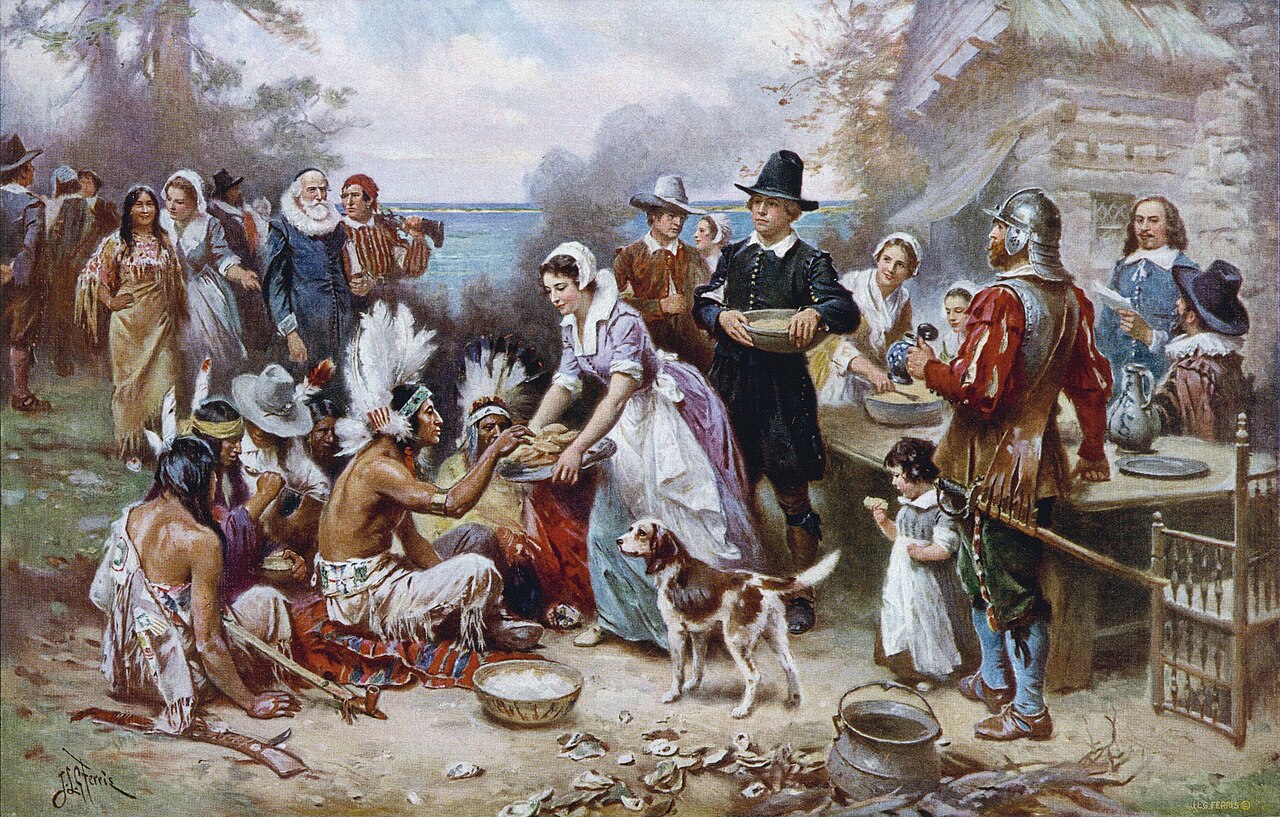
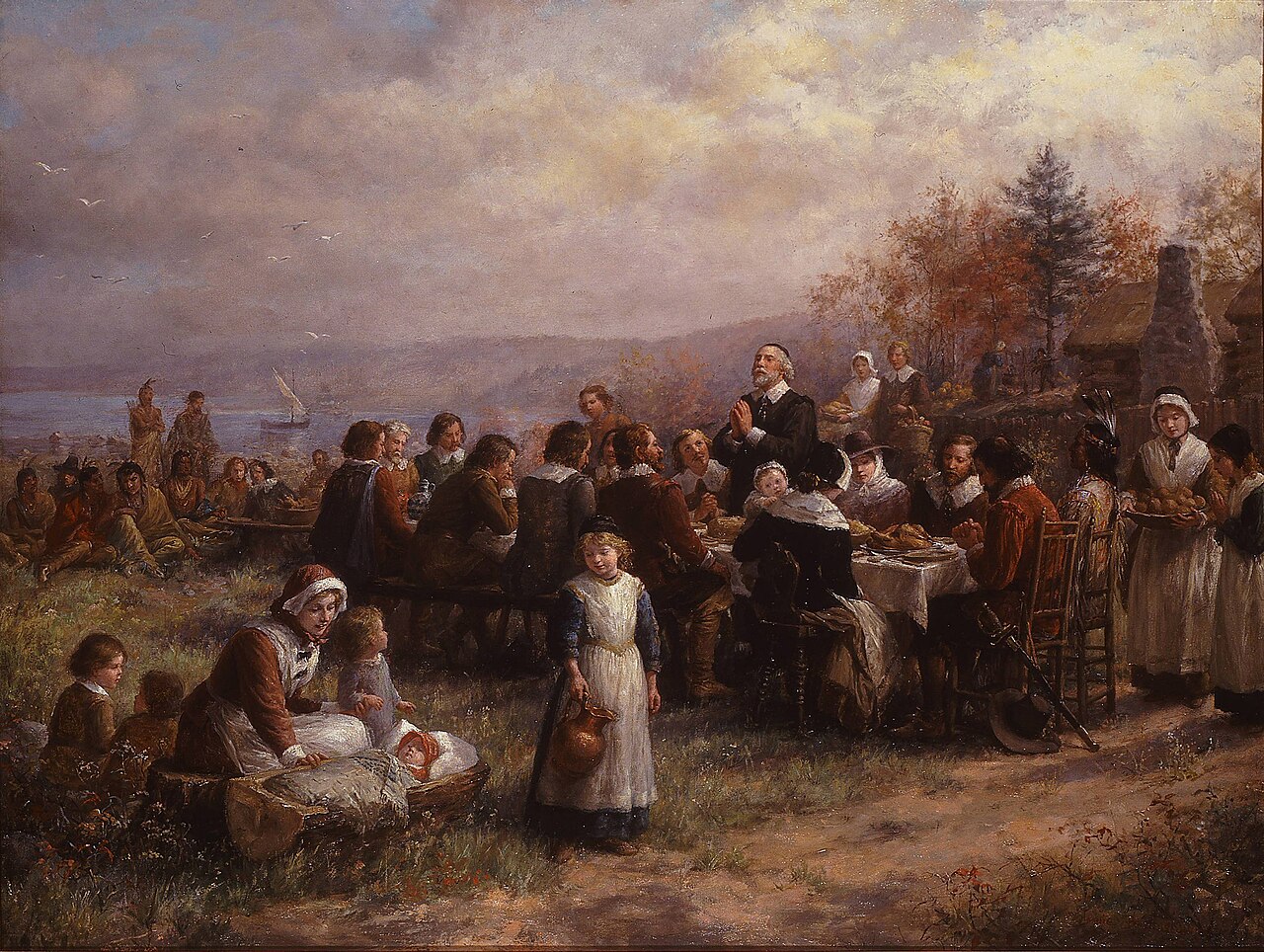
The core fact ✅ Verified: In the autumn of 1621 there was a three-day harvest celebration attended by the English colonists and roughly ninety Wampanoag (Pokanoket) men. The primary record is a letter by Edward Winslow dated 11 December 1621, printed in Mourt's Relation (London, 1622).
Track A — Traditional: In 1621 the Pilgrims and the Indians shared a harvest; this was America's "First Thanksgiving," a symbol of friendship and coexistence.
Track B — Revisionist: At the time, the gathering was not called a "thanksgiving." A seventeenth-century English "day of thanksgiving" was a religious occasion of sermons, prayer, and often fasting — a wholly different thing from the feasting and games of 1621. The label "First Thanksgiving" is a nineteenth-century invention: in 1841 the Unitarian minister Alexander Young, annotating Winslow's passage in Chronicles of the Pilgrim Fathers, was the first to call it "the first Thanksgiving" (✅ Verified). The first event the primary sources actually call a "thanksgiving" was a religious day of thanks in the summer of 1623, after rain broke a drought (✅ Verified). Whether the Wampanoag were "invited" is not stated in the sources — the Smithsonian's National Museum of the American Indian (NMAI) notes that the roughly ninety Wampanoag men came to investigate after hearing the English fire their guns, and were then included; this is a silence in the record, and both readings are inferences (⚠️ Disputed). The pumpkin pie, the turkey, the "hand in hand" imagery of the modern holiday are almost all later accretions; Lincoln made it a national holiday only in 1863 (✅ Verified).
Museum position: Plimoth Patuxet describes the Pokanoket and Plymouth colonists as coming together "after a season of diplomacy" to share a harvest feast, and states plainly that "it wasn't even called Thanksgiving back then." The museum's educational resources also introduce the 1623 day of thanksgiving and the 1998 National Day of Mourning monument.
National Day of Mourning ✅ Verified: Since 1970, Native Americans have gathered at noon each Thanksgiving on Cole's Hill in Plymouth for a National Day of Mourning. Its origin: the Wampanoag man Frank "Wamsutta" James was invited to speak at the official 350th-anniversary dinner; after reviewing his text the organizers asked him to cut passages (one contested point was his account of the Pilgrims taking corn the Wampanoag had buried); James refused and instead spoke beside the statue of Massasoit. It is organized by the United American Indians of New England (UAINE). In 1998 the Town of Plymouth erected a plaque on Cole's Hill formally recognizing the observance; it reads that for many Native people "Thanksgiving Day is a reminder of the genocide of millions of their people, the theft of their lands, and the relentless assault on their cultures."
Sources: Winslow, letter in Mourt's Relation (1622); Plimoth Patuxet YATH, "Eye-Witness Account of the 1621 Harvest Celebration" and "A Day of Thanksgiving, Summer 1623"; Pilgrim Hall Museum, "The First Thanksgiving" and "National Day of Mourning"; Smithsonian NMAI, NK360° "Treaty and Harvest Celebration"; Smithsonian Institution, "Thanksgiving: From Local Harvests to National Holiday"; UAINE (uaine.org).
Topic 2 — The Nature of the 1621 Alliance: Friendship or Geopolitics?
The core fact ✅ Verified: On 22 March 1621 (Old Style), Plymouth's governor John Carver reached a six-article agreement with Ousamequin (whose title was Massasoit): neither side would harm the other; offenders would be surrendered and punished; stolen goods would be returned both ways; mutual defense (if one side were attacked without cause, the other would aid it); neighboring allies would be brought into the peace; and both sides would set aside weapons when visiting. The original does not survive — every surviving text comes from English works (Mourt's Relation, Bradford's Of Plymouth Plantation). We have only one side's record (✅ Verified; the museum itself states "the original written treaty does not survive").
Track A — Traditional: Out of goodwill and hospitality, Ousamequin made "the first peace treaty on American soil," which held for over fifty years, until it unraveled after his death — a model of covenant-keeping.
Track B — Revisionist: The historian David J. Silverman (George Washington University; This Land Is Their Land, Bloomsbury, 2019) argues that Ousamequin's people had just been devastated by the epidemic of 1616–19, while their rivals the Narragansett were pressing them for tribute; he sought the English to counterbalance the Narragansett and preserve both Wampanoag independence and his own position. In Silverman's words: "It's not because he was innately friendly. It's because his people have been decimated by an epidemic disease, and Ousamequin sees the English as an opportunity to fend off his tribal rivals." He adds that from the very beginning a sizable number of Wampanoag disagreed with the decision to ally (⚠️ Disputed — a dispute over motive).
A cross-cultural covenant ⚠️ Disputed: In September 1621, nine sachems separately signed a document of allegiance to King James I. The museum notes that the "King James" framing likely reflects an English perspective rather than a Wampanoag understanding of what the agreement meant — the Wampanoag tradition of alliance was oral, sealed with ceremonial gift-giving and renewed periodically, unlike an English written instrument. Moreover, the negotiations passed through interpreters (Tisquantum, Samoset), and no primary evidence confirms that the terms were rendered accurately to Ousamequin (❓ Unresolved). In short, the agreement so often called a "model covenant" was itself cross-cultural, asymmetric, and recorded by only one side.
Museum position: The museum frames 1621 as coming "after a season of diplomacy," and explicitly notes that the original is lost, that oral and written covenant traditions differ, and that the "King James" framing may be an English construction.
Sources: Mourt's Relation; Plimoth Patuxet YATH, "Plymouth/Pokanoket Agreement"; Library of Congress Law Blog, "The Treaty That Saved Plymouth Colony"; World History Encyclopedia, "Pilgrim-Wampanoag Peace Treaty"; Silverman, This Land Is Their Land (2019); Smithsonian Magazine, "The Myths of the Thanksgiving Story."
Topic 3 — Who Was Tisquantum (Squanto)?
Track A — Traditional: Squanto was "a special instrument sent of God" — he taught the Pilgrims to plant corn and catch fish and was key to the colony's survival, proof of Providence. Bradford's own words in Of Plymouth Plantation: "he directed them how to set their corn, where to take fish… and was a special instrument sent of God for their good beyond their expectation." (✅ Quotation verified.)
Track B — Revisionist: Before he was an asset to the colony, Tisquantum was first a victim — kidnapped by the English and sold into slavery in Spain. In 1614 the English captain Thomas Hunt seized him and some two dozen others and shipped them to Málaga to be sold. Around 1619 he returned home to find that his village of Patuxet had been wiped out by the epidemic of 1616–19; he was among the last of the Patuxet (✅ Verified). In 2024, researchers found in the Provincial Historical Archive of Málaga a deed dated 22 October 1614 recording the transfer of "more than twenty-five indigenous men held by Thomas Hunt" — a primary document unveiled that year by Purificación Ruiz and Antonio Girón alongside the Barnard College historian Drew Lipman and the museum's senior historian Richard Pickering. His "help," then, can be read as a survivor's political improvisation amid ruins.
His own political maneuvering ⚠️ Disputed: According to Winslow and Bradford, around 1622 Tisquantum spread rumors and intrigued to undermine Ousamequin and supplant him, even claiming he could unleash the English "plague" at will. Ousamequin demanded he be handed over for execution; Bradford, valuing him as interpreter, refused — itself a breach of the second article of the 1621 agreement. But these charges all come from English texts, and both the English and Ousamequin had motives to discredit Tisquantum; there is no independent Wampanoag record. That the episode was recorded is certain; that it happened as recorded is not.
Fish as fertilizer ❓ Unresolved: The famous detail that "Squanto taught the Pilgrims to bury fish in the cornfields as fertilizer" has long been questioned — some scholars think the practice more likely reflects what he saw in Europe during captivity; others find no local evidence for it. We neither affirm nor deny it here.
Museum position: In 2024 the museum publicly championed the newly found Málaga archive, actively foregrounding the "kidnapping and enslavement" line of the story, and invited Indigenous historians to present alongside its staff.
Sources: Bradford, Of Plymouth Plantation; Winslow (via Bradford); Plimoth Patuxet, "Recent Revelations on Tisquantum's Journey"; World History Encyclopedia, "Squanto"; Silverman, This Land Is Their Land (2019).
Topic 4 — Is Plymouth Rock Real?
 Myth image
 Myth image
 Myth image
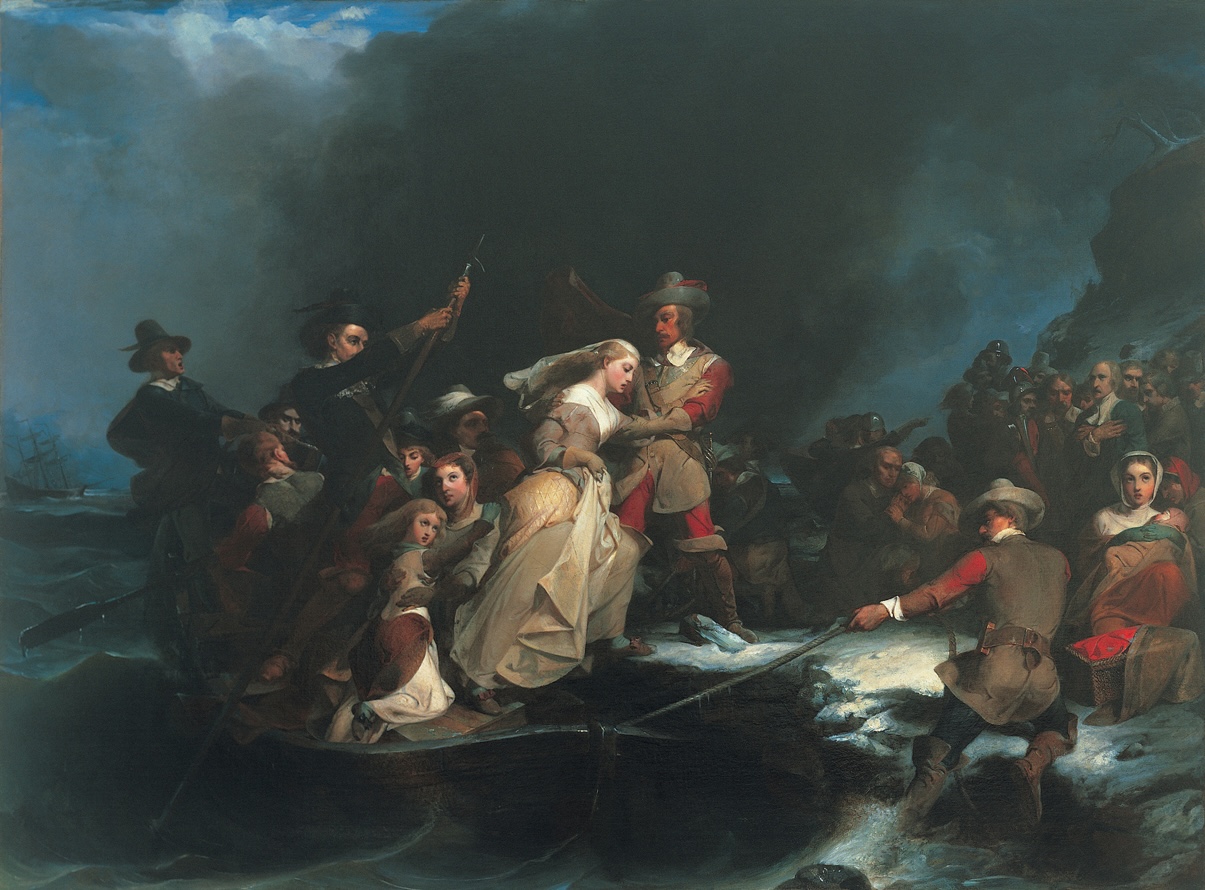
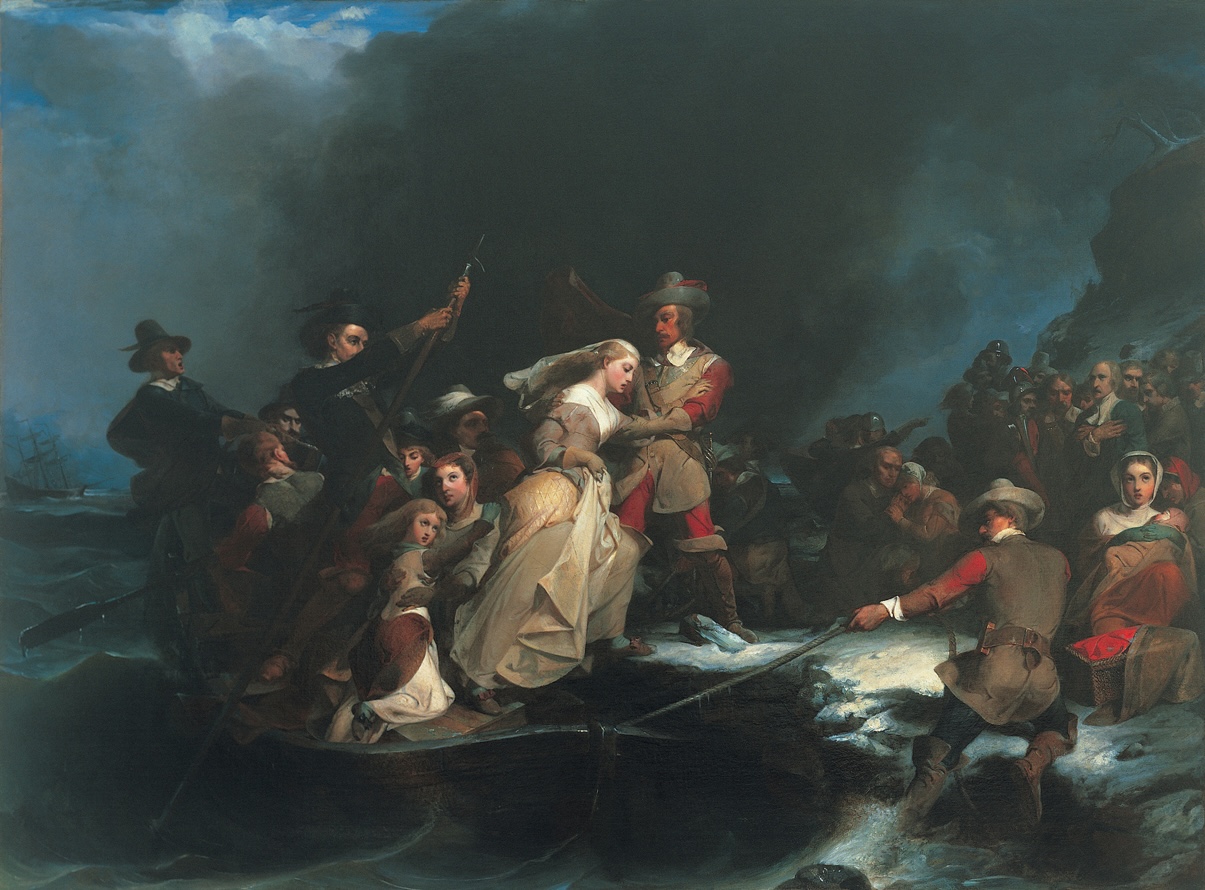
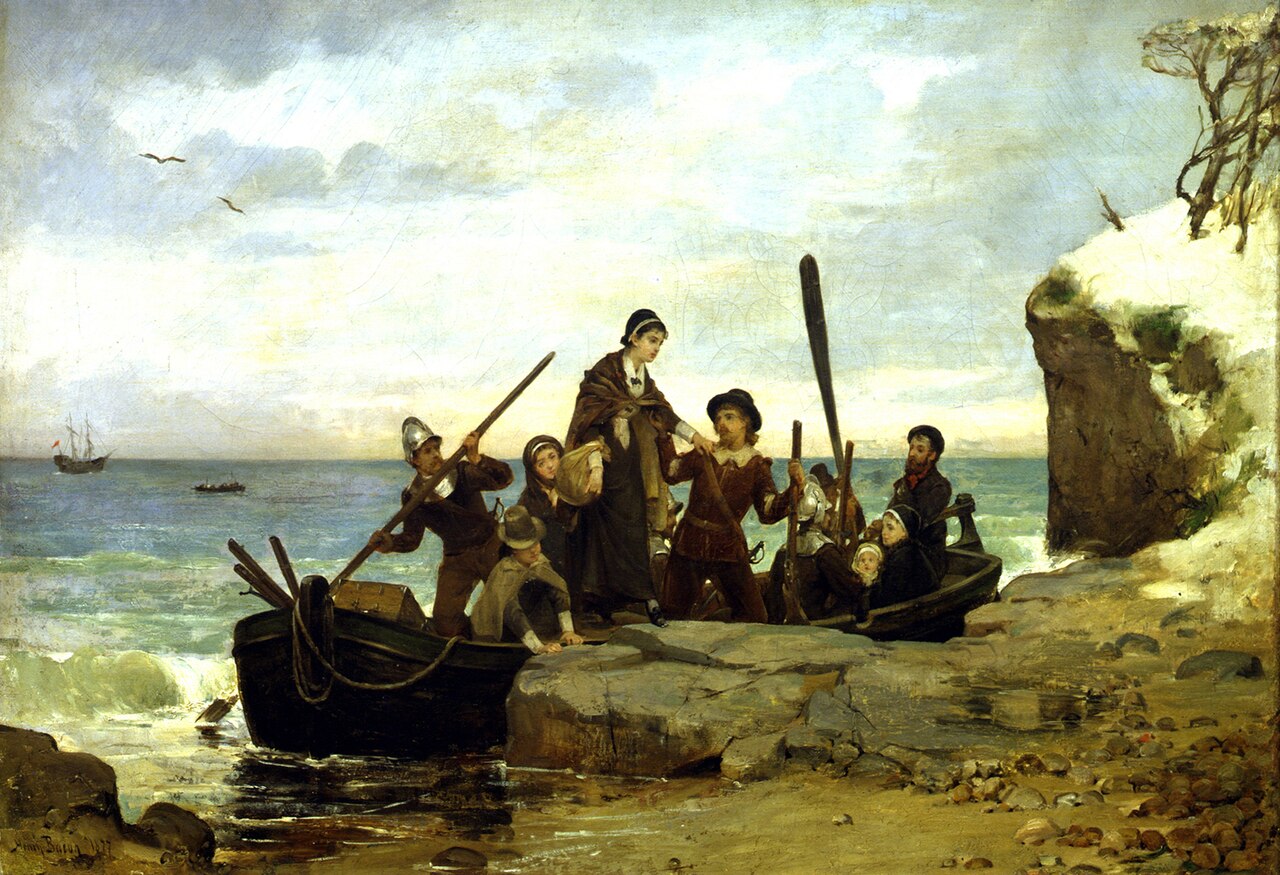
Track A — Traditional: It is the very rock the Pilgrims first stepped onto in the New World — America's founding stone.
Track B — Revisionist: Neither primary source — Bradford's Of Plymouth Plantation nor Mourt's Relation — mentions any landing rock at all (✅ Verified). The rock's association with the landing first appears in 1741, in the oral testimony of the 94-year-old church elder Thomas Faunce — 121 years after 1620, and Faunce was not a witness; he attributed the claim to his father, who did not reach Plymouth until 1623 (✅ Verified). In 1774 townspeople tried to move the rock by oxcart and it split in two (contemporaries read this as an omen that the British Empire would divide). The "1620" carved on its face is later: it was cut in 1880 when the Pilgrim Society rejoined the two halves and set the stone beneath a granite canopy (✅ Verified).
Museum position ⚠️: Pilgrim Hall Museum's stated conclusion is that "the claims and contentions that hover about the Rock can never be definitively addressed, due to unavoidable gaps in the historical evidence." The institution itself concedes the question can never be settled.
This is the most one-sided of the eight questions: nearly all the hard facts point to Track B, and they are stated by the local institution itself. The rock is a perfect specimen of how a symbol gets manufactured.
Sources: Pilgrim Hall Museum, "History of Plymouth Rock"; Smithsonian Magazine, "The True Story Behind Plymouth Rock"; Bradford, Of Plymouth Plantation; Mourt's Relation.
Topic 5 — Where Does the Word "Pilgrims" Come From?
 Myth image
 Myth image
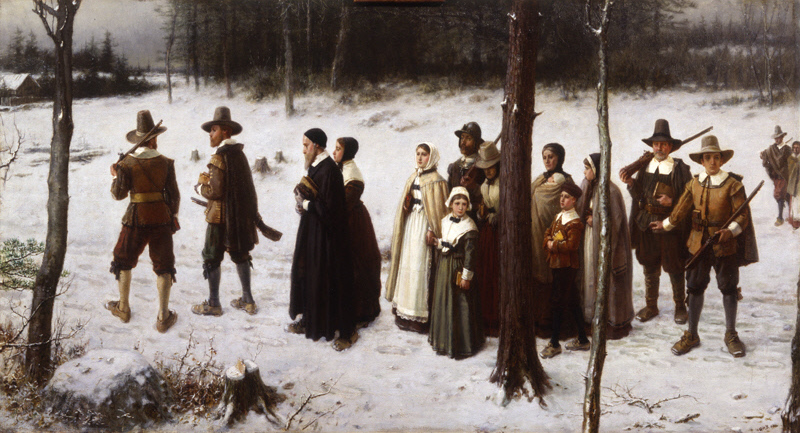
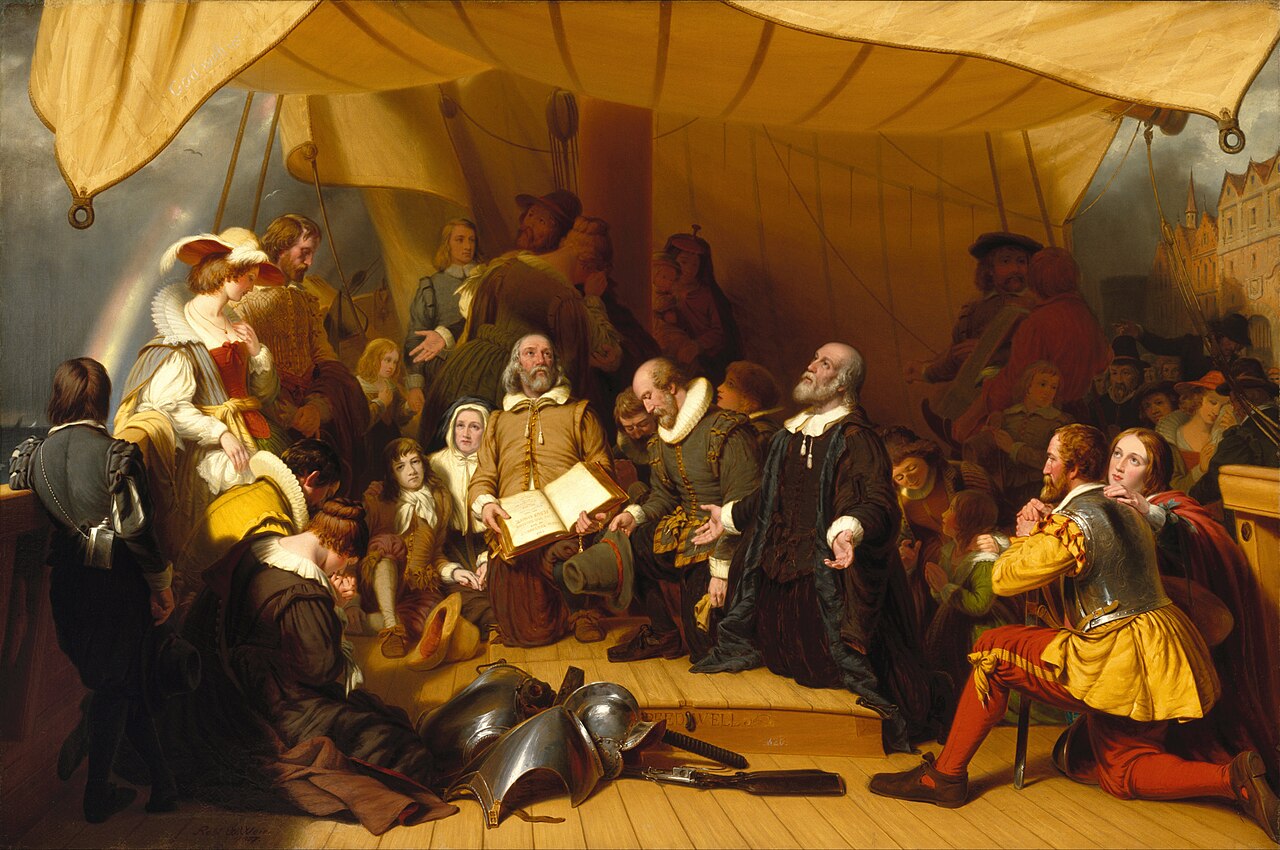
Track A — Traditional: "Pilgrim Fathers" was their own name for themselves and their identity.
Track B — Revisionist: Bradford did use the word "pilgrims," but as an image from Hebrews 11:13, not as a group name — recalling their 1620 departure from Leiden, he invoked the scriptural "strangers and pilgrims" on the earth who could have returned home but longed for a better country (✅ Verified). For about 150 years afterward, apart from quoting Bradford himself, almost no one called this group "Pilgrims" (✅ Verified). The modern proper name "Pilgrims / Pilgrim Fathers" took shape in the 1790s–1820s: the first non-quoting use on record is at the Boston Forefathers' Day celebration of 22 December 1798, where a toast was raised to "the Pilgrims of Leyden"; and on 22 December 1820 Daniel Webster used "the Pilgrims" repeatedly in his widely circulated bicentennial oration at Plymouth, fixing the label (✅ Verified). As for what they called themselves day to day, the sources more often show "Saints" (as opposed to the "Strangers" aboard the same ship), "the Church," or "planters"; no single answer is possible (❓ Unresolved).
Museum position ⚠️: The museum generally uses "Pilgrims" in exhibits and materials (it is by now the established common term), while explaining in its educational resources how the label accreted over time. (No dedicated statement exists on this point; this is an observation.)
Sources: Bradford, Of Plymouth Plantation; Wikipedia (compilation), "Pilgrims (Plymouth Colony)"; Britannica, "Pilgrim Fathers."
Topic 6 — The Museum's Own Evolution and Controversy
Institutional history ✅ Verified: In 1947 Henry Hornblower II founded Plimoth Plantation; Mayflower II arrived in 1957; the English village opened in 1959; an Indigenous area (the Wampanoag Homesite) was established in the early 1970s; the Grist Mill was added in 2013; and in 2020 the institution was renamed Plimoth Patuxet Museums.
Track A — Traditional: The museum is a pioneer of the "bi-cultural museum" — it established an Indigenous area as early as the 1970s, staffed by actual Native people (not costumed role-players), and renamed itself in 2020 to honor the region's Indigenous history. (Each of these is factual.)
Track B — Revisionist ✅ Verified (multiple public reports): A number of Wampanoag people — including current and former leaders of two federally recognized tribes — have publicly charged that the museum's bi-cultural mission had regressed, that Indigenous staff were leaving, and that the Homesite was under-maintained. In July–August 2022 came calls for a boycott: Aquinnah Wampanoag tribal chair Cheryl Andrews-Maltais called the museum "tone deaf"; former staffer Tia Pocknett said the museum wanted to be "the Wampanoag Pilgrim Disney"; Paula Peters, Kerri Helme, and others spoke out as well. Critics also noted that the 2020 renaming had the effect of removing the word "Wampanoag" from much of the museum's material (the former "Wampanoag Homesite" is now the "Historic Patuxet Homesite").
Museum response ✅ Verified: On 1 September 2022 the museum issued a public statement acknowledging the concerns and listing commitments: a new Indigenous programs and exhibits building (goal: $4 million), more Indigenous leadership, more Wampanoag representation on the board, expanded partnerships with Indigenous cultural institutions, and stronger recruitment and development of Indigenous staff. The statement reads: "Changing the name to Plimoth Patuxet Museums in 2020 acknowledged what was already true — that the history and cultural heritage of the region's Indigenous people are essential." As of mid-2026, verifiable follow-through includes the appointment of Brad Lopes (Aquinnah Wampanoag) as Director of Wampanoag and Indigenous interpretation (✅ Verified). The $4 million exhibits building, however, remains unfunded — the structure that broke ground in 2023 was a separate, smaller "support building," a different structure from the public exhibits building (✅ Verified). Whether the boycott has ended, and the current state of relations between the museum and the Wampanoag Consulting Alliance formed by some tribal members, is not publicly documented (❓ Unresolved — absence of evidence is neither reconciliation nor its opposite).
A theft case ⚠️ The facts are established; the interpretation is contested: In November 2022 the museum found two rush mats and two bearskins missing from a wetu at the Homesite, valued at about $10,000. Mashpee Wampanoag tribal chair Brian M. Weeden and another Mashpee resident, Phillip C. Hicks Jr., were charged with theft. The Boston Globe framed the episode against the backdrop of a rupture between the tribe and the museum. According to capenews.net, Weeden received one year of "pretrial probation," which ended on 17 December 2024, and the four items were returned intact (⚠️ single-sourced). Note: Massachusetts pretrial probation is not a conviction and requires no admission of guilt; on successful completion the case is dismissed. Weeden was still Mashpee tribal chair as of late 2025. The final disposition of the co-defendant, Hicks, is not publicly recorded (❓ Unresolved).
The Homesite's current framing ✅ Verified: its staff are "contemporary interpreters," "We are not playing a role," and Wampanoag culture "continues to thrive today."
Sources: Plimoth Patuxet, Museums Statement (2022-09-01); Mashpee Wampanoag Tribe official blog (2022-08-30); NPR (2022-08-10); Boston Globe (2022-12-11, 2022-12-25); capenews.net (2023-12-29); Plimoth Patuxet news releases on the Indigenous Program Support Building (2023-10-04) and the appointment of the Director of Algonquian Exhibits and Interpretation; Smithsonian Magazine, "Massachusetts' Plimoth Plantation Will Change Its Name."
Topic 7 — King Philip's War (1675–76): How the Alliance Ended
 Myth image
If the 1621 agreement really was a model of covenant-keeping, the most honest question is why it did not last. The answer is this war.
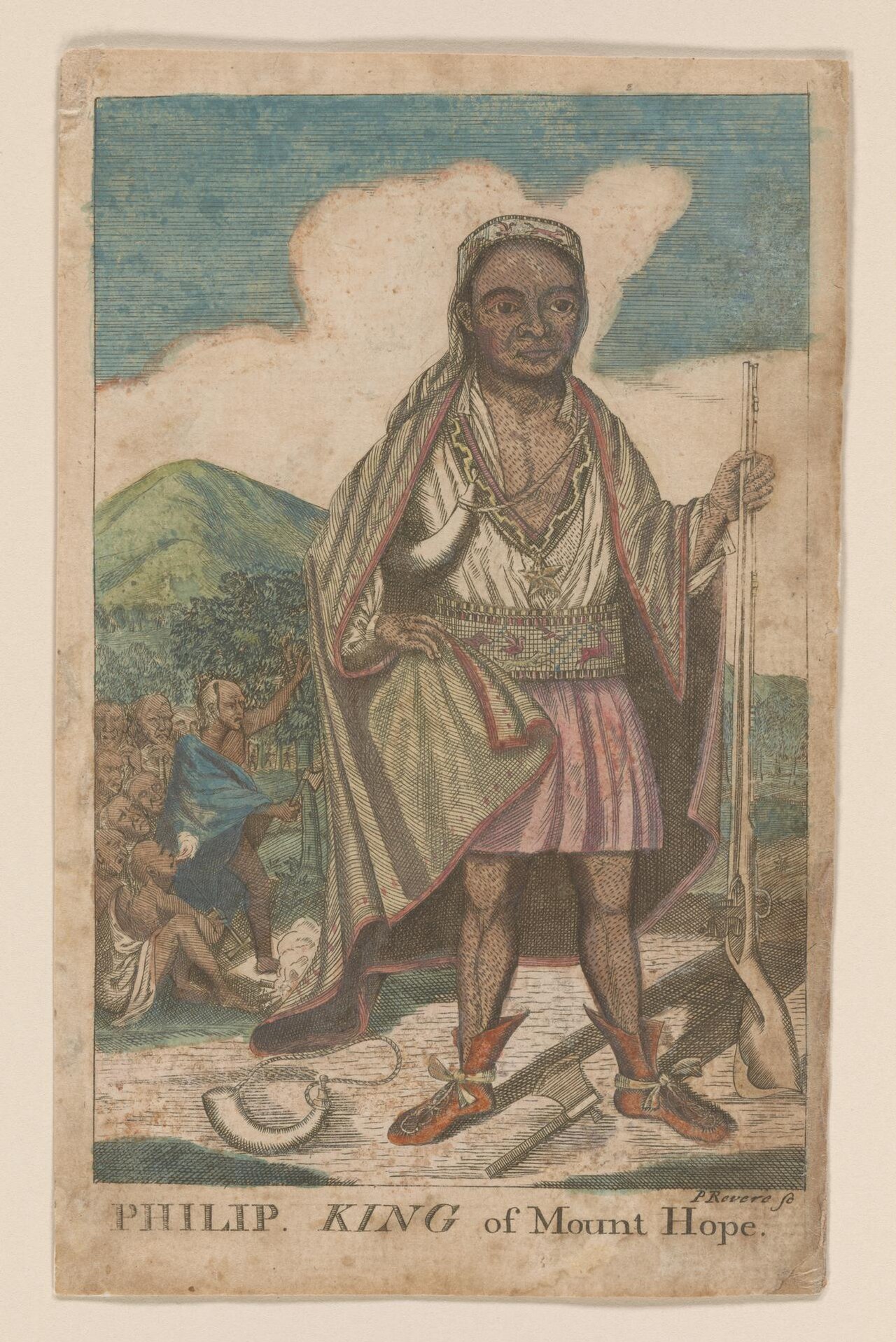
People and dates ✅ Verified: 1675–1676 (some scholars extend it to 1678, including the northern front). The great sachem who led the Wampanoag was Metacomet (whom the English called "King Philip") — the son of Ousamequin. The son of the very man who made the 1621 agreement was the one who ended it.
Track A — Traditional: A frontier war in which the colonies secured their right to survive through blood and fire. (Nineteenth-century accounts often portrayed Metacomet as a treacherous "savage chief.")
Track B — Revisionist ✅ Each element verified: This was a war of sovereignty. In the fifty-five years after 1621, the English kept expanding, land was ceded or seized, colonial courts extended jurisdiction over Native people, and cultural pressure mounted. Metacomet abandoned his father's path of alliance only after repeated English breaches. The trigger was the John Sassamon case: Sassamon, a Harvard-educated Christian Indian and former adviser to Metacomet, warned Plymouth in January 1675 that Philip was preparing for war; soon after, his body was found under the ice of a pond. Three Wampanoag men were tried by a Plymouth court (a jury of twelve colonists plus six Native elders) and hanged on 8 June 1675. This struck at the heart of the "covenant" — by asserting criminal jurisdiction over Wampanoag people, Plymouth was denying their sovereignty.
Devastation and outcome ✅ Verified: In proportion to population, this was among the bloodiest wars in American history — more than half of the ninety colonial settlements in southern New England were attacked and twelve were destroyed outright; some 1,200 houses were burned; colonial deaths reached roughly 5 percent of the population (Native deaths and enslavement were proportionally far higher). On 12 August 1676, Metacomet was hunted down near Mount Hope in Rhode Island by a force under Benjamin Church and shot by a "praying Indian," John Alderman. His head was mounted on a pike and displayed at Plymouth for more than twenty years; his wife and son, along with the families of many Native captives, were sold into slavery in the West Indies. (Some historians hold that the Mohawk turning against Metacomet was "the blow that lost the war"; this is one scholarly view, not consensus ⚠️.)
Museum position: The museum's public framing is "living history plus Wampanoag people who are still here today" (the Historic Patuxet Homesite emphasizes that the culture "continues to thrive today"). On King Philip's War itself, no dedicated position statement from the museum was found.
A documented personal friendship, and its other face: The covenant failed less from any decay of goodwill than from structure — the two parties were grossly unequal in power, and over fifty-five years the English population and landholding kept swelling; two legal traditions were incompatible (English written contract vs. Wampanoag oral covenant); and jurisdiction finally broke it. It is worth adding that personal trust genuinely existed: in March 1623, Edward Winslow walked dozens of miles to Pokanoket to tend the gravely ill Ousamequin, washing his mouth and scraping his tongue, feeding him corn porridge and sassafras broth; on recovering, Ousamequin said, "Now I see the English are my friends and love me." (✅ Primary text verified: Winslow, Good Newes from New England, 1624.) Yet during that same visit Ousamequin also revealed to Winslow a plot by the Massachusett against a nearby colony, which within weeks triggered Standish's killings at Wessagusset. The "care" was tied directly to a massacre — the personal trust was real, but it was embedded in power and calculation from the start, and it died with the two men; a generation later came King Philip's War. The true version is more persuasive than the sentimental one.
Sources: Britannica, "King Philip's War"; Wikipedia, "Metacomet" and "King Philip's War" and "John Sassamon"; Teaching American History, "Metacomet Explains the Causes of King Philip's War"; History.com, "King Philip's War"; Connecticut History, "America's Most Devastating Conflict"; Winslow, Good Newes from New England (1624; Project Gutenberg #66332, Wikisource); The Massachusett Tribe at Ponkapoag, "The Massacre at Wessagusset."
Topic 8 — The Great Dying (1616–19) and the "Empty Land"
The core fact ✅ Verified: From 1616 to 1619 an epidemic swept the New England coast (from Penobscot Bay in Maine to Narragansett Bay in Rhode Island), with death rates in some communities of 75 to 90 percent. Patuxet — the future site of Plymouth — was wiped out entirely. When the Pilgrims surveyed the site in December 1620, they found cleared, once-cultivated fields but no people. One direct reason the Pilgrims could establish themselves at Patuxet is precisely that its people had just died and left workable fields behind (✅ Verified).
Track A — Traditional: God had prepared an empty land for his people (Providence), and the legal basis for taking it was vacuum domicilium ("vacant dwelling-place"). This really was the English view at the time — and not merely as after-the-fact rationalization: the primary evidence is the Charter of New England, granted by King James I on 3 November 1620, whose preamble reads: "within these late Yeares there hath by God's Visitation reigned a wonderfull Plague, together with many horrible Slaugthers, and Murthers, committed amoungst the Savages and brutish People there, heertofore inhabiting, in a Manner to the utter Destruction, Devastacion, and Depopulacion of that whole Territorye…" In other words, "a wonderful plague sent by God's Visitation" was written directly into the royal legal instrument that authorized the granting of the land. (✅ Quotation verified against the primary text — three independent sources agree; note: this is the King's charter, not Bradford's words.)
Track B — Revisionist: This was a catastrophe of contact-borne epidemic — the "empty land" was a scene of annihilation, not a natural void. Silverman (2019) and the Smithsonian's NMAI, among others, have rebuilt the narrative on this basis. The pathogen remains unresolved (⚠️ Disputed): the older candidates are yellow fever, smallpox, and plague; newer proposals include chickenpox and trichinosis; and in 2010 John S. Marr and John T. Cathey, writing in the U.S. CDC's Emerging Infectious Diseases, proposed a leptospirosis (with Weil's syndrome) hypothesis. Notably, the authors themselves wrote that this is not a settled conclusion but "a heuristic for others to criticize and explore," conceding that "the causes of most historical epidemics may never be proven." The very people who proposed the hypothesis marked it as uncertain — which is exactly what scholarly honesty looks like.
Museum position ✅ Verified: The museum brought "Patuxet" into its name, and the Historic Patuxet Homesite opens by speaking of "Native peoples who have lived here for over 12,000 years" — meeting the "empty land" narrative with the depth of time.
Sources: Marr & Cathey, Emerging Infectious Diseases 2010;16(2) (CDC); American History Central, "Great Dying"; PBS LearningMedia, The Pilgrims; The Charter of New England, 1620 (Yale Law School, Avalon Project; University of Groningen; American Battlefield Trust); Silverman, This Land Is Their Land (2019); Historic Ipswich, "The Great Dying 1616–1619."
A Note on Names
- Wampanoag — The name of an Indigenous nation whose homeland covers parts of today's southeastern Massachusetts and Rhode Island.
- Patuxet — Both a place (the site of today's Plymouth) and a people; the "Patuxet" in the museum's name.
- Ousamequin — His personal name; Massasoit was a title, not a name.
- Tisquantum (Squanto) — His name was Tisquantum; English sources usually call him Squanto.
- Metacomet (King Philip) — Ousamequin's son; "King Philip" was the name the English gave him.
- sachem — A leader or head-leader.
- wetu — A Wampanoag domed dwelling.
A Closing Note
Eight questions, more than forty factual claims — roughly seven in ten verified by multiple independent sources, roughly two in ten genuinely disputed among scholars, the rest unresolved. We have not quietly smoothed any of the disputes into a comfortable conclusion.
The principle is simple: better to mark something "disputed" than to force a verdict; better to say less than to invent. The more a history has been retold, and the more it carries a nation's image of itself, the more it deserves to be told honestly — and in the plural. The rest of the judgment is yours.
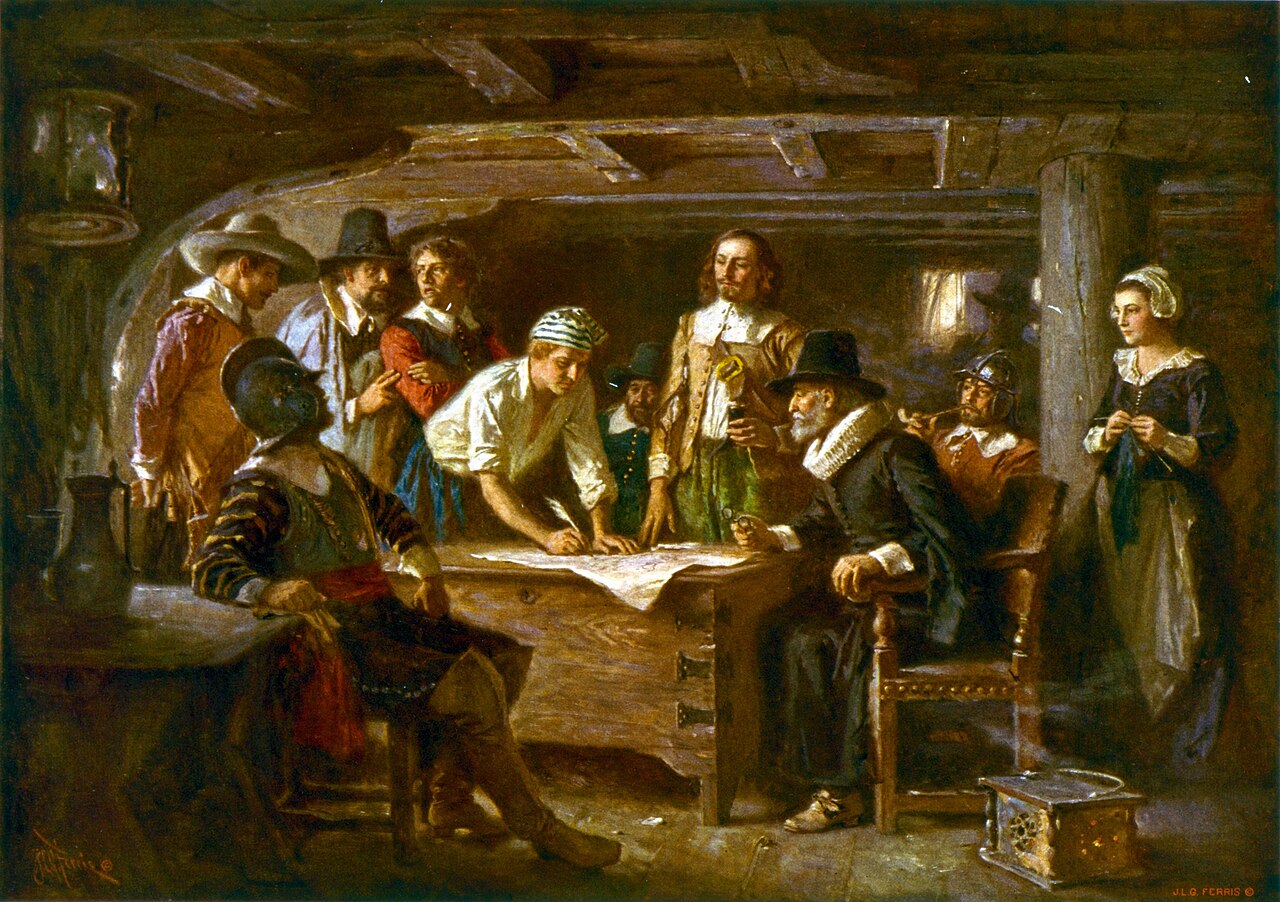
More Myth Paintings
A few more widely-circulated constructions — evidence of the opposite.
 Myth image