Short-Film Production Blueprint — From the Mayflower to Plymouth
Three hard rules for this blueprint. (1) Use only verified assets; invent nothing. Narration and captions are taken verbatim from
story.md/dual-track.md; no new conclusions are added. (2) Design no Wampanoag / Native character shots at all. Anything touching Native people is carried by environment, objects, title cards, and third-person narration only, and is flagged "⚠️ must be co-created with the Wampanoag community, not AI-generated." (3) Label AI-generated material honestly. Wherever an AI concept image appears, both the end card and the caption note "AI concept art, not a historical image." Alliance, not friendship — where the record is contested, present both tracks side by side; the image takes no side.
1. Positioning
Logline
A band of people, stripped of every external authority, made order out of nothing but their promises to one another — on land newly emptied of its Native people — and from the first signature, that order shut someone out.
Runtime targets
- One master film: about 3.5 minutes (210 seconds), 11 shots. Compress the seven acts into a single "covenant" throughline: the compact → the crossing → power made in the cabin → the winter of death → the people shut out → the calculus of alliance → the end of the covenant → the grammar that survived. Suited to YouTube / the site's homepage / looping exhibition playback.
- A series of 8 clips: 30–90 seconds each. Each has one standalone hook, publishable on its own to TikTok / Reels / Shorts / X, independent of the others, and all pointing to
usa.lighthope.aifor the deep read.
Tone and audience
- Tone: restrained, cold, honest. No sentimental agitation, no heroic epic, no cozy myth. The visual language follows the existing six-color palette (maritime ink-blue / parchment cream / candle amber / winter gray-white / autumn rust-red / oak brown and hemp beige), one or two dominant colors per shot, the rest muted to gray.
- Audience: ordinary bilingual (Chinese–English) viewers who have a vague impression of "the origin of Thanksgiving" and "America's founding myth" but have never read revisionist scholarship; history educators; museum visitors. Core promise — "You think you know, but the record has been silent at the crucial points all along."
2. The Master Film (about 3.5 minutes · 11 shots)
The single most forceful throughline: rather than spreading effort evenly across the seven acts, bite down on one thread only — the covenant — how it was invented in an empty room, became politics in a ship's cabin, became the only reason not to disband in the winter of death, how from the first day it drew the Wampanoag outside the door, and how it was finally ended by the very hand of Ousamequin's son. Structure = the birth of a promise, its boundary, its rupture, its legacy.
Master score: a single minimal string line over an ambient bed across the whole film, going quietest at the winter of death, leaving space at "the people shut out," and rising very slowly at the closing "the grammar survived" — but never triumphant.
| Shot | Duration | Image (asset) | Narration / caption (EN) | Music / sound | ⚠️ Honesty note |
|---|---|---|---|---|---|
| S1 | 18s | Reuse pledge-room-candle (the empty room of the pledge, candle amber, slow push in toward the Bible) |
"The story does not begin at sea. It begins in a room." Title card: free people / joined themselves / by a covenant | Low clarinet sustained tone, indoor silence, faint pop of the candle wick | Do not shoot this as a secret society or heroic group portrait; an empty room plus objects is enough. This is the grammatical origin of "covenant," not legend. |
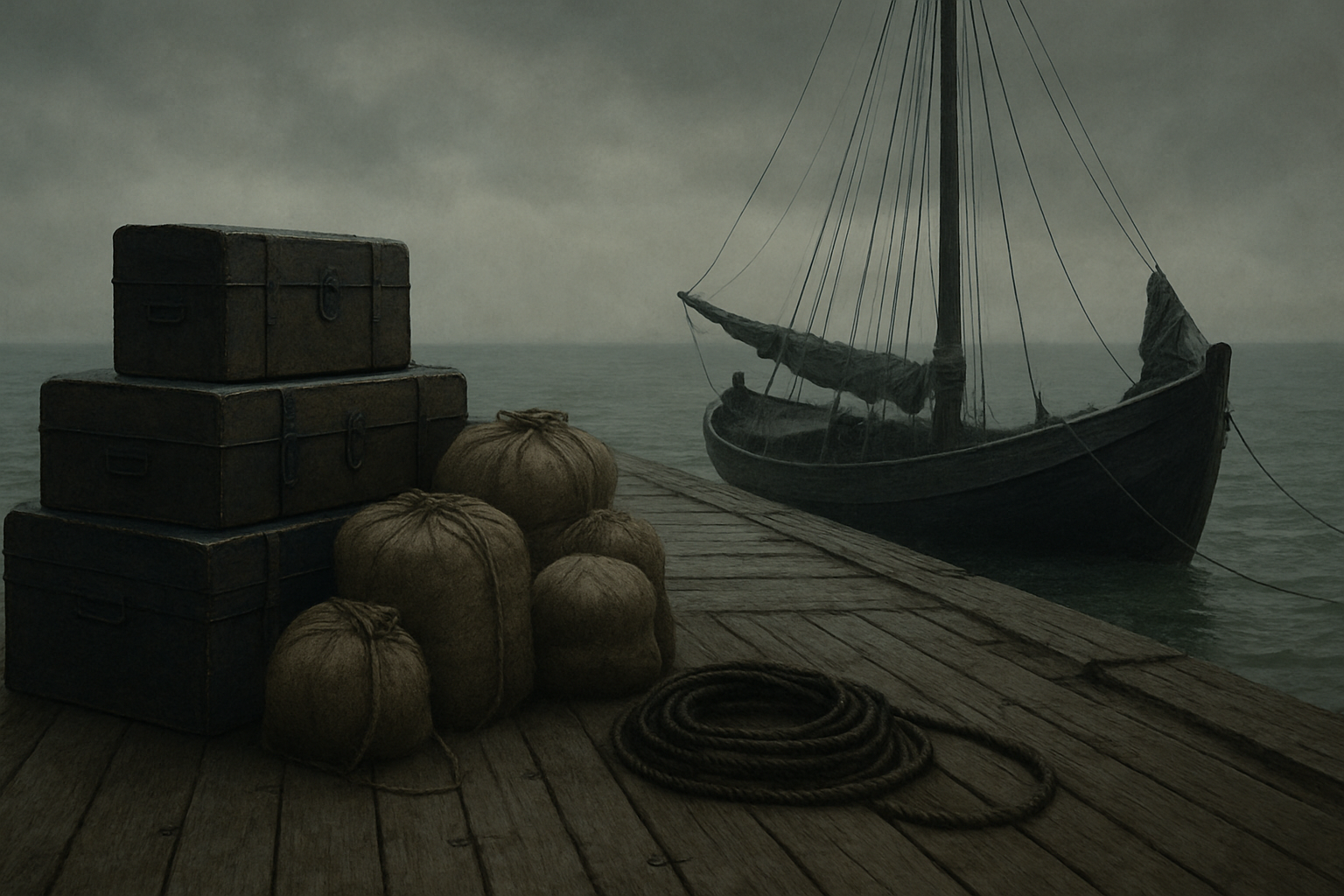
| S2 | 15s | Reuse departure-quay (crates and hawsers on the departure pier, no people; slow pan toward open sea) |
"When they set out, they were simply people who would not turn back." | A layer of strings enters, distant surf and gulls | Do not glorify a "Pilgrims' proud departure" — the name "Pilgrims" was appended 150 years later; at this moment they have no halo. |
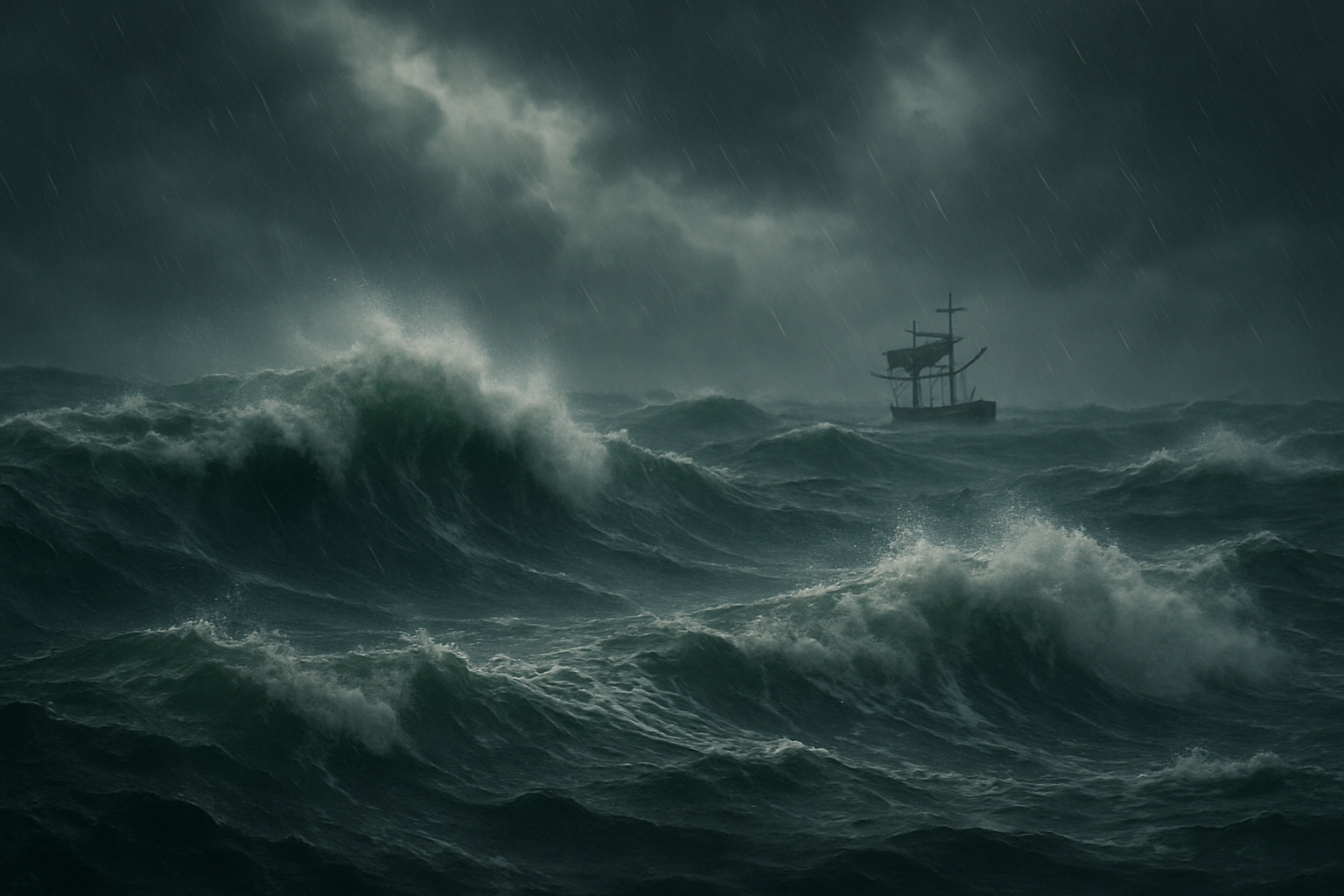
| S3 | 18s | Reuse storm-at-sea (square-rigger with sails struck, lying ahull, iron-gray-green waves swallowing a dark silhouette) |
"…strike all sail and let the ship drift… trusting the hull and the sea." | Low-frequency rumble, wind, groaning timbers, voices gone | The storm is endured, not heroically steered; give no valiant close-up of a helmsman. |
| S4 | 18s | Reuse cabin-corner-tension (a dim corner of the ship's cabin, an empty bench, swaying lamp shadow; slow push toward the lamp shadow on the wall) |
"The ship arrived — in the wrong place. 'None had power to command them.'" | Strings cut abruptly, only the creak of the lamp cord and whisper-like ambience remain | This line is from Bradford — a cool legal argument by the "Strangers" (the majority), not a villain's line; do not demonize the Strangers. |
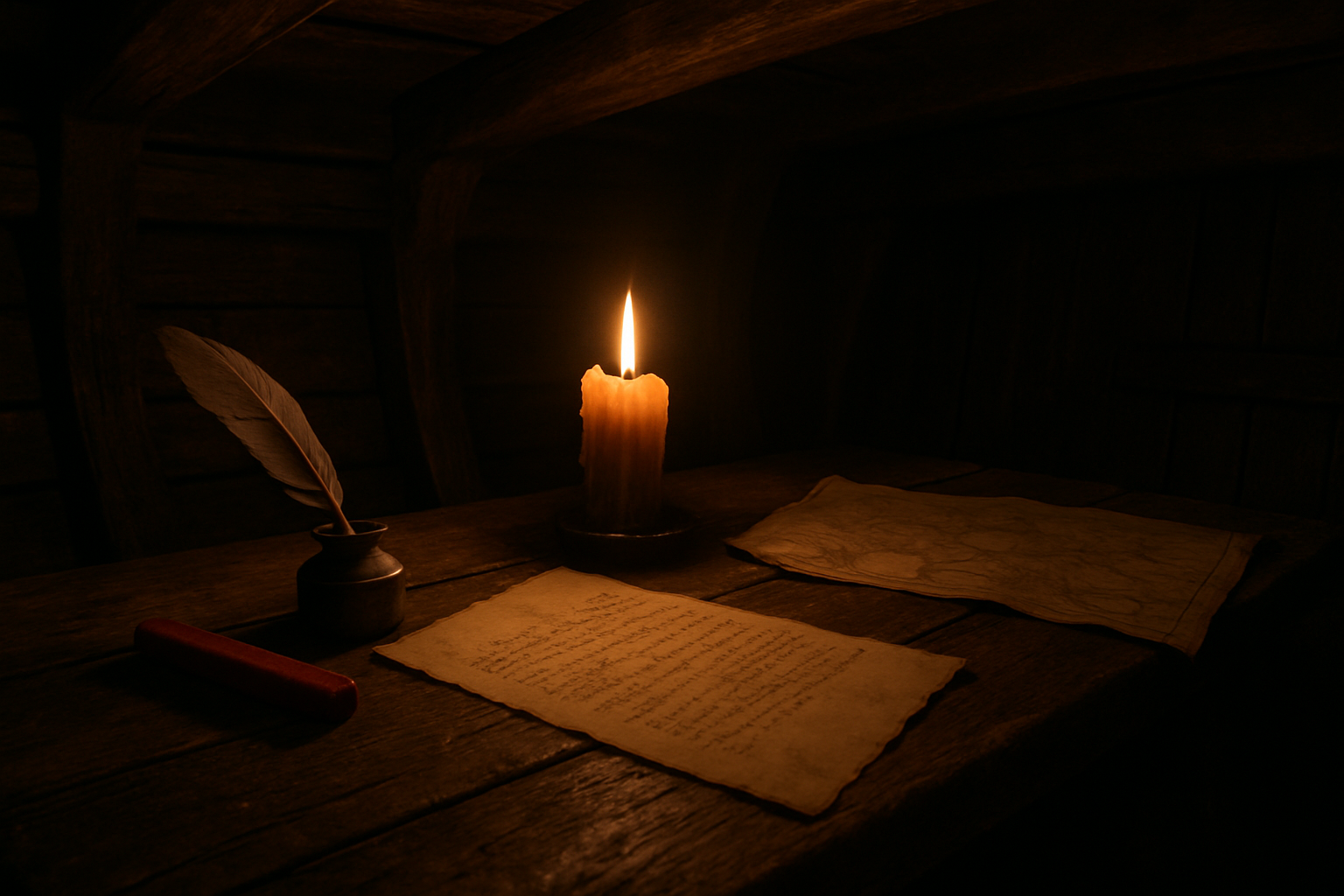
| S5 | 22s | Reuse cabin-covenant (parchment by candlelight, a quill hovering above the page; shallow focus following the nib) |
"Forty-one adult men signed… two verbs side by side: Covenant and Combine." | Scratch of the quill, drip of sealing wax, strings returning very faintly | If hands enter frame, shoot only adult men's hands; do not imply women, servants, or children signed — that is the point of the next shot. |
| S6 | 24s | New generation needed: pull back from the cabin's candlelight out through the cabin door, a cold empty gray sea and a low shadow of shore beyond, a signed document on the table. Prompt: Photorealistic cinematic concept art, no people, no human figures. View from inside a candlelit 17th-century ship's cabin looking out through an open doorway to a cold empty gray sea and a low distant shadow of wooded shore at dusk; a signed parchment on a table in the warm foreground. Muted palette: candle amber inside, ink-blue and gray-white outside. Contemplative, documentary realism, no modern objects. | "'Government by consent' — whose consent? Zero women, no servants, a third were children; and the Wampanoag, here for thousands of years, wholly absent and never consulted." | Strings leave space, a single very-low heartbeat-like pulse | ⚠️ Carry the Native people's "absence" through the door and the sea as symbols; generate no Wampanoag figure whatsoever. A Native-related theme — the title-card wording must be co-created with the Wampanoag community, not spoken for by AI. |
| S7 | 20s | Reuse coles-hill-slope (an empty winter slope of Cole's Hill, thin snow and cold mist, nearly monochrome; very slow push through the mist) |
"Of the 102, only about fifty were left. Of every two people, one did not survive." | The film's quietest point, near silence, only wind and distant sea | The death toll is confirmed (Bradford records 44 dead); carry it through emptiness, cold, and stillness — no spectacle of bones. |
| S8 | 22s | Reuse autumn-saltmarsh (the salt marsh coast at the former site of Patuxet, dry grass in the wind, no people, no objects; slow aerial lateral move) |
"This 'empty land' was a scene of catastrophe. Tisquantum spoke English because he had been kidnapped, enslaved, and had lost his whole village. The pact that saved the colony was an alliance, not a friendship." | Elegiac strings, wind dominant | ⚠️ Do not depict Tisquantum or Ousamequin, and place no Native objects; carry it through the land he returned to, emptied by the "Great Dying." Must be co-created with the Wampanoag community. Not one of the six terms says "friendship"; no original survives, every word comes from the English side. |
| S9 | 18s | New generation needed: a split-screen symbol — on the left, an aged book page from 1841 where "the first Thanksgiving" was first written down; on the right, a turkey silhouette / pumpkin pie and other 19th-century imagery, deliberately hazed and desaturated as "myth added later." Prompt: Photorealistic cinematic concept art, no people, no human figures. A split symbolic still life: an aged 1841 printed book page on one side; on the other, in deliberate haze and desaturation, a turkey silhouette and a pumpkin pie signalling later myth. Muted palette: parchment cream vs faded warm tones. Documentary realism, no modern objects. | "The 1621 three-day harvest was real. But the label 'First Thanksgiving' was pinned on only in 1841; the turkey and pumpkin pie are almost all later additions." | The myth side is desaturated; a muted, slightly distorted nostalgic melody | ⚠️ The myth elements must be visually layered (hazed / faded), never given the same visual weight as historical fact. About ninety Wampanoag were present — state this in a title card, not through imagery, and co-create with the community. |
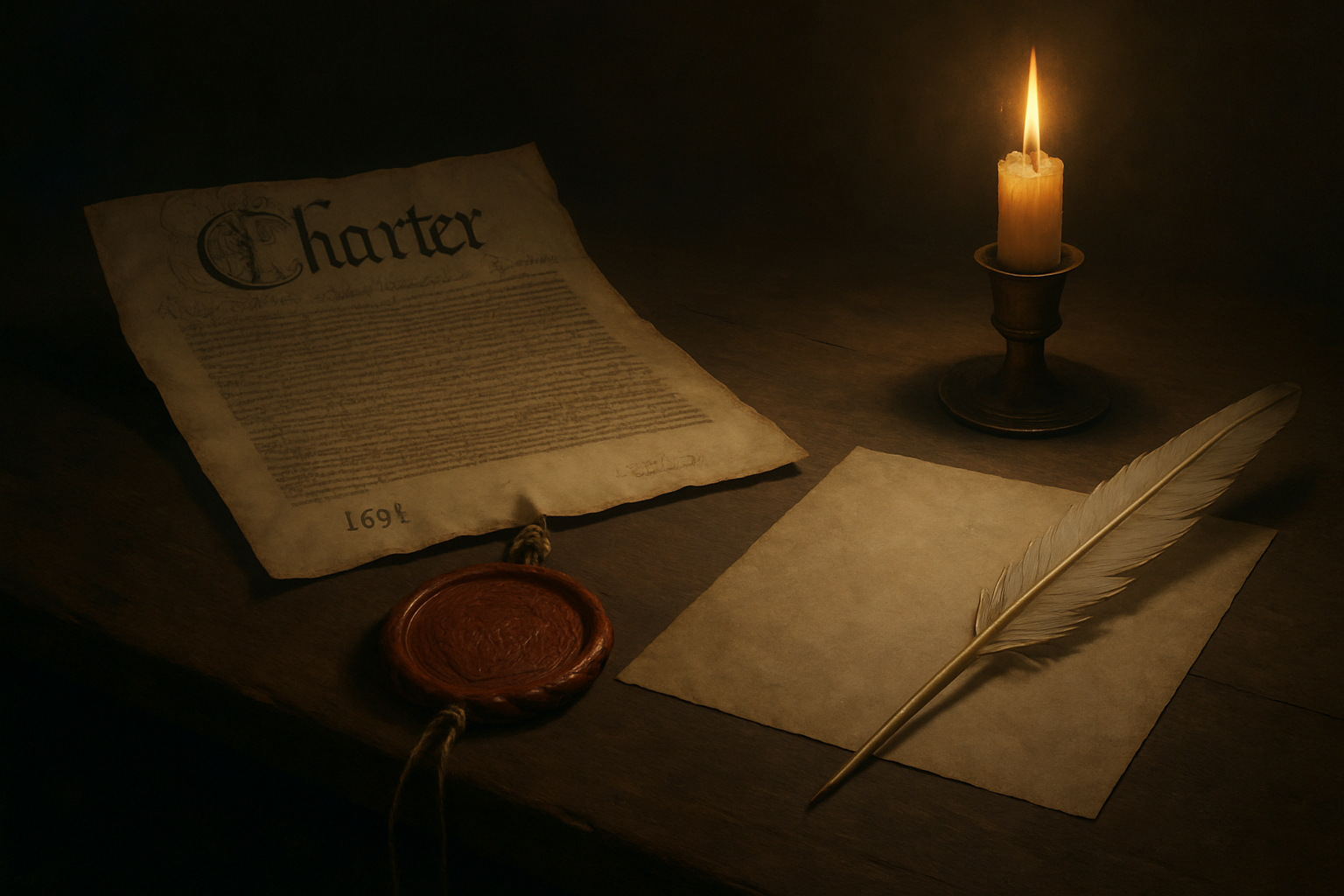
| S10 | 20s | Reuse royal-charter-close (the 1691 royal charter dissolving toward a blank page; deep-shadow candlelight) |
"If the alliance was a model covenant, the honest question is why it did not last — the son of the man who made it, Metacomet, ended it (King Philip's War, 1675–76)." | Bass sinking, a single muffled distant thunderclap | ⚠️ The war was a war of sovereignty, not a "betrayal"; do not portray Metacomet as a "savage chief." Native-related — the title card must be co-created with the Wampanoag community. No combat or character shots of any kind. |
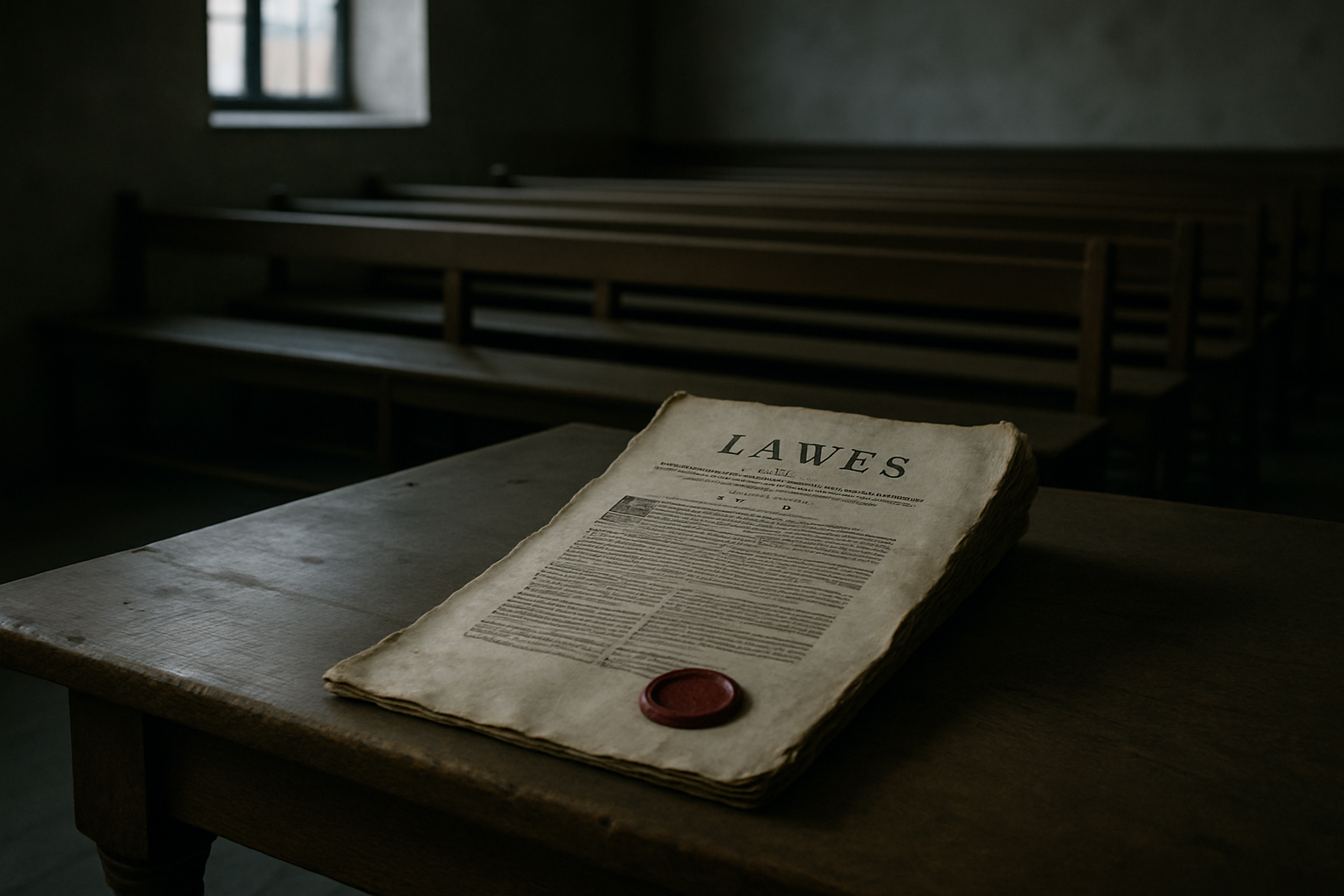
| S11 | 20s | Reuse plymouth-law-code dissolving into royal-charter-close to close (the empty bench of the 1636 legal code → open space pointing toward Philadelphia) |
"A covenant is not an institution that protects you, but a grammar that can be inherited. Plymouth ended; its grammar survived." End card: the full story, both tellings, and all sources → usa.lighthope.ai | Strings rising very slowly, but resting on an unresolved chord, never triumphant | Unified end card: "Some images are AI concept art, not historical images; Wampanoag-related content must be co-created with the community, not AI-generated." |
Shot subtotal: 11 shots, about 213 seconds. Reuses 8 existing concept images (pledge-room-candle departure-quay storm-at-sea cabin-corner-tension cabin-covenant coles-hill-slope autumn-saltmarsh royal-charter-close plymouth-law-code), with 2 new generations needed (S6 cabin door looking out to sea, S9 myth/history split-screen). Narration can be cut and spliced directly from the already-rendered per-act audio (story-zh-act*.mp3 / story-en-act*.mp3).
3. The Clip Series (8 clips · 30–90 seconds each)
Each stands alone; a unified CTA card closes each: "Two tellings, all sources, the full story → usa.lighthope.ai". Every clip touching Native people (③④⑦ and part of ⑧) is flagged "must be co-created with the Wampanoag community."
Clip ① · "Two Hundred Words to Hold Up a Colony"
- Duration: about 60s
- Core line: How does a document of under two hundred words — one that doesn't even lay out a structure of government — get called the starting point of American self-rule?
- Assets:
cabin-corner-tension→cabin-covenant; originalsbradford-manuscript-mayflower-compact-page.jpg,ferris-mayflower-compact-1620.jpg(labeled a later imagined painting); audiostory-zh/en-act3.mp3 - First-3-second hook: white text on black, "This document is under 200 words." → cut to the parchment by candlelight.
- CTA: title card "Track A calls it the source of constitutional government; Track B says before 1776 it didn't even have a name → usa.lighthope.ai"
Clip ② · "The First Winter, When Half of Them Died"
- Duration: about 45s
- Core line: Of the hands that signed the compact, within a hundred days one in every two was in the ground.
- Assets:
coles-hill-slope,winter-hearth,death-and-birth-diptych; audiostory-zh/en-act4.mp3 - First-3-second hook: "102 people boarded the ship." Hold a beat → "50 survived the first winter."
- CTA: "That compact made in the cabin had now become the only reason they did not disband → usa.lighthope.ai"
Clip ③ · "Alliance, Not Friendship" ⚠️ must be co-created with the Wampanoag community
- Duration: about 75s
- Core line: The pact told as a "model of friendship" was actually six cool security clauses — and it does not contain the word "friendship" even once.
- Assets:
autumn-saltmarsh(landscape, no people, no objects) + pure title cards listing the six terms; audiostory-zh/en-act5.mp3 - First-3-second hook: "Six terms of the pact — how many mention 'friendship'?" → large text "0".
- CTA: "Silverman: 'not because he was innately friendly' — this was geopolitics initiated by the Wampanoag → usa.lighthope.ai"
- Red line: Depict no Native figure whatsoever; present the six terms as title cards; the title-card wording must be confirmed with the community.
Clip ④ · "The Kidnapped Interpreter" ⚠️ must be co-created with the Wampanoag community
- Duration: about 75s
- Core line: Tisquantum spoke English because he had been seized by an English captain, sold into slavery in Spain, and returned home to find his whole village dead.
- Assets:
autumn-saltmarsh; new generation needed — a symbolic still life of the "1614 Málaga deed" (Prompt: …a somber still life of an early-17th-century Spanish legal deed on aged paper, faded brown ink, a red wax seal, an archival label, cold side light; no readable specific text; no people); audiostory-zh/en-act5.mp3 - First-3-second hook: "He helped the Puritans. But before that —" → cut to the old deed in cold light.
- CTA: "In 2024, researchers found that 1614 deed in the Málaga archive. This is trauma, not legend → usa.lighthope.ai"
- Red line: Do not depict Tisquantum himself; the kidnapping and enslavement must never be treated as exotic adventure.
Clip ⑤ · "Two Tellings of the Same History"
- Duration: about 60s
- Core line: It's not "one right, one wrong" — often the primary record is silent at the crucial points, and different people fill that silence in different ways.
- Assets:
farewell-still-life,night-graves-legend(two "hazed legend" images as illustration); originalsbrownscombe-first-thanksgiving-at-plymouth-1914.jpgvsmourts-relation-1622-title-page.jpg; audio can usestoryor a separate caption track - First-3-second hook: the three-state markers "✅ verified ⚠️ contested ❓ unresolved" flash by.
- CTA: "We tagged the strength of evidence for every fact. Eight issues — judge for yourself → usa.lighthope.ai"
Clip ⑥ · "The Most Famous Rock, With No Evidence at All"
- Duration: about 45s
- Core line: Neither primary source ever mentions a landing rock; the "1620" carved on its face was cut only in 1880.
- Assets:
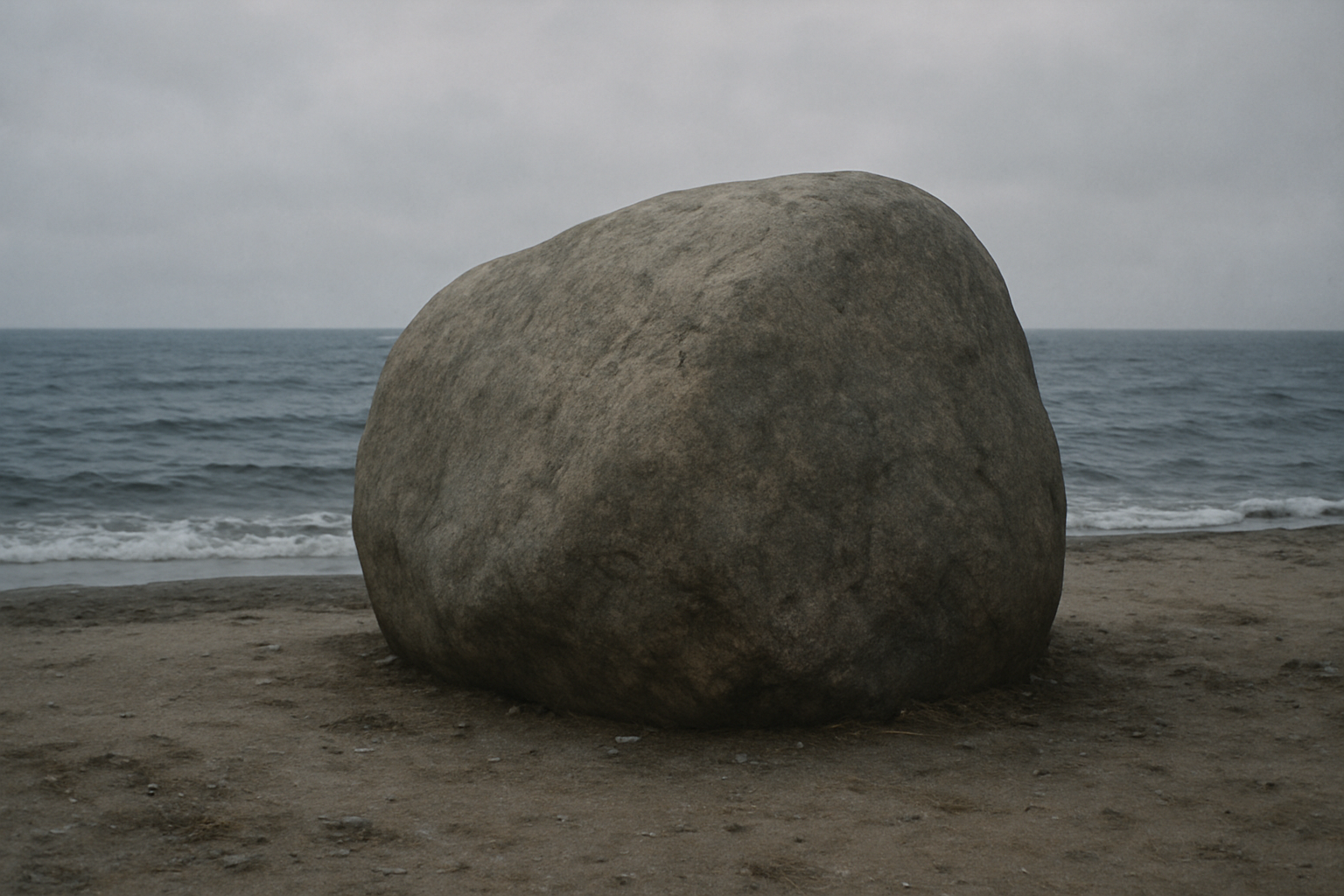
plymouth-boulder(de-monumentalized, eye-level); original comparisonsrothermel-landing-of-the-pilgrims-plymouth-rock.jpg,currier-ives-landing-of-the-pilgrims-1620.jpg(labeled later myth paintings); audiostory-zh/en-act4.mp3 - First-3-second hook: "Plymouth Rock has 1620 written on it." Hold a beat → "Those four digits were carved on only in 1880."
- CTA: "Even the Pilgrim Hall Museum itself says: the authenticity of this rock can never be settled → usa.lighthope.ai"
Clip ⑦ · "Why the Covenant Did Not Last" ⚠️ must be co-created with the Wampanoag community
- Duration: about 90s
- Core line: The son of the man who made the 1621 alliance ended it by his own hand fifty-five years later — this is not betrayal, it is structure.
- Assets:
plymouth-law-code,royal-charter-close,coles-hill-slope; originalrevere-philip-king-of-mount-hope-1772.jpeg(Metacomet / King Philip, labeled an 18th-century engraving); audiostory-zh/en-act7.mp3 - First-3-second hook: "In 1621, they made an alliance. In 1675, his son made war."
- CTA: "King Philip's War: by population ratio, one of the bloodiest wars in American history → usa.lighthope.ai"
- Red line: No combat or character shots; frame it as a "war of sovereignty"; the title cards must be confirmed with the community.
Clip ⑧ · "The Real Record vs. the Myth Paintings"
- Duration: about 75s
- Core line: The "Thanksgiving" in your head comes almost entirely from 19th-century oil paintings; the primary record looks like this.
- Assets: left column, myth paintings (
brownscombe-first-thanksgiving-at-plymouth-1914.jpg,ferris-first-thanksgiving-1621.jpg,bacon-landing-of-the-pilgrims-1877.jpg,boughton-pilgrims-going-to-church-1867.jpg) against right column, primary originals (bradford-of-plimoth-plantation-manuscript.jpg,mourts-relation-1622-title-page.jpg,champlain-1613-port-st-louis-patuxet-map.jpg,john-smith-1616-new-england-map.jpg) - First-3-second hook: "This 'First Thanksgiving' painting was made in — 1914."
- CTA: "The myth was painted later; the record was there all along. Look at the gap between them → usa.lighthope.ai"
- Note: All are public-domain originals, no AI generation, no newly fabricated Native figures; every myth painting is labeled with its date of creation.
4. Production Checklist
A. Existing assets ready to use directly (verified)
- 21 AI concept images (
content/public/_images.json→/images/*.png): all scene / object / atmosphere empty shots, no people, no Native figures. The master film reuses 9; the clips reuse about 10. - 20 public-domain historical images (
web/public/images/pd/): manuscripts (Bradford, Mourt's Relation, Mayflower Compact page), old maps (Champlain 1613, John Smith 1616, Wood 1634, Foster 1677, Blaeu 1635), portraits (Winslow, Revere's King Philip), 19th–20th-century myth paintings (Brownscombe, Ferris, Bacon, Boughton, Currier & Ives, Rothermel, Weir). → Mainly for Clips ⑤⑥⑦⑧ to make the "real record vs. myth" comparison. - 14 narration audio tracks (
web/public/audio/story-{zh,en}-act1–7.mp3): seven acts × Chinese/English. Can be cut and spliced directly into the master film and each clip's narration, no re-recording needed. - 14 already-rendered per-act videos (
web/public/video/story-{zh,en}-act1–7.mp4): finished pieces of image + audio + captions. Usable as ready-made rough cuts for the clip series (especially Clips ①②④⑥⑦, which map closely to single acts), or simply trimmed and published. - Caption text:
story.md(seven acts, bilingual paragraph by paragraph),dual-track.md(eight issues, dual-track + three-state markers) — the sole source for all narration / title-card text, quotable verbatim.
B. What's still missing
- 3 AI concept images to be newly generated (all "no people," captioned "AI concept art, not a historical image"):
- Master film S6: cabin door looking out to the empty sea ("the people shut out")
- Master film S9 / Clip ⑤: split-screen of the 1841 "first Thanksgiving" book page vs. 19th-century myth imagery
- Clip ④: symbolic still life of the 1614 Málaga deed
- Music: a minimal string theme + an ambient bed (surf, wind, candle, quill, sealing wax, distant thunder). Needs a royalty-free / original score; one for the master film, with variations shared across the clips.
- Wampanoag community co-creation sign-off: the title-card wording of master-film S6/S8/S10 and Clips ③④⑦ (and ⑧'s Native-related statements) must be reviewed by the community; any Native character imagery must never be AI-generated — if needed in future, it must be filmed / licensed with the community's participation.
- Vertical reformatting: the existing assets are mostly horizontal compositions; clips for Reels / Shorts / TikTok need 9:16 versions (re-crop, or generate new images in vertical format).
- Honesty title-card templates for opening / closing: a unified end card of "AI concept art statement + Wampanoag co-creation statement + usa.lighthope.ai."
C. Next actions (suggested order)
- First use the 14 already-rendered per-act mp4s to quickly cut Clips ①②⑥ — three sample clips of purely verified assets — to validate pacing and platform feedback (zero added cost).
- Generate the 3 new concept images (S6, S9/⑤, ④) to complete the master film and Clips ④⑤.
- Lock the score theme and apply it across the master film's 11 shots.
- Send the title-card drafts for master-film S6/S8/S10 and Clips ③④⑦ to the Wampanoag community for review; finalize once returned.
- Produce the 9:16 vertical cuts, schedule publication, and drive all traffic to
usa.lighthope.ai.
This blueprint adds no new historical conclusions; it only translates the verified seven-act narrative and dual-track issues into shootable shots and publishable clips. Every AI-generated item is labeled, and everything touching Native people must be co-created with the Wampanoag community, not AI-generated. The rest of the judgment is left to the viewer.
Storyboard Drafts (voiced · subtitled)
Concept image + act narration + estimated-timing subtitles. A rough pre-visualization, not a finished film.
Act One — The Choice at Leiden
Concept Art (AI-generated · mood)
 AI concept art
 AI concept art
 AI concept art
 AI concept art
 AI concept art
 AI concept art
 AI concept art
 AI concept art
 AI concept art
 AI concept art
 AI concept art
 AI concept art
 AI concept art
 AI concept art
 AI concept art
 AI concept art
 AI concept art
 AI concept art
 AI concept art
 AI concept art
 AI concept art
Full shot-by-shot storyboard (32 shots)
Storyboard — From the Mayflower to Plymouth
This is a working shot-breakdown of the seven-act story for a future AI film. It draws no new conclusions; it only turns the verified narrative into filmable shots. Each shot lists: shot number, frame description (scale / subject / setting / light), camera movement, mood and palette (drawn from the Visual Direction six-color set), a linked concept image (reuse one of the eight already generated by id, or mark "new generation needed" with a safe prompt), narration / caption points (from the story; quotable but never invented), and one ⚠️ honesty note.
Two lines that never move. (1) This storyboard designs no shot depicting any Wampanoag / Indigenous individual. That requires living-community participation; AI cannot stand in for it. Every act touching Indigenous people is carried by environment / symbol / title card / third-person narration, and the shot is marked "to be co-created with the Wampanoag community, not AI-generated." (2) Alliance, not friendship; disputes run on two tracks, and the frame adjudicates for no one.
Palette key. Naval ink-blue|Parchment cream|Candlelight amber|Winter gray-white|Autumn rust|Oak brown & hemp beige. One or two colors lead each frame, the rest muted to gray; avoid bright modern teals and any fluorescent color.
Act One — The Choice at Leiden (4 shots)
c. 1606–1620 · Scrooby → Leiden
A1-S1 · A Room Where They Pledged (empty)
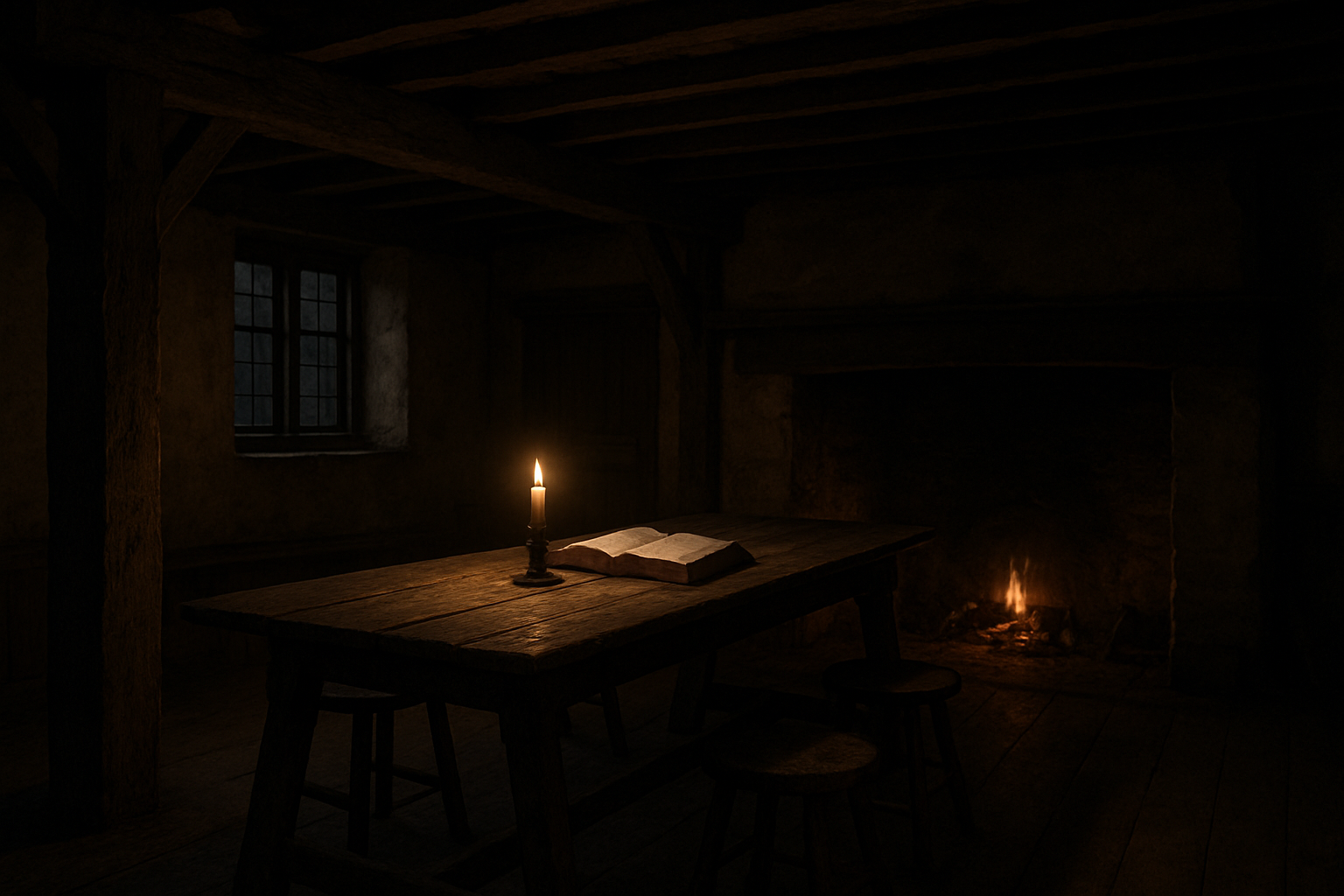
- Frame: Interior, medium-close. A plain English farmhouse hall at night: a long wooden table, empty stools, a single beeswax candle, rough beams overhead, an open old Bible on the table. No people. A low hearth.
- Camera: Slow dolly-in to the Bible and candle.
- Palette: Candlelight amber leads; oak brown and deep shadow beneath.
- Image: New generation needed. Prompt: Photorealistic cinematic concept art, no people, no human figures. Interior of a plain early-17th-century English farmhouse hall at night, a long rough wooden table with empty stools, a single lit beeswax candle, an open old leather Bible on the table, heavy oak beams, a low hearth fire. Warm candle glow against deep shadow, chiaroscuro. Muted palette: candle amber, oak brown, ink black. Intimate, reverent, documentary realism, no modern objects.
- Narration: "The story does not begin at sea. It begins in a room."
- Caption quote: "free people / joined themselves / by a covenant."
- ⚠️ Honesty note: Do not stage the Separatist meeting as an exotic secret society or a heroic tableau; an empty room and objects suffice. This is the grammar of covenant, not a legend.
A1-S2 · Twelve Years at Leiden
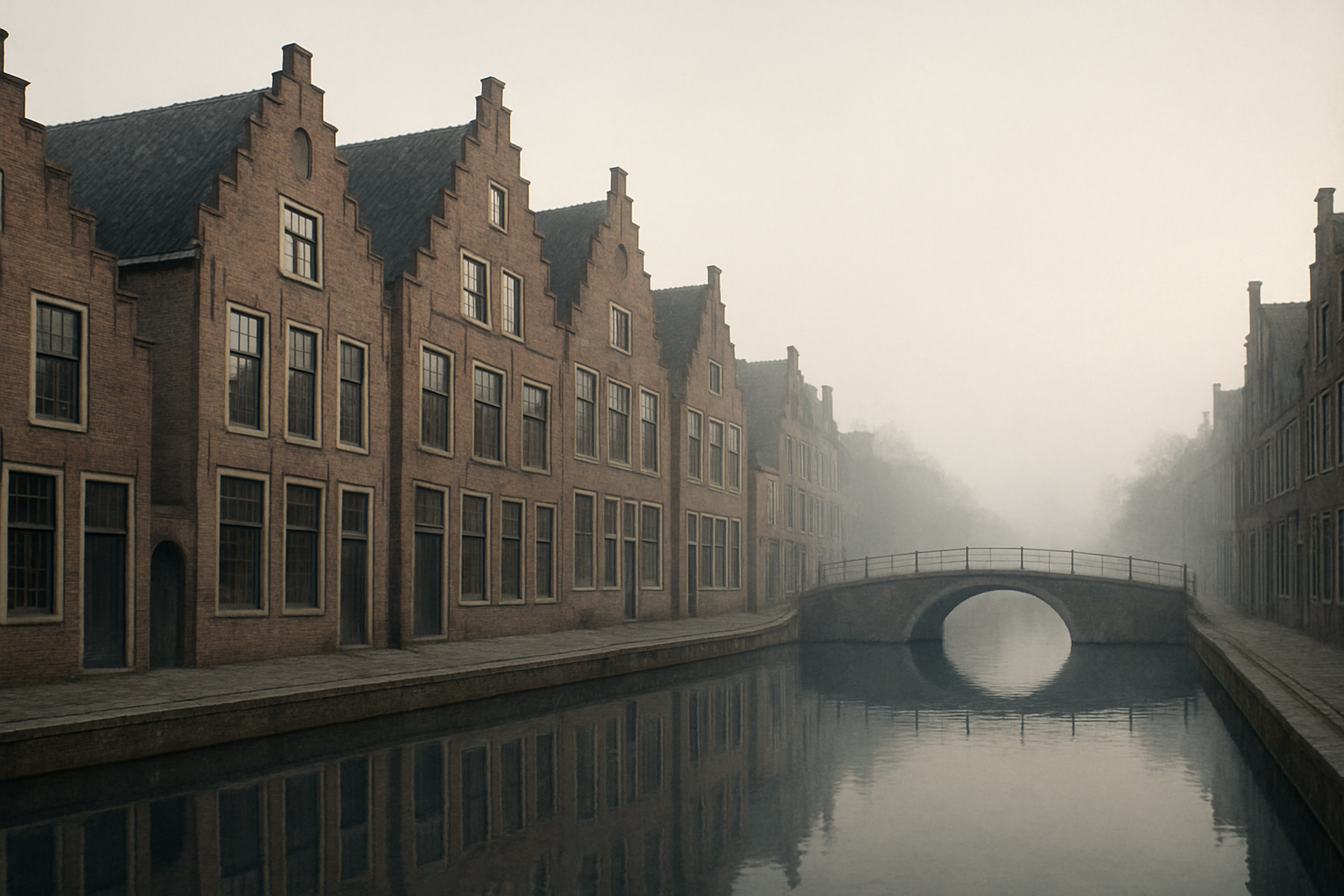
- Frame: Exterior, wide. Dawn over Leiden's canals, brick stepped gables, a stone bridge, flat northern light, mist on the water. No people, or only unreadable distant silhouettes.
- Camera: Locked long take, or a very slow pan across the water.
- Palette: Naval ink-blue into winter gray-white, brick red as accent.
- Image: New generation needed. Prompt: Photorealistic cinematic concept art, no people, no human figures. A quiet early-17th-century Dutch canal in Leiden at dawn, brick stepped-gable houses reflected in still water, a stone footbridge, thin morning mist, flat pale northern sky. Muted palette: ink-blue water, gray-white sky, faded brick red. Serene, still, documentary realism, no modern objects, no boats.
- Narration: "…moved to Leiden and stayed about twelve years… They could have stayed, and been safe."
- ⚠️ Honesty note: This is safety, not suffering; do not imply persecution at Leiden with a gloomy filter — the persecution was in England; Leiden was the safety they chose to give up.
A1-S3 · People Who Would Not Turn Back (departure)
- Frame: Exterior, medium to wide. Wooden chests on a quay, bundled baggage, a coil of rope, a small vessel waiting; gray-green water to the horizon. No figure close-ups — only objects and the vessel.
- Camera: Low locked angle, then a slow tilt out to open water.
- Palette: Naval ink-blue leads; hemp beige and oak brown accents.
- Image: New generation needed. Prompt: Photorealistic cinematic concept art, no people, no human figures. A 17th-century wooden harbor quay at grey dawn: stacked sea chests, bundled baggage, a coil of tarred rope, a small wooden vessel moored waiting to depart, gray-green water stretching to the horizon. Overcast cool light. Muted palette: naval ink-blue, hemp beige, oak brown. Restrained, expectant, documentary realism, no modern objects.
- Narration: "When they set out, they were simply people who would not turn back."
- ⚠️ Honesty note: Do not render a glorious "Pilgrim" send-off. The name "Pilgrims" was pinned on 150 years later; here they have no halo.
A1-S4 · ⚠️ Robinson's Farewell
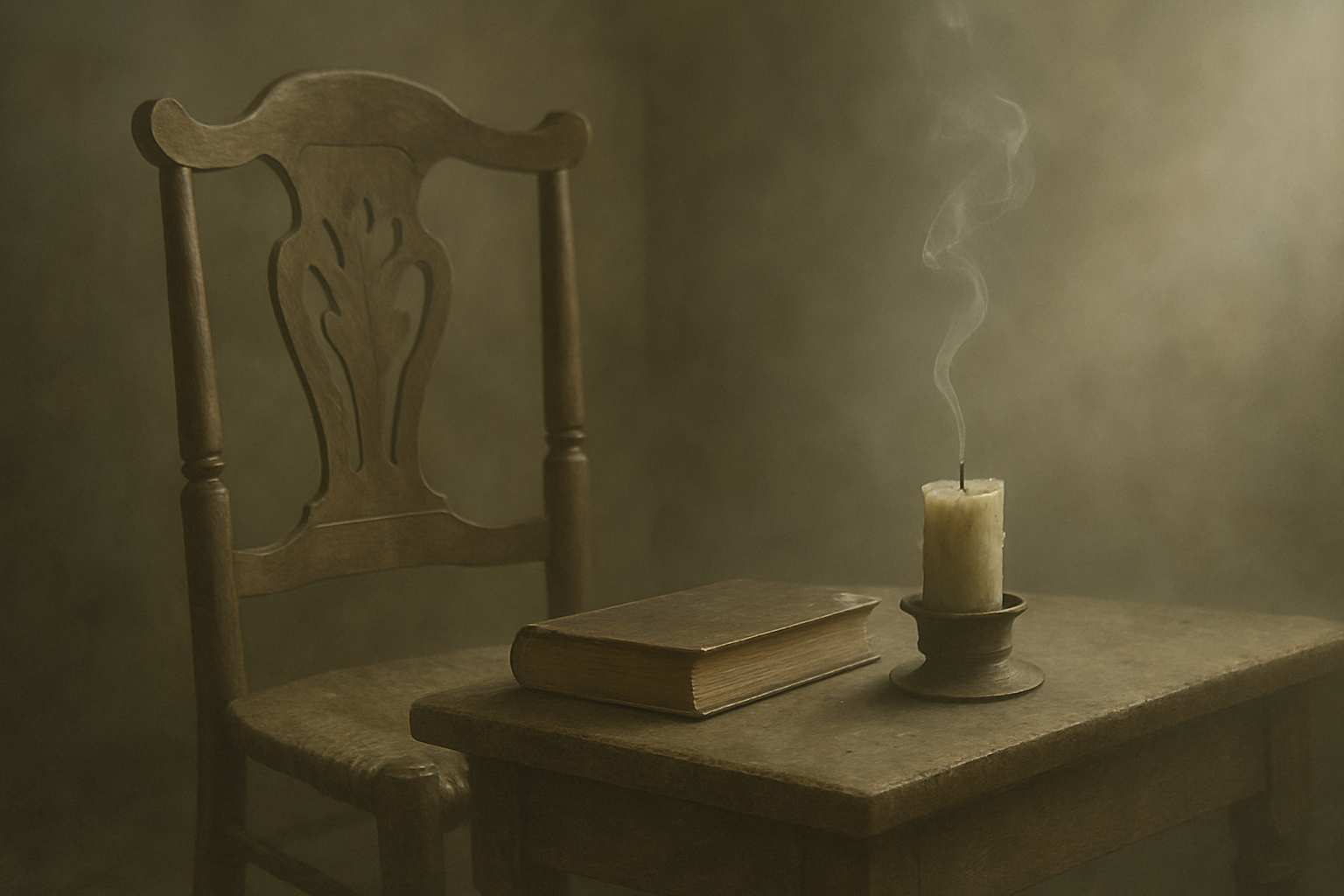
- Frame: Interior still life, close. An empty preacher's chair or a closed book, beside a just-extinguished candle trailing a thread of smoke. Deliberately hazed and desaturated to mark it as legend being told.
- Camera: Locked; only the smoke moves.
- Palette: Parchment cream + candlelight amber, desaturated and hazed.
- Image: New generation needed. Prompt: Photorealistic cinematic concept art, no people, no human figures. A still life marking a legend: an empty carved wooden chair beside a closed leather book and a just-extinguished candle trailing a single thin thread of smoke, in soft haze and desaturated light. Muted, faded palette: parchment cream, dim amber, gray. Dreamlike, uncertain, documentary realism, no modern objects.
- Caption quote: "…'more truth and light yet to break forth out of his holy Word.'"
- ⚠️ Honesty note: The caption must state on-screen: its only source is Winslow's recollection 26 years later (1646), who concedes it was "or to the same purpose," not verbatim. Use haze/desaturation to visually separate it from the record; never stage it as fact.
Act Two — The Crossing (5 shots)
autumn 1620, ~66 days · the Atlantic
A2-S1 · A Ship Built for Cargo
- Frame: Exterior, wide establishing. A 17th-century English square-rigged merchant ship on gray-green water, three masts, high stern castle, furled or reefed sails, alone on a vast sea.
- Camera: Very slow aerial orbit, stressing the ship's smallness.
- Palette: Naval ink-blue + winter gray-white.
- Image: Reuse
ship-at-anchor(or new-generate a same-style underway version if motion is wanted). - Narration: "The Mayflower was a merchant ship, not a passenger vessel."
- ⚠️ Honesty note: The square-rigger is good downwind, poor upwind — plant that fact for the later "could not turn south"; do not shoot a heroic ship cleaving the waves.
A2-S2 · The Windowless Belly
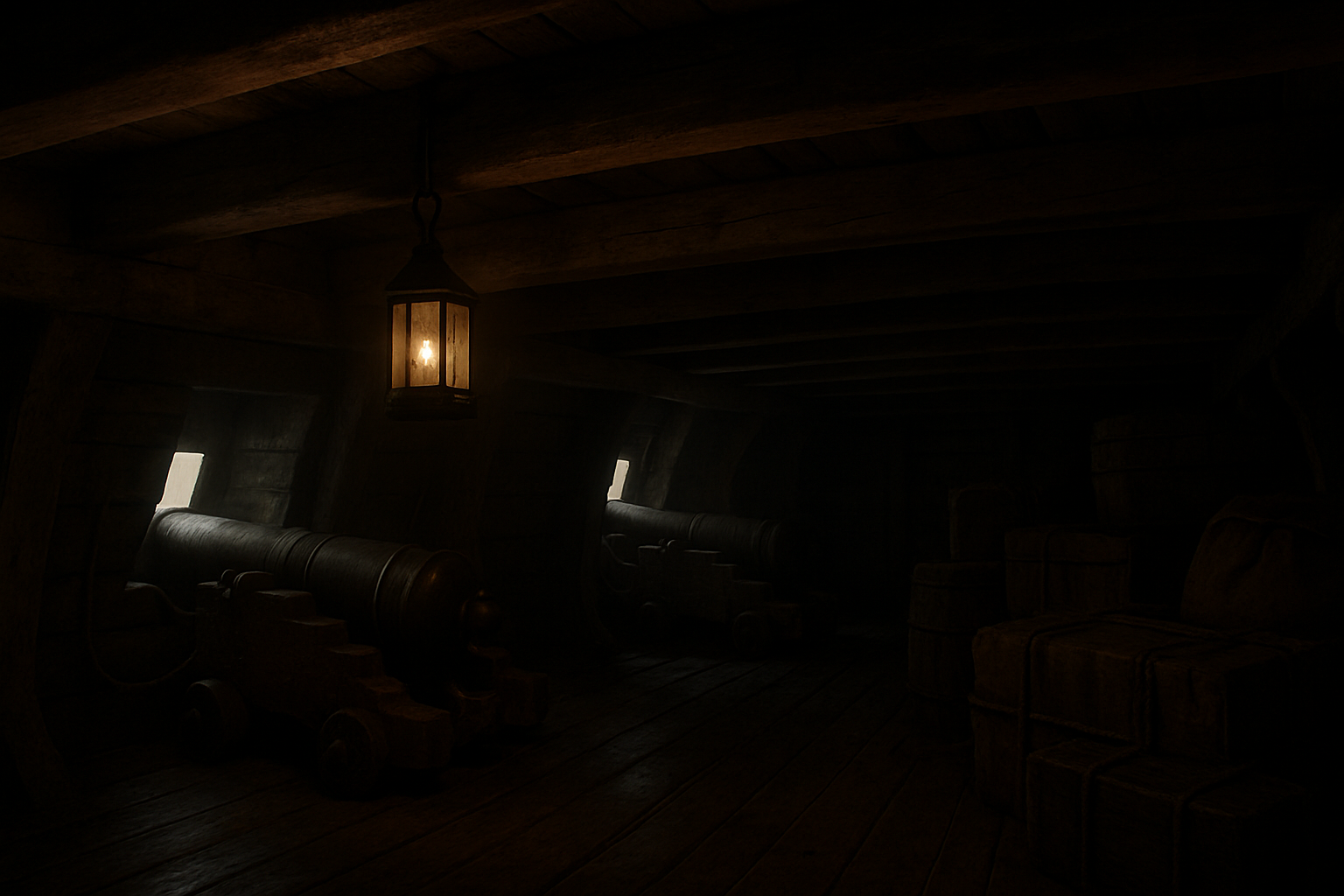
- Frame: Interior, medium. The gun deck below main deck: about five feet of headroom (an adult cannot stand straight), windowless, cramped and damp, beams pressing low; a single swaying lantern the only light, one chink of cold daylight. Empty, or only unreadable stacked baggage in the dark.
- Camera: Slight handheld (ship's roll), slow push-in.
- Palette: A point of candlelight amber against oak brown and black.
- Image: New generation needed. Prompt: Photorealistic cinematic concept art, no people, no human figures. Interior of the cramped windowless gun deck below the main deck of a 17th-century merchant ship, headroom barely five feet, heavy low oak beams, damp dark planks, a single swaying lantern casting weak light, one thin chink of cold daylight through a gap, stacked baggage in shadow. Claustrophobic, half-dark, damp. Muted palette: candle amber, oak brown, black shadow. Documentary realism, no modern objects.
- Narration: "No windows, headroom of about five feet, no latrines, no private rooms."
- ⚠️ Honesty note: Show the cramp and discomfort, but not a torture-dungeon spectacle; this is ordinary people dully enduring a cargo hold.
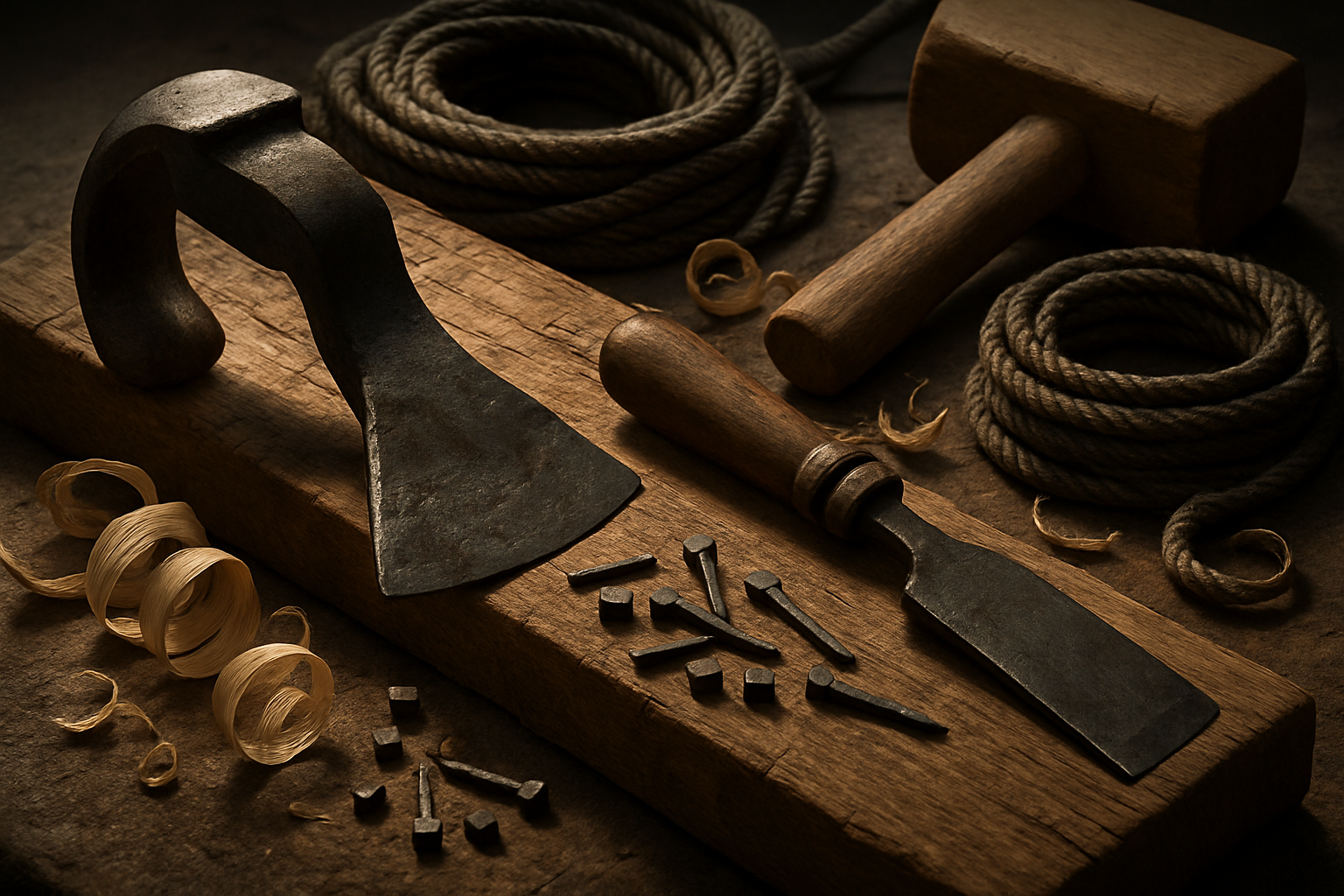
A2-S3 · The Knocked-Down Shallop
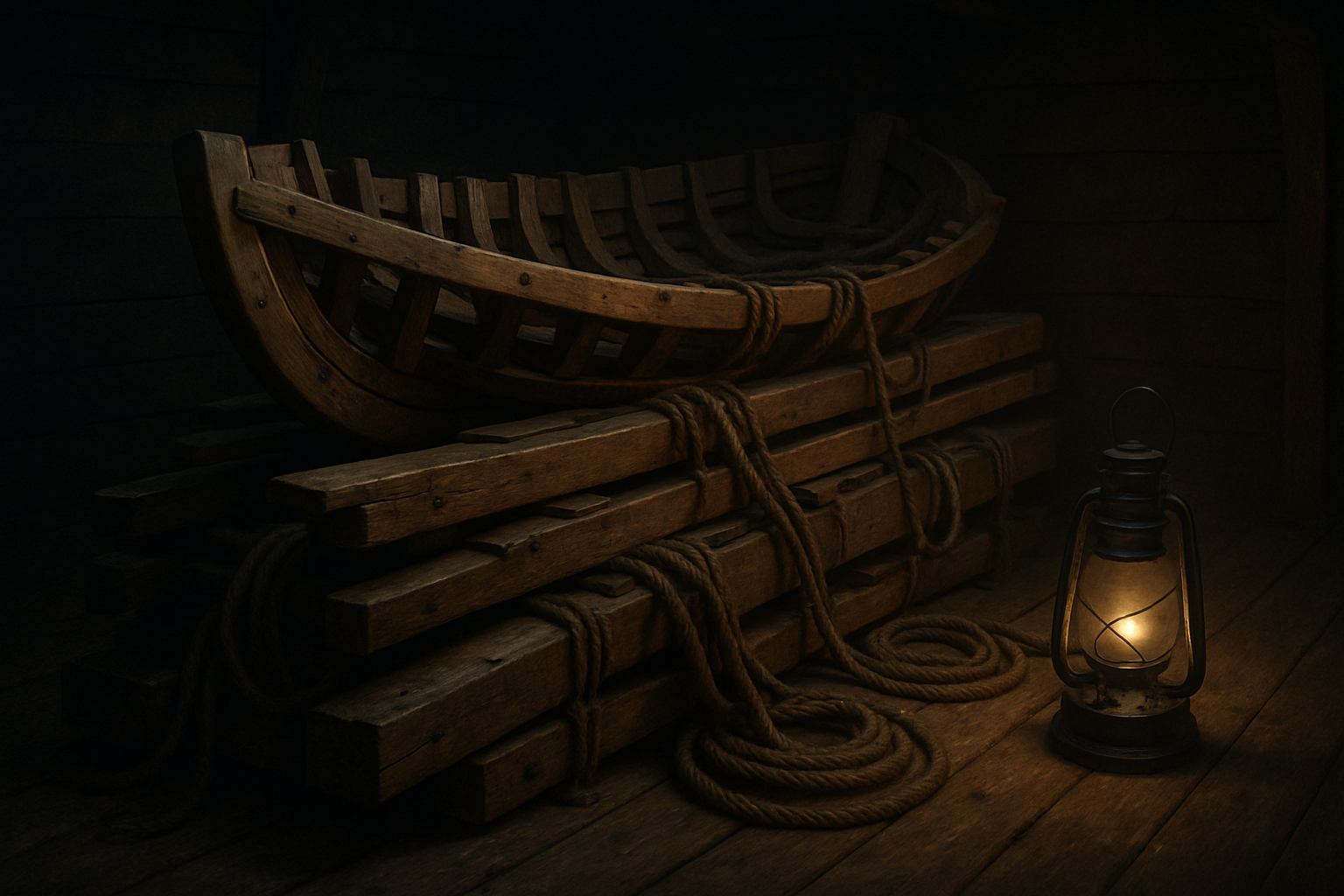
- Frame: Interior still life, close. In the hold, the disassembled parts of a thirty-foot single-masted shallop — timbers, keel, ribs — lashed and stacked, to be rebuilt ashore.
- Camera: Locked, slow pan across the timber.
- Palette: Oak brown & hemp beige.
- Image: Reuse the object texture of
shipwright-toolsas reference; a dedicated new generation is recommended. Prompt: Photorealistic cinematic concept art, no people, no human figures. Still life in a dark ship's hold: the disassembled timbers, keel and ribs of a small 30-foot boat lashed together and stacked, tarred ropes, wood grain and forge-marked nails, lit by a single lantern. Muted palette: oak brown, hemp beige, iron gray, deep shadow. Tactile, documentary realism, no modern objects. - Narration: "…it was that boat which later scouted the coast and chose the site."
- ⚠️ Honesty note: Pure object shot, no dispute; keep the honest materials (English oak, square nails, tarred hemp).
A2-S4 · The Storm, Lying Ahull
- Frame: Exterior, wide. Iron gray-green North Atlantic swells; the ship with all sail struck, drifting beam-on (lying ahull), a dark silhouette swallowed by the sea. Foreground: heaving water and wind-torn spray.
- Camera: High aerial push-down, or a locked long take of the ship buried and rising.
- Palette: Iron gray, deep sea-green, cold white foam (naval ink-blue + winter gray-white).
- Image: Reuse
storm-at-sea. - Narration: "…strike all sail and let the ship drift beam-on to the waves… trusting the hull and the sea."
- ⚠️ Honesty note: The climax is endurance, not heroic helming — no valiant close-up at the wheel; "almost nothing to do but wait it out."
A2-S5 · One Death, One Birth
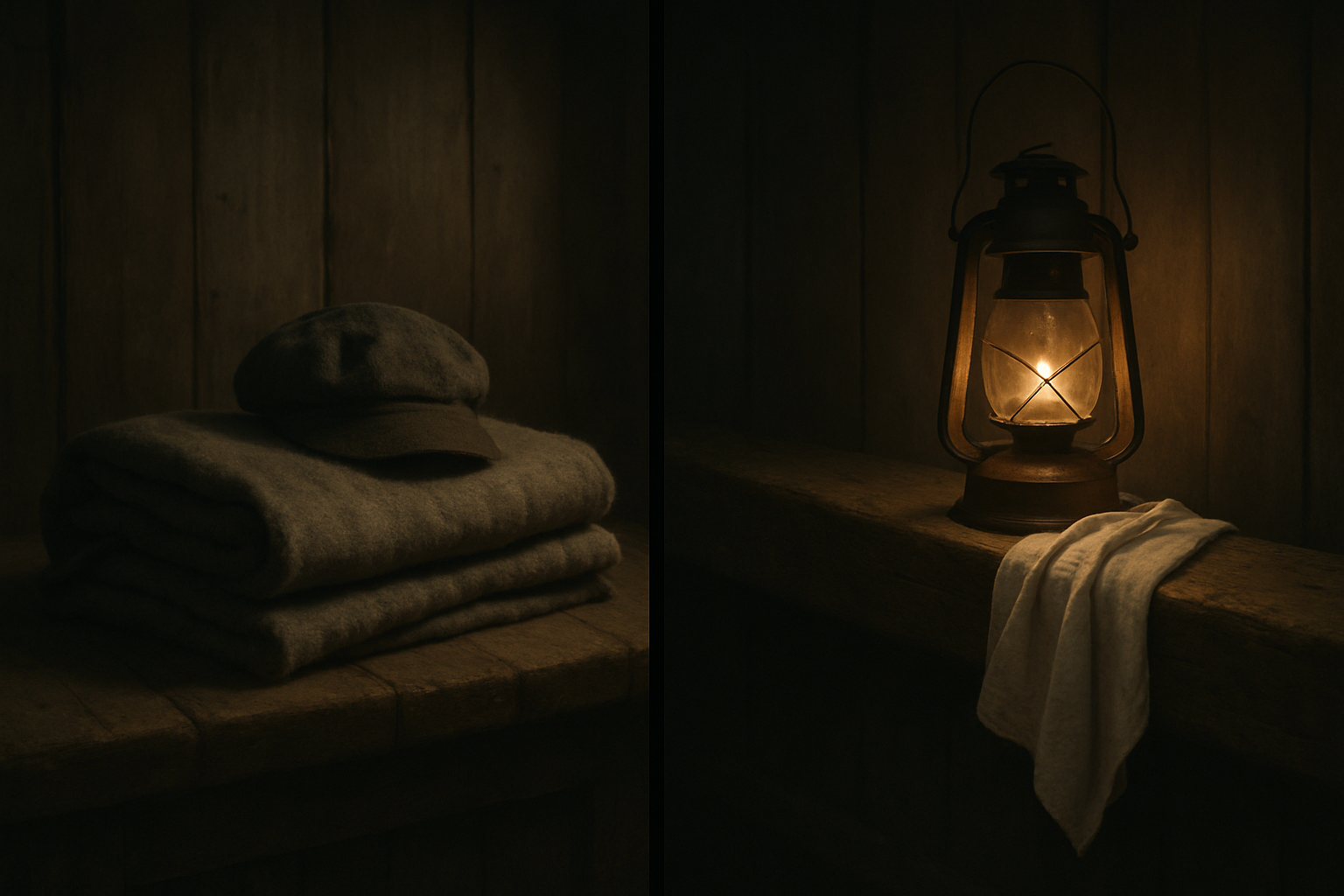
- Frame: Interior still life, close diptych. Left: a folded old blanket and an empty cap (a hint of the dead, William Butten); right: a clean swaddling cloth over a ship's timber (a hint of the infant, Oceanus). Objects only, no people.
- Camera: Locked; the two frames dissolve one into the other.
- Palette: Parchment cream and candlelight amber, cold shadow at the edges.
- Image: New generation needed. Prompt: Photorealistic cinematic concept art, no people, no human figures. A quiet diptych still life inside a dim ship's cabin: on one side a folded worn wool blanket with an empty cap; on the other a clean white swaddling cloth laid over a wooden beam, lit by a single lantern. Tender, solemn. Muted palette: parchment cream, candle amber, cold gray shadow. Documentary realism, no modern objects.
- Narration: "A passenger died at sea; a baby was born at sea, named Oceanus — 'of the ocean.' One death, one birth."
- ⚠️ Honesty note: If numbers appear, note that 101/102 and 65/66/67 differ by "when you close the books," not by contradiction; follow the museum's 102 people, ~66 days.
Act Three — The Compact in the Cabin (5 shots)
11 Nov 1620 (O.S.) · Provincetown Harbor
A3-S1 · Landed in the Wrong Place
- Frame: Exterior, wide. The low dunes, sand spit, shallows and morning mist of Cape Cod's tip; the ship at anchor. The geography is Cape Cod — not the Hudson of the patent.
- Camera: Slow aerial lateral drift across the spit.
- Palette: Silver-blue into ink-blue at dawn, restrained, no triumphant gold.
- Image: Reuse
harbor-dawn. - Narration: "The ship arrived — but in the wrong place. Their patent was worthless here."
- ⚠️ Honesty note: This is the geography of a legal ground falling away; not the joy of arriving at a Promised Land.
A3-S2 · "None Had Power to Command Them"
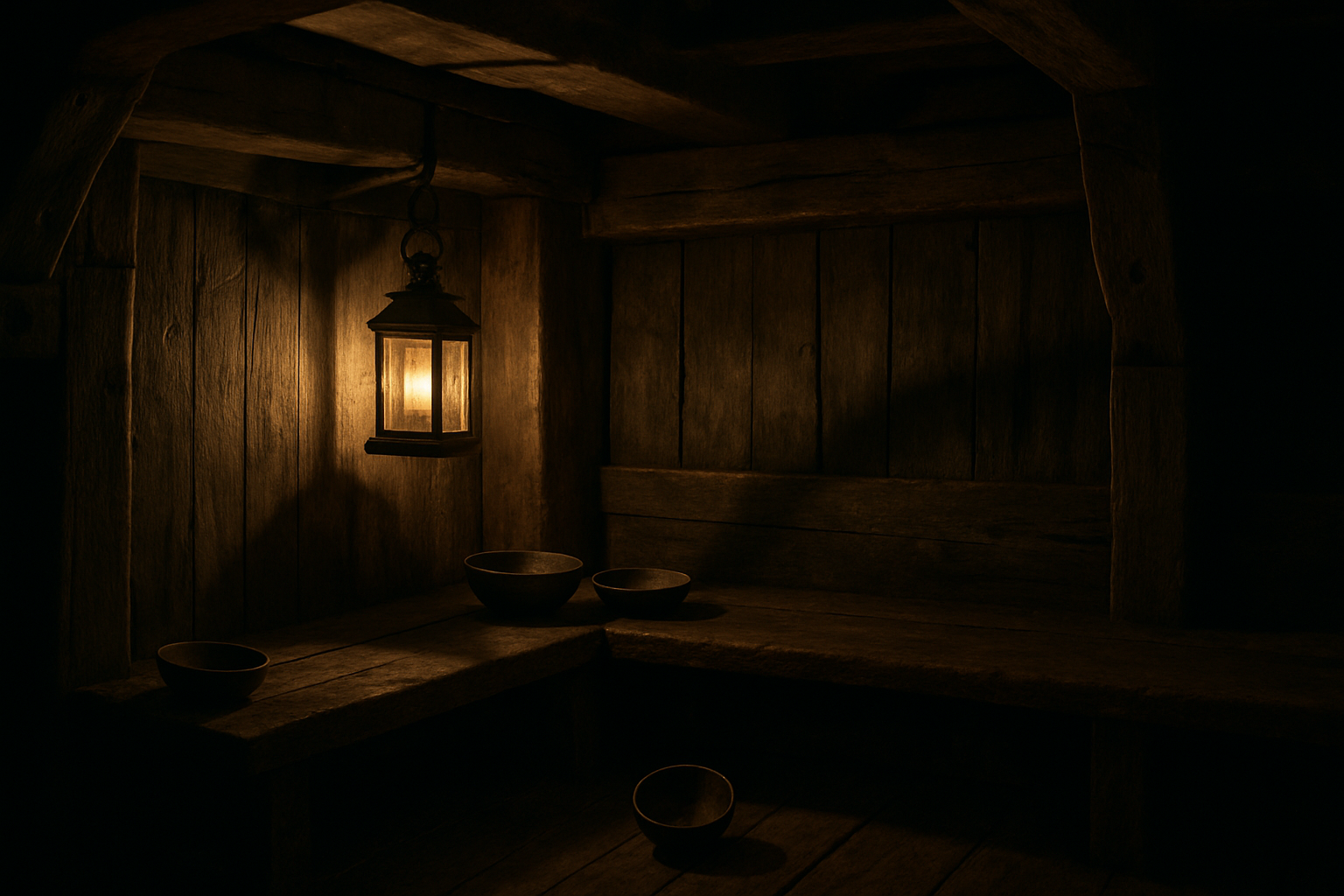
- Frame: Interior, medium. A dim corner of the cabin: an empty bench, scattered wooden bowls, a lantern's shadow swinging on the wall — tension carried by the space, not faces. The quote rises as a caption.
- Camera: Slow push-in to the swinging shadow.
- Palette: Oak brown and black shadow, a point of candlelight amber.
- Image: New generation needed. Prompt: Photorealistic cinematic concept art, no people, no human figures. A tense dim corner of a 17th-century ship's cabin: an empty wooden bench, scattered wooden bowls, a single lantern throwing a swinging shadow on rough plank walls, heavy beams. Uneasy, charged emptiness. Muted palette: oak brown, black shadow, faint candle amber. Chiaroscuro, documentary realism, no modern objects.
- Caption quote: "…for none had power to command them."
- ⚠️ Honesty note: From Bradford: the Strangers (the majority) making a cool legal argument, not villains' lines; do not demonize them.
A3-S3 · Signing, One by One
- Frame: Interior still life, close. Under candlelight, parchment with faint iron-gall ink, a goose quill hovering above the page; pewter inkwell, sealing wax. Show a hand about to set the quill, or just the page and quill — no face.
- Camera: Locked slight push, or shallow-focus following the nib.
- Palette: Parchment cream + candlelight amber over oak brown.
- Image: Reuse
cabin-covenant. - Narration: "Forty-one adult men signed, one by one; John Carver first, at once chosen first governor."
- ⚠️ Honesty note: If a hand appears, an adult man's hand only; never imply women, servants, or children signed — that boundary is the next shot's point.
A3-S4 · Two Verbs
- Frame: Interior extreme close-up. On the parchment, the words Covenant and Combine side by side in iron-gall ink (macro drift across the letters).
- Camera: Macro lateral move, Covenant to Combine.
- Palette: Parchment cream, ink black.
- Image: New generation needed. Prompt: Photorealistic cinematic macro concept art, no people, no human figures. Extreme close-up of aged parchment showing two handwritten 17th-century words in dark iron-gall ink side by side, faint fibers of the vellum visible, warm candlelight raking across. Muted palette: parchment cream, ink black, amber highlight. Intimate, textural, documentary realism, no modern objects.
- Caption quote: "Covenant (theological) beside Combine (secular) — a church's grammar turning into a politics."
- ⚠️ Honesty note: Present the "government by consent" motif, but leave room for Track B; do not call it a direct source of the U.S. Constitution (see A3-S5).
A3-S5 · ⚠️ Who Was Left Outside the Door
- Frame: Interior to symbol. The signed document on the table; the camera slowly pulls back and out through the cabin door to an empty gray sea and a shadow of land — the "boundary" made literal as a doorway. No figure beyond the door.
- Camera: Slow pull-back dolly through the doorway.
- Palette: Amber within, winter gray-white and ink-blue without.
- Image: New generation needed. Prompt: Photorealistic cinematic concept art, no people, no human figures. View from inside a candlelit 17th-century ship's cabin looking out through an open doorway to a cold empty gray sea and a low distant shadow of wooded shore at dusk. A signed parchment on a table in the warm foreground, cold light beyond the threshold. Muted palette: candle amber inside, ink-blue and gray-white outside. Contemplative, documentary realism, no modern objects.
- Narration: "'Government by consent' — whose consent? Zero women; no servants; a third were children; and the Wampanoag, here for thousands of years, wholly absent and never consulted."
- Two-track card: Track A: a founding document of self-government (J.Q. Adams, 1802: "the only instance… of that positive, original social compact"). Track B (Bilder et al.): "civil body politic" was the standard legal term for a corporation; before 1776 it was neither named "the Mayflower Compact" nor thought politically important.
- ⚠️ Honesty note: This shot carries Indigenous absence through the door/sea symbol; generate no Wampanoag figure. The consent was real, but the boundary was there from day one. Touching Indigenous subject matter — confirm caption wording with the Wampanoag community, not AI voice.
Act Four — The First Winter (5 shots)
Dec 1620 – Mar 1621 · Patuxet → Plymouth
A4-S1 · Already-Cleared Fields
- Frame: Exterior, wide. Beside the winter shore, a stretch of cleared but peopleless old fields, furrows faint under frost, Town Brook and bare woods alongside.
- Camera: Slow aerial push across the furrows.
- Palette: Winter gray-white leads; autumn rust in dead grass.
- Image: New generation needed. Prompt: Photorealistic cinematic concept art, no people, no human figures. A wide winter coastal landscape: a stretch of already-cleared old planting fields, faint frozen furrows under frost, a spring-fed brook running past, bare leafless woods and a strip of cold gray sea beyond. Still, heavy silence of a place that was lived in, not empty wilderness. Muted palette: winter gray-white, autumn rust dead grass, ink-blue water. Elegiac, documentary realism, no buildings, no modern objects.
- Narration: "Why fields ready-made but no people? Because there had been a village here, called Patuxet."
- ⚠️ Honesty note: This land was Patuxet; the mood is "a place that was lived in," never the myth of God-given empty wilderness. No Indigenous figure or object; the thread pays off in Acts Five and Eight. Confirm wording with the Wampanoag community.
A4-S2 · One of Every Two
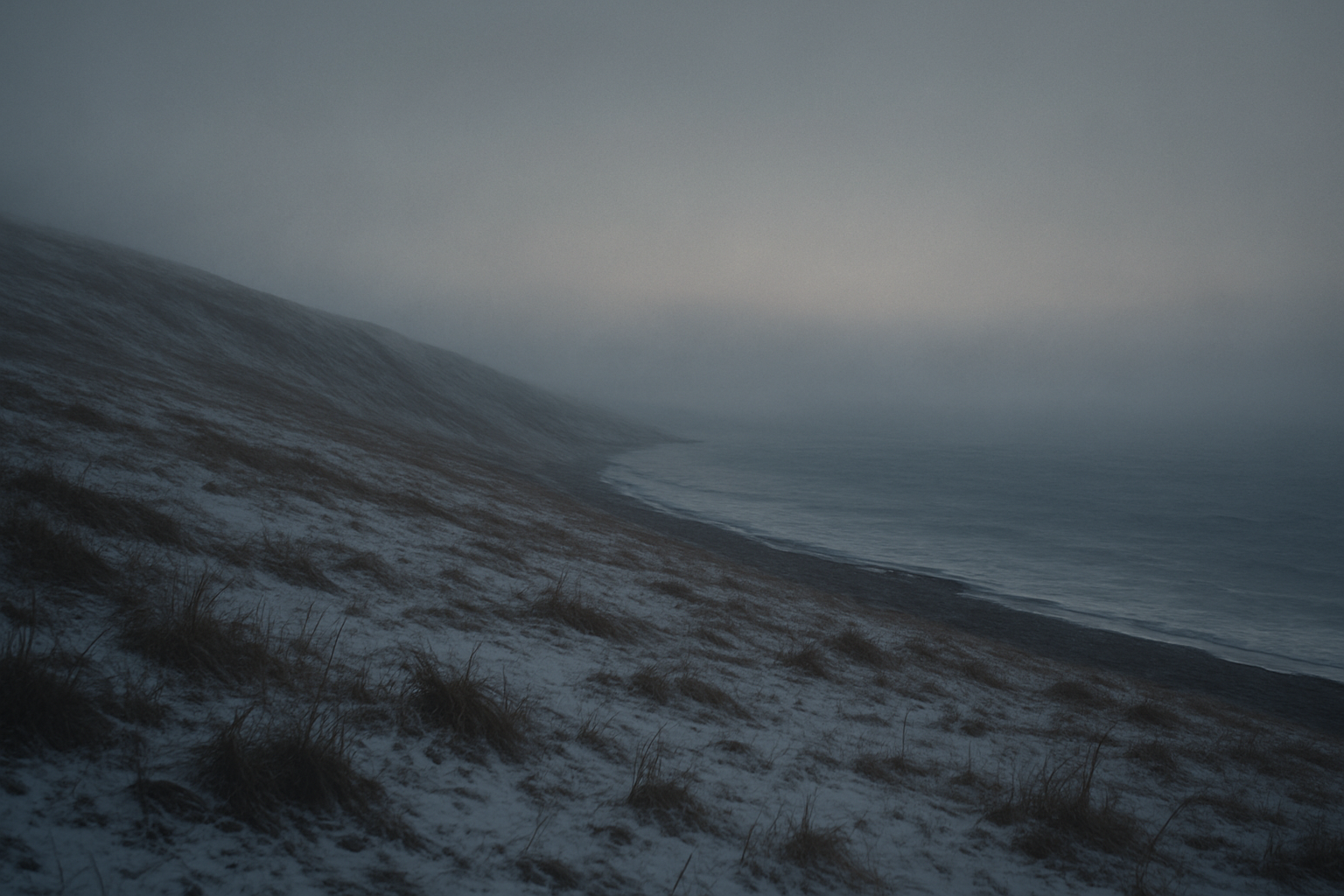
- Frame: Exterior, wide empty shot. The slope of Cole's Hill by the shore, thin snow, cold fog, faded light; no grave spectacle — just a silent winter slope.
- Camera: Locked long take, a very slow push through fog.
- Palette: Winter gray-white, near-monochrome.
- Image: New generation needed. Prompt: Photorealistic cinematic concept art, no people, no human figures. A bleak low coastal hill slope under thin snow and cold fog at dawn, faded gray light, a strip of icy sea below, bare grass showing through snow. Utterly still and silent, no graves visible, no markers. Muted near-monochrome palette: winter gray-white, faint ink-blue. Somber, restrained, documentary realism, no modern objects.
- Narration: "Of the 102, only about fifty were left alive. Of every two people, one did not survive."
- ⚠️ Honesty note: The dying is documented (Bradford: 44 deaths); carry it with emptiness, cold, stillness — no bones spectacle.
A4-S3 · The Reason Not to Scatter (empty hearth)
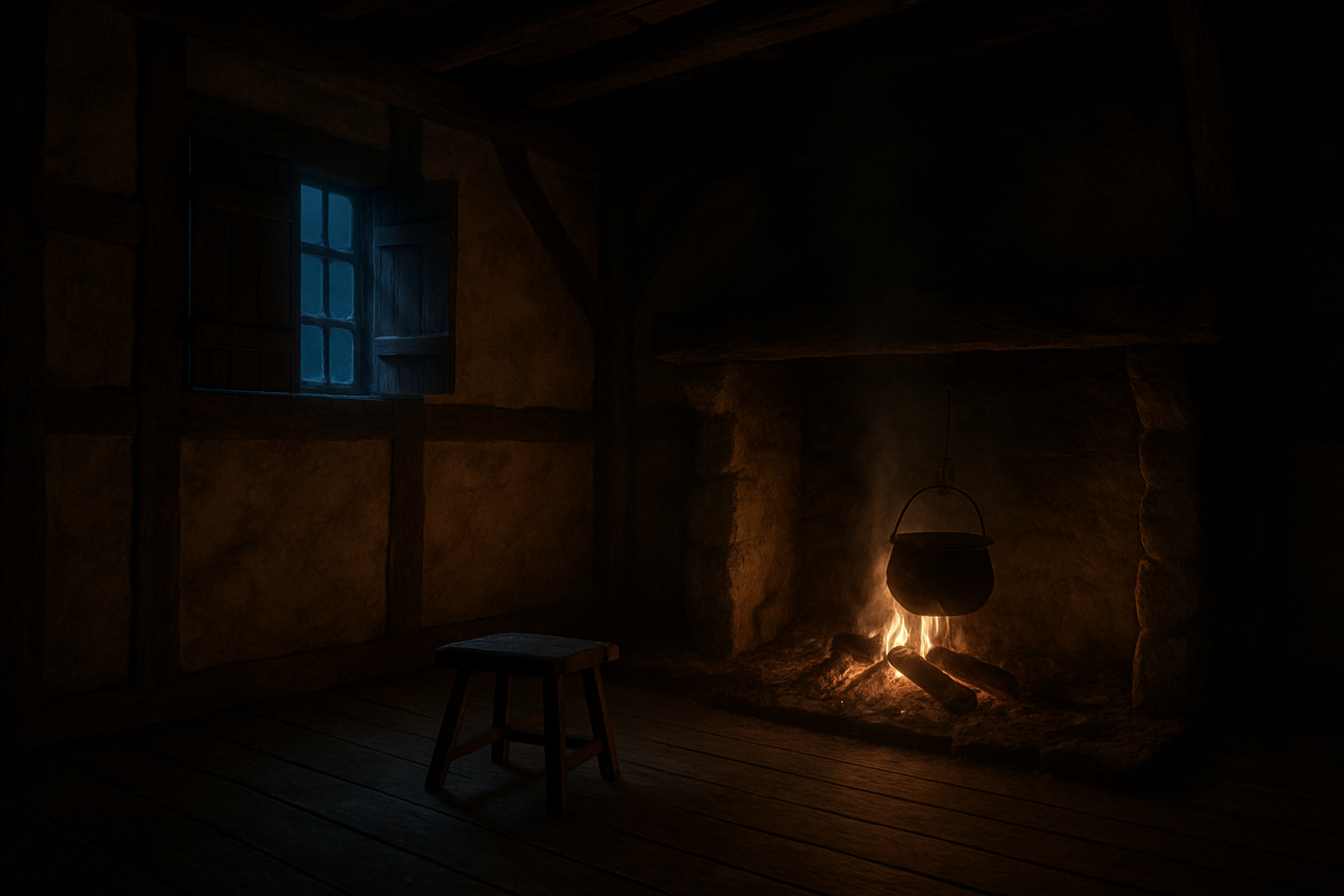
- Frame: Interior empty shot. A timber-and-daub house, a low fire in a stone-and-clay hearth, cold moonlight through a shut shutter; an iron pot, a wooden stool. No one.
- Camera: Locked; only firelight flickers.
- Palette: Ember amber against blue-gray cold.
- Image: Reuse
winter-hearth. - Narration: "Now the compact was the only reason a band of dying people did not scatter."
- ⚠️ Honesty note: The warmth is lonely, not cozy; a village crossed in ten minutes, where "you cannot be anonymous."
A4-S4 · ⚠️ The Graves in the Night
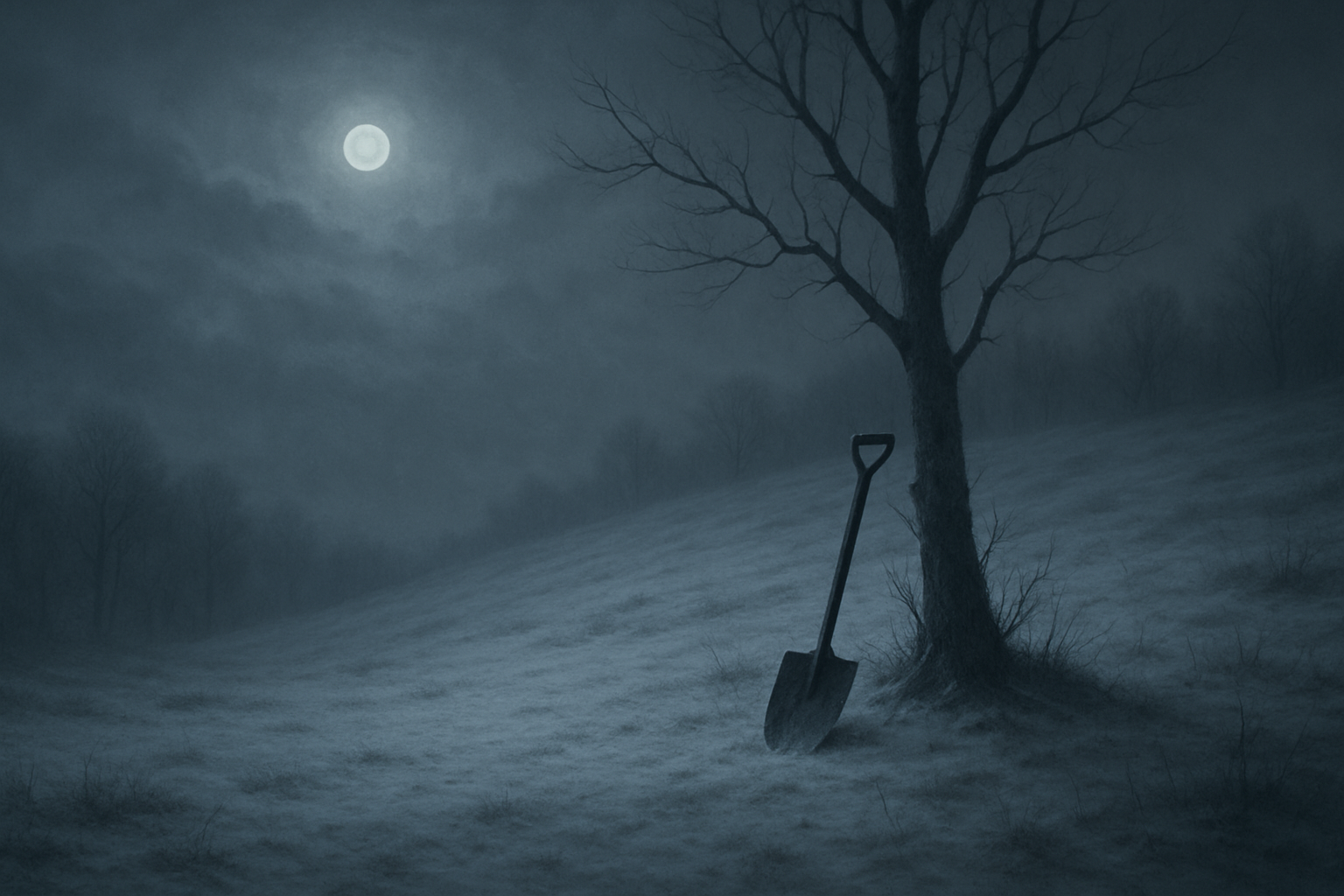
- Frame: Exterior night, symbolic empty shot. A moonlit winter slope, deliberately hazed and desaturated (marked as legend); an iron spade leaning on a tree, the ground level and unmarked.
- Camera: Locked; cloud shadow drifting over cold moonlight.
- Palette: Winter gray-white + cold blue moonlight, desaturated and hazed.
- Image: New generation needed. Prompt: Photorealistic cinematic concept art, no people, no human figures. A moonlit winter hillside at night in deliberate haze and desaturation to signal a legend, an iron spade leaning against a bare tree, level unmarked ground under thin snow, cold drifting cloud shadow. Dreamlike, uncertain. Muted palette: winter gray-white, cold blue moonlight. Documentary realism, no graves shown, no modern objects.
- Narration: "Secret night burials with levelled graves — a tradition that took shape only in the 18th–19th centuries, with no support in the primary record."
- ⚠️ Honesty note: The most cinematic detail is the one without evidence; mark it as legend by haze/desaturation, state the primary silence in the caption, never stage it as fact.
A4-S5 · ⚠️ The Most Famous Stone
- Frame: Exterior still life. An ordinary granite boulder by the shore, unmarked in cold light; deliberately plain framing, none of a monument's low heroic angle.
- Camera: Locked eye-level, or a very slow pan across the stone.
- Palette: Winter gray-white and ink-blue; the stone's brown-gray.
- Image: New generation needed. Prompt: Photorealistic cinematic concept art, no people, no human figures. An ordinary weathered granite boulder on a cold gray shoreline, plain flat framing at eye level, no carving or markings on it, overcast light, gray sea behind. Deliberately unmonumental and understated. Muted palette: winter gray-white, ink-blue sea, gray-brown stone. Documentary realism, no modern objects.
- Narration: "Neither primary source mentions any landing rock. The '1620' on its face was carved only in 1880."
- ⚠️ Honesty note: Do not shoot the rock as a landing relic; it is a specimen of how symbols are manufactured — the famous stone has almost no evidence, the important document has a text. No "1620" in frame, no staged stepping-ashore.
Act Five — Tisquantum and the Alliance of 1621 (4 shots)
spring 1621 · Plymouth & Pokanoket
Act-wide line. The two real Indigenous protagonists (Tisquantum / Ousamequin) and the Wampanoag are never given figure shots. Everything below is carried by environment, objects, title cards, and third-person narration, and every shot must be co-created with the Wampanoag community, not AI-generated.
A5-S1 · Spring on the Ruins
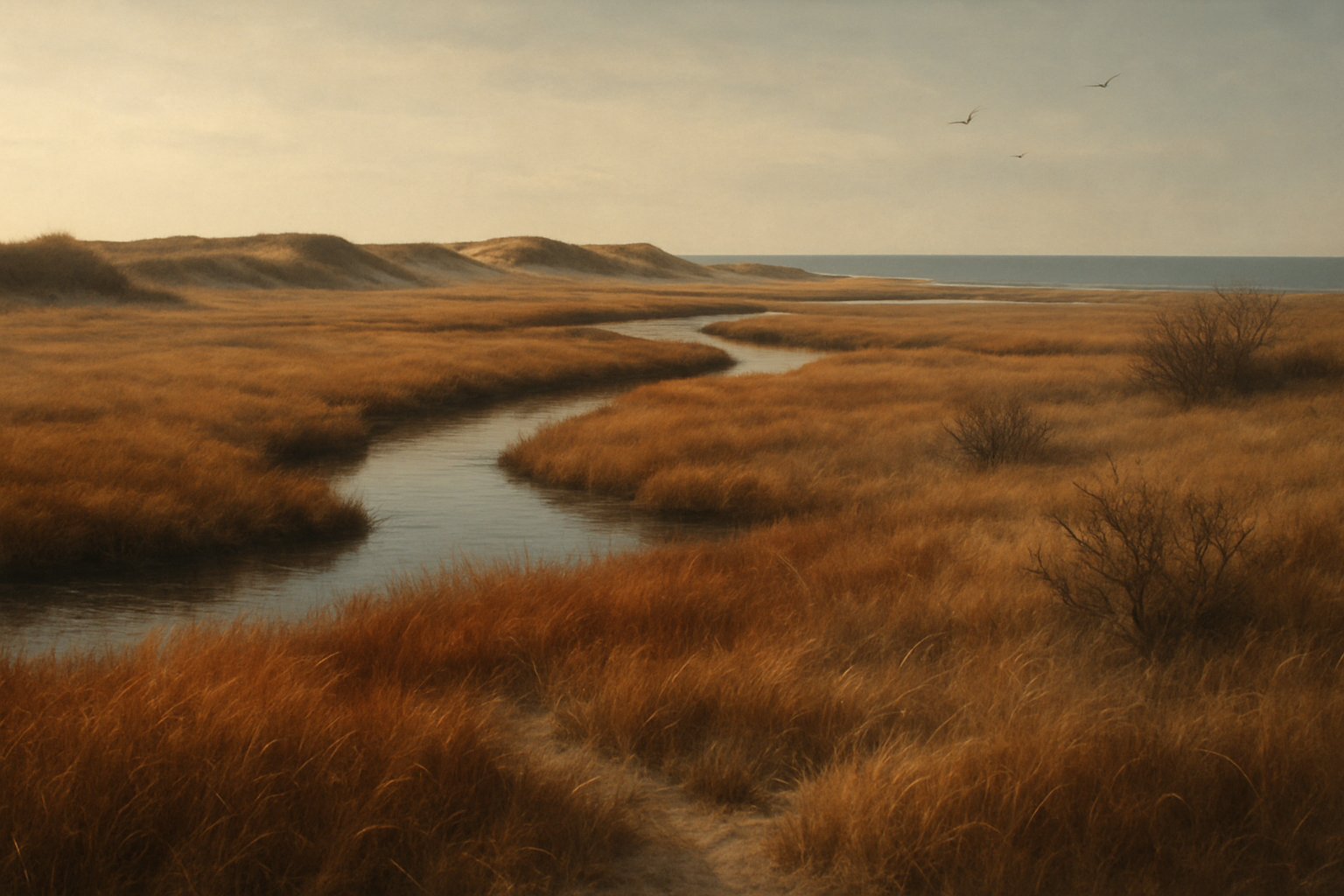
- Frame: Exterior, wide. Early-spring wetland and shore around the site of Patuxet: last year's grass edged with new green, a tidal creek, a line of gray sea, wind bending the grass. Landscape only — no people, no Indigenous objects.
- Camera: Slow aerial glide, wide and elegiac.
- Palette: Autumn rust into early-spring gray-green, ink-blue sea.
- Image: Reuse
autumn-saltmarsh(or a same-constraint early-spring version). - Narration: "In March 1621, a Native man who spoke English walked into the English camp."
- ⚠️ Honesty note: Do not depict Tisquantum; carry it through the land he returned to, emptied by the Great Dying. The landscape holds "a place that was lived in," not empty wild. Co-create with the Wampanoag community.
A5-S2 · The Málaga Deed
- Frame: Interior still life, close. An old 1614 Spanish deed (a symbolic object, not a reproduction of the real document), sealing wax, faded ink, an archival tag; empty shadow beside it. Document object only, no people.
- Camera: Locked slight push, shallow focus across the ink.
- Palette: Parchment cream, ink black, cold shadow.
- Image: New generation needed. Prompt: Photorealistic cinematic concept art, no people, no human figures. A somber still life of an early-17th-century Spanish legal deed on aged paper, faded brown ink, a red wax seal, an archival label at the corner, lit coldly from one side against deep shadow. Grave, documentary mood, no readable specific text. Muted palette: parchment cream, ink black, cold gray. Documentary realism, no modern objects.
- Narration: "He spoke English because in 1614 Thomas Hunt seized him and shipped him to Málaga to be sold. In 2024, researchers found a deed dated 22 October 1614 in the Málaga archive."
- ⚠️ Honesty note: This is trauma, not legend; grave and restrained. Never render kidnapping and enslavement as exotic adventure or lucky fate.
A5-S3 · Six Articles, No "Friendship"
- Frame: Interior still life, close. An English-written agreement lies open (an English copy only — symbolizing "recorded by one side"), six clauses as short dashes; a quill beside it. No negotiation scene, no figures.
- Camera: Locked, slow tilt down the six clauses.
- Palette: Parchment cream + candlelight amber.
- Image: Reuse the still-life language of
cabin-covenant; a new generation is recommended. Prompt: Photorealistic cinematic concept art, no people, no human figures. A still life of an open English-written 17th-century agreement on parchment, six short clause lines faintly visible in iron-gall ink, a goose quill resting beside it, warm candlelight and heavy shadow. Grave, spare. Muted palette: parchment cream, candle amber, ink black. Documentary realism, no modern objects. - Two-track card: Track A: out of goodwill, "the first peace treaty on American soil," holding 50+ years. Track B (Silverman 2019 / Nanepashemet): a defensive geopolitical move initiated by the Wampanoag to counter the Narragansett after the epidemic; "not because he was innately friendly." No original survives; every word comes from English works, and no evidence confirms the six articles were rendered accurately.
- ⚠️ Honesty note: Alliance, not friendship — neither frame nor card may imply affection at first sight; from the start a sizable number of Wampanoag opposed it. Confirm wording with the Wampanoag community.
A5-S4 · ⚠️ Even "the Survivor" Resists Simplification
- Frame: Interior symbol, close. A small balance scale (or two empty bowls), an English document on one pan and a blank on the other — the asymmetry of "charges from English texts, no independent Wampanoag record." Deliberately hazed.
- Camera: Locked; the scale sways faintly, then stills.
- Palette: Parchment cream and cold gray, desaturated.
- Image: New generation needed. Prompt: Photorealistic cinematic concept art, no people, no human figures. A symbolic still life in soft haze: a small old brass balance scale on a wooden table, an aged folded document on one pan, the other pan empty, cold side light, deep shadow. Quiet, contemplative, signalling uncertainty. Muted desaturated palette: parchment cream, cold gray, ink black. Documentary realism, no modern objects.
- Narration: "By English accounts, around 1622 Tisquantum intrigued to supplant Ousamequin — but these charges all come from English texts, both sides had motive against him, and there is no independent Wampanoag record. That it was recorded is certain; that it happened as recorded is not."
- ⚠️ Honesty note: Depict neither man; use the scale/blank for evidentiary asymmetry. The "fish-fertilizer" detail is doubtful — neither affirmed nor denied, not staged as fact. Co-create with the Wampanoag community.
Act Six — The Harvest and the "First Thanksgiving" (4 shots)
autumn 1621 · Plymouth
Act-wide line. The ~90 Wampanoag (Pokanoket) men present are given no figure shots; the feast is carried by objects, empty scenes, title cards. Indigenous elements must be co-created with the Wampanoag community, not AI-generated.
A6-S1 · The First Real Harvest
- Frame: Exterior still life, medium-close. On a long wooden table, the autumn harvest: corn, squash, wild fowl (feathered game), fish, coarse earthenware and treen; empty benches beside it, rust-gold woods behind. No people.
- Camera: Slow lateral dolly along the table.
- Palette: Autumn rust and candlelight amber, oak-brown table.
- Image: New generation needed. Prompt: Photorealistic cinematic concept art, no people, no human figures. A long rough wooden table outdoors in autumn laden with a 17th-century harvest: corn cobs, squashes, wild fowl, fish, coarse earthenware and wooden bowls, empty benches beside it, rust-and-gold autumn woods behind, soft overcast light. Warm, abundant yet restrained. Muted palette: autumn rust, candle amber, oak brown. Documentary realism, no modern objects, no people.
- Narration: "In autumn 1621 there was indeed a three-day harvest celebration; the English and ~90 Wampanoag men were present. This is the core fact, verified."
- ⚠️ Honesty note: No Indigenous cultural object as table dressing; the real feast needs no myth. The ~90 Wampanoag present are stated in caption, not shown as figures.
A6-S2 · ⚠️ Myth and Record
- Frame: Interior symbol, close. Left: an old 1841 annotated book page that first wrote "the first Thanksgiving" (the label's origin); right: 19th-century imagery (a turkey silhouette, pumpkin pie), hazed as later myth.
- Camera: Locked; the two halves slowly cross-dissolve.
- Palette: Parchment cream (record) against desaturated warm (myth).
- Image: New generation needed. Prompt: Photorealistic cinematic concept art, no people, no human figures. A split symbolic still life: on one side an aged 1841 printed book page with faint annotation; on the other, in deliberate haze and desaturation, 19th-century holiday imagery — a turkey silhouette and a pumpkin pie — signalling later myth. Muted palette: parchment cream on the factual side, faded warm tones on the myth side. Documentary realism, no modern objects, no people.
- Two-track card: Track A: the 1621 "First Thanksgiving," symbol of friendship. Track B: it was not then called a "thanksgiving"; the label is Alexander Young's, 1841; the first true "thanksgiving" in the sources is summer 1623 after rain broke a drought; turkey and pumpkin pie are largely 19th–20th-century additions; Lincoln, 1863, made it a national holiday.
- ⚠️ Honesty note: Myth elements must be visually layered (haze/desaturation) as legend being told, never given the record's visual weight.
A6-S3 · An Honest Silence
- Frame: Exterior empty scene, wide. Open ground and tree line beyond the feast, morning light; a wisp of dispersing musket smoke hanging in cold air (symbol of "came at the sound of gunfire"). No people.
- Camera: Locked; the smoke drifts very slowly.
- Palette: Winter gray-white into autumn rust, gun-smoke blue-gray.
- Image: New generation needed. Prompt: Photorealistic cinematic concept art, no people, no human figures. A wide empty clearing at a rust-gold autumn wood's edge at morning, a single thin wisp of pale musket smoke hanging and dispersing in cold still air, soft light. Quiet, ambiguous, restrained. Muted palette: winter gray-white, autumn rust, blue-gray smoke. Documentary realism, no modern objects, no people.
- Caption: "Were the Wampanoag 'invited'? The sources do not say. The Smithsonian notes they came to investigate after hearing gunfire, and were then included. Both 'invited' and 'came at the sound of gunfire' are inferences."
- ⚠️ Honesty note: A gap in the record; both readings stand, the frame decides neither; use smoke as symbol, not staged action. Confirm with the Wampanoag community.
A6-S4 · Another Voice on the Same Hill
- Frame: Exterior, medium. A close view of the 1998 bronze plaque on today's Cole's Hill (National Day of Mourning), cold gray light; the Plymouth slope around it. Plaque and setting only, no figures.
- Camera: Slow push-in to the plaque's inscription.
- Palette: Winter gray-white and bronze verdigris.
- Image: New generation needed. Prompt: Photorealistic cinematic concept art, no people, no human figures. A weathered bronze memorial plaque with green patina set on a stone on a low grassy coastal hill under cold overcast light, a strip of gray sea beyond, no readable specific text. Solemn, contemporary yet timeless. Muted palette: winter gray-white, bronze verdigris, cold slate. Documentary realism, no modern objects except the plaque, no people.
- Narration: "Since 1970, on Thanksgiving noon, Native people gather on Cole's Hill for the National Day of Mourning. In 1998 the town set a plaque: for many, Thanksgiving is 'a reminder of the genocide of millions of their people, the theft of their lands, and the relentless assault on their cultures.'"
- ⚠️ Honesty note: This is contemporary Native voice and an officially recognized inscription, quotable as is; on the same ground, thanksgiving and mourning both real, both to be heard. Confirm presentation with the Wampanoag community; do not appropriate.
Act Seven — The Long Arc and the Unfinished (5 shots)
1623–1676 and after · Plymouth & southern New England
A7-S1 · A Documented Personal Trust
- Frame: Interior still life, close. A wooden bowl of corn porridge, a bundle of sassafras root, a cloth — the objects of tending the sick (symbolizing the 1623 record of Winslow walking dozens of miles to feed him). No figures — and above all no depiction of Ousamequin.
- Camera: Locked slight push, shallow focus in candlelight.
- Palette: Candlelight amber and oak brown, a touch of winter gray-white.
- Image: New generation needed. Prompt: Photorealistic cinematic concept art, no people, no human figures. An intimate still life by candlelight: a wooden bowl of pale corn porridge, a bundle of sassafras root, a folded clean cloth on a rough table, warm low light and deep shadow. Tender, grave, quiet. Muted palette: candle amber, oak brown, faint gray. Documentary realism, no modern objects.
- Narration: "In March 1623, Ousamequin lay gravely ill; Winslow walked dozens of miles to tend him with corn porridge and sassafras broth. On recovering: 'Now I see the English are my friends and love me.'"
- ⚠️ Honesty note: The quote is primary-verified (Winslow, Good Newes, 1624). But do not lift it into a warm ending: on the same visit Ousamequin revealed a Massachusett plot that triggered Standish's killings at Wessagusset within weeks — care tied directly to massacre. Depict no Indigenous figure; co-create with the Wampanoag community.
A7-S2 · Self-Government by Mutual Agreement
- Frame: Interior still life, close. A page of Plymouth's 1636 written law code (symbolic), a seal, a row of empty benches at a town-meeting table. No people.
- Camera: Locked, slow pan across the benches and the code.
- Palette: Parchment cream and oak brown.
- Image: Reuse the still-life language of
cabin-covenant; a new generation is recommended. Prompt: Photorealistic cinematic concept art, no people, no human figures. A still life of a 17th-century written law code on a table — an aged bound page, a wax seal, a row of empty wooden benches behind at a plain meeting hall, cool daylight from a small window. Sober, civic, spare. Muted palette: parchment cream, oak brown, cool gray. Documentary realism, no modern objects. - Narration: "Plymouth never obtained a royal charter; it had to generate authority from 'we agree among ourselves.' In 1636 it completed the first written law code in America, with a rudimentary bill of rights — five years before Massachusetts Bay. Here the credit really is Plymouth's."
- ⚠️ Honesty note: Affirm the institutional achievement; but leave room for the next shot's boundary — inward trust, outward exclusion (Quakers in 1658; the Wampanoag outside from 1620).
A7-S3 · ⚠️ What the War Was
- Frame: Exterior, wide empty shot. The embers and broken timbers of a burned settlement, an ash-strewn ground after cold rain; a bare tree line beyond. No combat, no figures, no Indigenous imagery — only the silence of aftermath.
- Camera: Slow aerial push over the ruin.
- Palette: Winter gray-white and ash-black, autumn rust in dying embers.
- Image: New generation needed. Prompt: Photorealistic cinematic concept art, no people, no human figures. A desolate wide aftermath: the smoldering embers and charred broken timbers of a burned 17th-century settlement on ash-strewn ground after cold rain, thin smoke rising, a bare gray tree line beyond, cold overcast light. Grave, still, no combat, no bodies. Muted palette: winter gray-white, ash black, dull ember rust. Documentary realism, no modern objects, no people.
- Two-track card: Track A: a frontier war, colonies securing survival by blood and fire (19th-century accounts cast Metacomet as a treacherous "savage chief"). Track B (each element verified): a war of sovereignty — 55 years of English expansion, colonial courts extending criminal jurisdiction over Native people; the trigger was the John Sassamon case, three Wampanoag men tried by a Plymouth court and hanged on 8 June 1675 — denying Wampanoag sovereignty.
- ⚠️ Honesty note: Metacomet is a real Indigenous person — no figure shot; carry the war through aftermath emptiness, no combat spectacle, no bodies. Co-create card and presentation with the Wampanoag community.
A7-S4 · The Signatory's Son Ended the Alliance
- Frame: Exterior symbol, wide empty shot. The cold shore and woods near Mount Hope, Rhode Island, gray rain-light; a single pike leaning in an empty clearing (an empty pike — never a head, never any figure), symbolic and restrained.
- Camera: Locked long take, wind in grass and rain.
- Palette: Winter gray-white and ink-blue, near-monochrome.
- Image: New generation needed. Prompt: Photorealistic cinematic concept art, no people, no human figures. A bleak wide empty shot of a cold New England shoreline and bare woods under gray rain, a single wooden pike or stake leaning alone in an empty clearing, wind-bent grass, a strip of iron sea. Somber, elegiac, restrained, nothing mounted on the pike, no bodies. Muted near-monochrome palette: winter gray-white, ink-blue, ash gray. Documentary realism, no modern objects, no people.
- Narration: "On 12 August 1676, Metacomet — Ousamequin's son — was killed near Mount Hope. The son of the man who made the 1621 alliance ended it. His wife and son, with many captives' families, were sold into slavery in the West Indies."
- ⚠️ Honesty note: The record notes his head displayed 20+ years — the film must never render any figure or head; only an empty pike and empty landscape, grave and never lurid. Depict no Indigenous person; co-create with the Wampanoag community.
A7-S5 · The Grammar Survived
- Frame: Interior still life to symbol. The 1691 royal charter folding Plymouth into Massachusetts Bay lies on a table (Plymouth's end); a slow dissolve to a quill and a blank sheet — negative space pointing to Philadelphia 150 years on.
- Camera: Locked slight push, slow dissolve.
- Palette: Parchment cream and candlelight amber, cold shadow to close.
- Image: Reuse
cabin-covenantas a closing echo; a new generation is recommended. Prompt: Photorealistic cinematic concept art, no people, no human figures. A closing still life: an ornate 1691 royal charter with a wax seal on a table, dissolving toward a bare goose quill and a blank sheet of parchment lit by a single candle, deep shadow around. Reflective, valedictory, open-ended. Muted palette: parchment cream, candle amber, cold gray shadow. Documentary realism, no modern objects. - Narration: "In 1691 a royal charter folded Plymouth into Massachusetts Bay. Seventy-one years of self-government rested never on legal grant but on mutual agreement. Yet its grammar survived — resurfacing in Philadelphia a century and a half later. The most honest lesson of the covenant ethic: not an institution that can protect you, but a grammar that can be inherited."
- ⚠️ Honesty note: No triumphant "great American origin" finale; Plymouth's own end was not a victory. Close on negative space; leave the judgment to the viewer.
Coda — Standing Constraints for the Pipeline
- Figure red line: the film generates no Wampanoag / Indigenous figure or cultural object (no wetu, mishoon, regalia). Every Indigenous-touching shot is marked "co-create with the Wampanoag community, not AI-generated." The English side too leans on objects, empty scenes, and symbols, avoiding specific face close-ups; if a hand is unavoidable, keep it partial and faceless.
- Two tracks on disputes: on every ⚠️ shot the frame adjudicates for no one; myth elements are visually layered (haze/desaturation) as legend being told.
- Color discipline: one or two lead colors per frame (the six-color set), the rest muted; avoid modern teals and fluorescents; keep true wear on metal and wood.
- Reusable concept images:
ship-at-anchor(A2-S1),storm-at-sea(A2-S4),cabin-covenant(A3-S3; still-life reference for A5-S3/A7-S2/A7-S5),harbor-dawn(A3-S1),winter-hearth(A4-S3),autumn-saltmarsh(A5-S1),shipwright-tools(A2-S3 reference),gristmill-waterwheel(spare: a Plymouth-economy interstitial). All other shots are "new generation needed," every prompt carrying "no people, no human figures." - One-strike veto: any shot sliding toward the "friendship myth," "empty wilderness," "sacred landing rock," or "cozy Thanksgiving" is void and reshot.