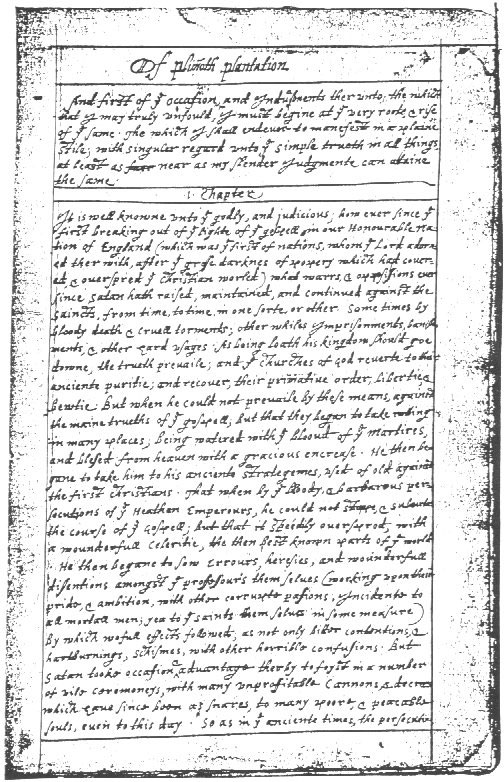
 Public domain
How a Book Survived
The Of Plimoth Plantation Facsimile Launch — An Edited Account
Three notes before you begin
1. This account does not attribute individual sentences to individual speakers. The launch featured several speakers, and the automatic captions this account is based on carry no speaker-separation information — the transcript cannot tell us who said what. Apart from the opening self-introduction, every point of attribution is marked
[speaker unverified].2. This is not a verbatim transcript. The source is automatic speech recognition (ASR): no punctuation, no paragraphing, and proper names almost always wrong. What follows is prose edited out of that raw material. Sentence breaks, paragraphs, and connective tissue are editorial. No sentence here may be quoted as anyone's exact words. To quote, return to the video, listen word by word, and cite a timecode.
3. Proper names have been corrected one by one. A correction table appears in the appendix. Spellings that could not be fully confirmed are marked
[?].
1. Opening: A Book with a Life of Its Own
The launch opens with a speaker who names himself:
"My name is Tom Begley. I am the special project writer at Plimoth Patuxet Museums, coordinator for our publication arm, Plimoth Patuxet Press, and project manager for this exciting book that we'll be discussing tonight."
This is the only attribution in the entire session that can be stated with confidence. Speaking for the Plimoth Patuxet Museums and the State Library of Massachusetts, he introduces this new edition of William Bradford's Of Plimoth Plantation.
A sketch of the author follows. Bradford was born in 1590 and died in 1657, and his life was full of incident. He was a passenger on the Mayflower, which arrived in the Wampanoag homeland in 1620, and he became Plymouth Colony's longest-serving governor — a position that gave him a close view of nearly every major event in the colony's development. The history he wrote records a small group of religious separatists, known to us as the Pilgrims, who left England seeking a religious freedom unavailable to them at home.
In manuscript form, the volume preserves an account of the Mayflower voyage, of relationships with seventeenth-century Indigenous communities, and of the founding of what became the first permanent European colony in New England — governed under the Mayflower Compact.
But the real subject of the evening is not that history. The opening turns almost immediately to something else:
"The Bradford manuscript has an interesting history of its own."
That sentence is the hinge of the whole event. What follows is not what the history was but how we came to know it — how the evidence itself survived.
Going deeper
1. "Plimoth" versus "Plymouth" is not a typo. The museum's name and the manuscript's title preserve the seventeenth-century spelling
Plimoth, while the modern town and colony are writtenPlymouth. Bradford himself wrote Of Plimoth Plantation on the page. ✅ Verified2. This manuscript is the primary source for the covenant chain. From the congregational covenants at Scrooby and Leiden, to the Mayflower Compact of 1620, to Plymouth's annual elections and General Court — the documentary spine of that line, running from religious covenant to local self-governance, is Bradford's manuscript. ✅ Verified
3. The original Mayflower Compact no longer exists. The earliest printed text comes from Mourt's Relation, London, 1622; the page in the manuscript is Bradford's own transcription. No signed original survives. ✅ Verified
2. The Missing Century
The manuscript's travels are the most fully told thread of the evening.
After Bradford's death in 1657 the volume stayed in his family for several generations. The family let historians and clergymen use the text, and those readers documented the colony's early decades. In the eighteenth century the book was collected by Thomas Prince into his New England Library, stored in the steeple of the Old South Meeting House in Boston.
Then, during the American Revolution, the pages disappeared.
"Likely taken by British regulars as they fled the city."
For almost a hundred years, no one knew where the original pages were.
The break came from careful readers. In the mid-1800s, observers noticed what the launch calls "those proverbial breadcrumbs" in a couple of books — citations whose content could only have come from the lost Bradford manuscript. Following that trail, the book was rediscovered in 1855, in the Bishop of London's library at Fulham Palace.
During the Q&A someone asked how the manuscript came to be in England at all. The answer was candid:
"There's not much to really add to it. We know when it disappears and when it leaves. But once it leaves Boston, we don't really know its story of what happened in England, and how it actually ended up in the Bishop of London's library. It's this blank sort of piece, almost a hundred-year period in the book's history, that we just don't really know."
[speaker unverified]
That is a remarkable thing to say at a book launch. An event designed to promote a new publication states plainly that its central artifact has an untraceable gap — and declines to fill it with speculation.
The manuscript returned to Massachusetts and was placed in the care of the State Library in 1897. The launch notes that it was Governor Roger Wolcott who deposited it there.
Going deeper
1. "Breadcrumbs" is a real bibliographic method. When a primary document goes missing, the standard route to finding it is to work backwards through the secondary works that cite it: if an author quotes a passage available nowhere else, that author must have seen the original — and where and when they saw it becomes the lead. The 1855 rediscovery followed exactly this path. ✅ Verified
2. The return was a diplomatic act, not a loan. The 1897 return was completed through formal Anglo-American negotiation, and the manuscript has not left Massachusetts since. The State Library's own chronology records the return and the publication of a complete facsimile under the same year — a detail that returns in Section 8. ⚠️ Disputed (the dating is contested; see Section 8)
3. The State Library: From Display Case to Conservation Bench
The second and third segments come from the State Library.
One speaker mentions having directed the library for over twelve years — "actually thirteen; today is my anniversary." For this speaker, the priority had always been to uncover documents and share them with the public. The Bradford manuscript is the library's most prized treasure, and "I really wanted more of the world to know that it existed." So one of the first things done was to seek funding to conserve and digitize it, so it could be out there in the world. [speaker unverified]
Another speaker describes the custody and the conservation work. The manuscript has been in the State Library's care since its return from England in 1897.
"Unfortunately, for a long time in the middle of the last century, we had it on display in our reading room."
Curatorial thinking has changed completely since. The manuscript is no longer displayed to the public; instead the library has worked hard to make it accessible by other means.
In 2012 the library received funding to have the volume completely repaired and digitized, work carried out at the Northeast Document Conservation Center (NEDCC) in Andover, Massachusetts. The process is described in concrete steps:
- every page and every type of ink was tested to confirm it could be treated;
- the volume was digitized first, to document its condition on arrival;
- it was taken apart and every page repaired;
- it was reassembled and fitted back into the same binding.
The resulting images went two ways. Several facsimiles were produced from them, all held at the State Library; and — more importantly, in the speaker's view — the images were deposited in the library's digital repository, so that "anyone who has a computer now can see the original pages."
But that was not enough.
"We really wanted to do more. We wanted to create a publication that was affordable and that let people see William Bradford's handwriting themselves."
[speaker unverified]
That is where the 2020 facsimile comes from.
Going deeper
1. "Digitize first, then conserve" is not an accident of sequence. Conservation irreversibly alters an object's physical state, so the professional standard is to image the item completely before touching it, fixing the pre-treatment condition as evidence. The sequence described — test, digitize, disbind, repair, rebind — is precisely that standard order. ✅ Verified
2. Returning the pages to the original binding was a deliberate trade-off. A seventeenth-century binding is itself an artifact, carrying information about the volume's history. Keeping it preserves that layer of evidence; the cost is that the repaired pages must be made to fit the old structure. ⚠️ Disputed (the launch gives no rationale; this reading follows standard conservation principle)
4. Turning the Pages
One segment of the launch is a page-by-page walkthrough of what people most want to see.
The first few pages are later additions. The speaker says so directly: the opening pages were added by people in Massachusetts when the volume came back from England in 1897 — "we wouldn't have included those now, but they did then." Then come bookplates, and notes in Bradford's hand and in the hands of his family, describing what happened to the volume after his death.
Then the Hebrew vocabulary. This is one of the most affecting parts of the book. Late in life Bradford taught himself Hebrew — reportedly because he thought he would be speaking to God in Hebrew in heaven, and wanted to know the original language himself.
Near the very end of the Hebrew vocabulary is a section laid out in the shape of a triangle.
"I think it's my favorite page in the whole volume. In that triangle he explains exactly what he wants to do — why he is making this vocabulary, why he wants to learn the language."
[speaker unverified]
Next, the first page of the narrative. This may be the best-known page in the book. The title stands at the top — but the speaker is careful to note that the title is one later readers assigned to the book. Bradford never called it that, and the manuscript has no real title page. Those words are simply in his handwriting, and so they became the title everyone now uses.
Then the Mayflower Compact. No original Compact document survives; there is no sheet bearing the signatures. But Bradford was one of the primary architects of the text, and these words are in his hand. The Compact opens "In the name of God, Amen," sets out the reasons for making the covenant, and closes "Anno Domini 1620."
Then the passage many people call a description of the first Thanksgiving. This is the autumn of 1621, and the words begin: "They began now to gather in the small harvest they had."
Finally the passenger list. Near the back are five pages listing everyone who came on the Mayflower — the pages nearly every Mayflower descendant wants to see. Bradford arranges them by family: the left column gives the number in each household, including servants and children; then, in most cases, the full names; and then — "the good part," in the speaker's phrase — an account of how each family grew or shrank, especially through that first winter, when only half of them came through.
Going deeper
1. The title Of Plimoth Plantation was assigned by later hands. Bradford wrote those words on the page, but never used them as a title, and the manuscript has no title page. The title in universal use today was extracted from his handwriting by later editors. ✅ Verified
2. The first winter's death toll is precisely recorded. Bradford set down 44 deaths between December 1620 and March 1621, leaving roughly fifty survivors. Those notes at the end of the passenger list — how many were left in each household — are that number rendered family by family. ✅ Verified
3. "The first Thanksgiving" is a label to handle with care. What Bradford records here is a harvest and a gathering in the autumn of 1621; he does not call it a thanksgiving. The name is a later attribution. ✅ Verified
5. Holding It
One segment comes from Nathaniel Philbrick — honorary trustee of the museum and the author whose 2006 book Mayflower is part of the backdrop to this conversation.
Its subject is what it is like to touch the object. Seeing Bradford's original manuscript, the speaker says, was one of the highlights of a research and writing life. He had come to the book through a printed edition, and it was an absolutely central text for his own work. He was long into the research before the opportunity came to hold the original in his hands.
"I've held original documents in the past, and it's always kind of like channeling the history in a sort of Star-Trekian way — it's there. But this was different."
[speaker unverified]
Different how?
First, its condition. The calfskin volume, handwritten by Bradford, "looks like it was completed yesterday."
Second, the handwriting itself. In his research the speaker had dealt with a great many seventeenth-century letters and documents, and most of that handwriting is nearly indecipherable to twentieth- and twenty-first-century eyes — but not Bradford's.
"I think it kind of reflects who the guy was. He wrote it in a very writerly way. The document just has an absolute beauty about it that was breathtaking."
Third, the Hebrew letters. What made it truly poignant, the speaker says, was seeing where, toward the end of his life, Bradford was working out Hebrew, in an attempt to reach a more direct association with the Bible and with the word of God.
"Here, in this manuscript in which he recorded the history of Plymouth Colony, he is working out his own spiritual quest. It made me appreciate the man, and the time, in a way I really could never have imagined if I hadn't had the chance to hold this manuscript in my hand."
Going deeper
1. Philbrick's Mayflower appeared in 2006 and measurably changed museum attendance. The launch notes that the book brought new interest to Plymouth Colony history and that visitation to the area spiked as people came to see the places it described. ✅ Verified
2. "The handwriting is legible" is a testable claim. That is precisely the point of a facsimile: it hands the judgment back to the reader to verify, instead of asking the reader to take a scholar's word for it. ✅ Verified
6. What a Facsimile Is, and Is Not
The later part of the launch returns to the editorial work.
The word facsimile is defined on the spot: an exact copy of a manuscript. This edition is a facsimile because it presents Bradford's original handwritten history through high-quality photographs of the book.
Since the rediscovery in London in 1855 there have been several scholarly editions — transcriptions that help readers contextualize the history within the broader scope of English and early American history.
So what makes this one different? The answer given is blunt:
"What makes our edition different is that it's not our edition. It is Bradford's history."
That is: Bradford's original handwritten history, with minimal changes to the original.
There is also a physical decision: the trim size. The book's pages are cut to match the actual dimensions of Bradford's manuscript in the State Library. The reasoning is that the library must take very careful measures to preserve the book so it can survive another four hundred years — which means everyday people do not get to hold the actual manuscript. This book aims to give the reader as close to that experience as it possibly can.
The front matter was deliberately kept minimal. Both the State Library and the museum wanted any added information kept to a minimum, so the edition provides only "very brief, concise introductory matter": a few introductory essays, plus the museum's key to reading seventeenth-century handwriting.
Going deeper
1. A facsimile and a critical edition answer two different questions. A critical edition answers what does the text say; a facsimile answers what does the evidence look like. Several of the former exist. The previous instance of the latter dates to the late 1890s — exactly which year is the subject of Section 8. ⚠️ Disputed
2. There is a documented gap regarding this edition's editorial credit. The verifiable record shows: no preface signed by Tom Begley has been found, and an independent book review states explicitly that the introduction and foreword come from the State Library of Massachusetts and run only about ten pages. The claim that can be sourced is that he edited this facsimile edition — supported by two independent sources, the museum's own description and Associated Press reporting. It should not be described as "he wrote the preface." ✅ Verified (as to "edited") / ❓ Unauditable (as to any signed preface)
7. Editorial Choices: The Name Added to the Index
Few editorial decisions were made, but each had a reason. The launch lists several:
- notes not written by Bradford were moved to the back of the book;
- blank pages were removed, to reduce the overall page count;
- further reading suggestions were provided, for readers who want to go on after the handwritten history;
- a detailed index was compiled, to help readers navigate directly to passages that interest them.
The index produced the best concrete example of the evening.
Working on it, the speaker says, brought the realization that editors and authors make judgment calls when they build an index — it is not mechanical labor. So the team looked at the text again, for places where they could add, from the position of a public history institution with decades of prior research behind it, new context to Bradford's account.
The example comes from the passenger list:
"In Bradford's passenger list he would list, for example, William Mullins and his wife. But we know his wife's name. We know his wife is Alice. So in our index, we put her full name."
[speaker unverified]
It is a very small act, and it carries real weight. Not one word of Bradford was altered — the text still reads "and his wife." The change happens in the index: a woman unnamed in the 1620 record has a name in the 2020 finding aid. The primary evidence is left exactly as it stands, and later scholarship is placed where it cannot be confused with it.
The launch also addresses why the handwriting is worth seeing:
"My favorite part of this new edition is having the opportunity to see the thought process of William Bradford as he's writing his history. When you hold these pages close to you, you'll see the way the ink appears on the page, how Bradford crams in little notes over his lines to add context to what he's writing, the way he scratched out words because he thought of a better way to say something. It's these moments where you actually see the man writing the history. It's not just printed words on a page — it is a person who lived and experienced and recorded their history so that we can learn from it centuries later."
[speaker unverified]
And a figure of speech, offered to explain why the medium matters:
"It's like buying Elvis on vinyl. That was the medium he worked in; it was how he intended it to be heard. Reading Bradford's text for yourself is like dropping the needle into the groove on a record — you can almost hear his quill scratching the paper."
[speaker unverified]
Going deeper
1. The Alice Mullins case is a model of layered attribution. The primary evidence (Bradford's "and his wife") and later research (that she was Alice) sit in two different places, so a reader can see plainly which layer is from 1620 and which from 2020. This is what auditable historical writing looks like. ✅ Verified
2. Removing blank pages is a trade-off worth noticing. Blank pages carry information too — they can show interruptions in composition, the structure of gatherings, and where material was later inserted. Dropping them to control page count exchanges completeness for readability. The launch states the decision openly. ✅ Verified (as to the decision having been made)
8. 1896 or 1906: A Year That Splits in Two
This section asks for extra patience.
In describing what makes this edition significant, the museum's materials use a "first since —" construction. But that year is written differently on different pages of the museum's own site.
This project's approach is to set out both, and reach no final verdict — and to explain what the disagreement itself means.
Layer A: What the institution asserts
- The museum's mayflower-experts page states that this is the first facsimile edition since 1906. ⚠️
Layer B: What the verifiable evidence points to
- The museum's shop page and its 2020 press release both give 1896; Associated Press reporting of 19 November 2020 likewise writes that the manuscript has been put into print for the first time "since 1896." ✅ Verified (three sources, one an independent third party)
- A facsimile from 1896 demonstrably exists: History of the Plimoth Plantation... Now Reproduced in Facsimile from the Original Manuscript, London: Ward & Downey / Boston: Houghton Mifflin, with an introduction by John A. Doyle. ✅ Verified
- The printer's certificate in the 1898 and 1901 federal editions states in plain type that the proofs were "compared word by word with the facsimile issued in 1896." ✅ Verified
- The State Library of Massachusetts chronology records the publication of a complete facsimile in 1897, the same year as the manuscript's return. ✅ Verified
- No corresponding publication can be found for 1906. Direct searching returns nothing. ✅ Verified
What the disagreement tells us
Set side by side, the most coherent reading is that the facsimile was produced in 1896 and issued in 1897 alongside the manuscript's return — on which reading "1896" and "1897" stop contradicting each other and simply mark two different moments, production and release.
1906, meanwhile, currently has nothing to attach to.
And this account stops there, without a final verdict. Not for want of evidence, but because the point of this section is something else:
"What an institution asserts" and "what is the case" are two different questions. A serious, careful, responsible institution has two different years on two of its own pages. That is not anyone's failure; it is what happens in any organization operating over decades. Copy is written at different times by different people, and cross-checking never happens automatically.
Which is exactly what this launch is itself about.
The whole event is the story of how a manuscript survived four hundred years — how it was lost, how it was found, how every page and every ink was tested and repaired, how it was digitized and given back to the public. It is a story about a chain of evidence, every link of which required someone to check it.
Turning that same standard back on the launch's own statements is therefore not an impertinence. It is the most faithful possible continuation of its theme. A year that splits in two demonstrates precisely what this manuscript's history has to teach: of any claim, ask how we know it.
Going deeper
1. The three-state markers used throughout. ✅ Verified — at least two independent sources agree. ⚠️ Disputed — sources conflict or scholarship divides; both tracks must be given. ❓ Unauditable — insufficient primary evidence, single-sourced, or unverifiable. Anything that could not be checked directly is marked ❓ rather than stated as fact.
2. This section is itself a method demonstration. Faced with conflicting sources there are three options: pick one (hiding the disagreement), omit the point (losing the information), or present both layers with their evidence weights. This account takes the third. ✅ Verified
9. Giving It a Voice: A Reading in Yorkshire English
The final formal segment moves the book from sight back to sound.
A speaker — identified as Richard Pickering, the museum's Deputy Executive Director and Chief Historian — offers this judgment:
"Colonial sources are studied, but William Bradford's Of Plimoth Plantation is actually read."
The reason is that the chronicle is filled with fine narrative, gorgeous characterization, and drama. "It's a book that still lives." For the museum it is "essentially our bible" — the masterwork returned to again and again in recreating the seventeenth century. It is a treasure of the Commonwealth because no other colony left a record as human, as deep, as detailed, and it is what allows the museum to recreate the past with a 360-degree detail rarely achievable elsewhere.
Then comes a specially prepared reading, delivered by the museum's Joshua Bernard [?] in the Yorkshire English dialect that Bradford himself spoke. Listeners are asked to attend to Bradford's commitment to simplicity, clarity, and truthfulness — in that period there was a strong suspicion of purple or overly descriptive language.
Two passages are read.
The first is the book's opening. Bradford declares that he will unfold the account "in a plain style, with singular regard unto the simple truth in all things, at least as near as my slender judgment can attain the same."
The second is often called the "O sacred bond" passage. Its provenance is worth stating: as an older man Bradford went back to the early pages he had written as a younger man, turned some of them over, and wrote his present feelings on the reverse. What he mourns is the breaking of a community — he had so wanted "all spirits and hearts knit together," but over time they fell asunder, and some walked away from the work established in 1620.
Together the two passages carry the deepest implication of the evening: the manuscript is not only a record, it is the trace of one man confronting the same past twice, at two different ages. And the reason a facsimile matters is that only in the handwriting can you see the page that was turned over.
The launch closes with an invitation:
"Time travel is possible with your own copy of Of Plimoth Plantation. You can go on a journey to four hundred years ago — no editor coming between you and the writer, a one-on-one conversation, uninterrupted."
[speaker unverified]
Going deeper
1. Bradford's Yorkshire origin is documented. He was born at Austerfield in Yorkshire, so a reading in Yorkshire dialect is a grounded attempt at reconstruction rather than a stylistic flourish. ✅ Verified
2. The "O sacred bond" page is physically written on a reversed leaf. This is visible only in a facsimile or in the original — any transcription sets it as ordinary running prose, and the act of turning back disappears. It is a concrete case of what a facsimile alone can carry. ⚠️ Disputed (so described at the launch; this account could not independently verify the page's physical form)
10. Questions from the Audience
Several audience questions closed the event. Three are worth recording.
Did the Pilgrims write anything else?
They did, and a good deal of it. Two texts were recommended:
- Mourt's Relation — the events of the colony's first year, from the arrival in New England, including the famous account of what is called the first Thanksgiving;
- Good Newes from New England — written a few years later, with much on early relationships with local Indigenous communities.
How does this relate to the 1898 Wright & Potter book?
The Wright & Potter edition was printed shortly after the manuscript returned to Massachusetts: the manuscript came back in 1897; that book was published in 1898.
The fundamental difference: Wright & Potter is a transcription — Bradford's words set in type, so the reader gets his wording but not his hand. The 2020 edition is a facsimile — photographs of the handwriting itself.
What day did the Pilgrims land at Plymouth?
The date given is December 11 (Old Style, the Julian calendar the Pilgrims themselves used); converted to New Style, December 21.
⚠️ A year requiring correction: the automatic transcript underlying this account records "1621" at this point. Historically, the Pilgrims arrived at Plymouth — as distinct from Cape Cod — on December 11, 1620 (Old Style). The transcript reflects either a recognition error or a slip of the tongue; this account corrects to the historical date. ✅ Verified
The answer also explains the calendar question: the museum narrates in Old Style, "because that's what they wrote down." England did not adopt the Gregorian calendar until 1752, so the whole early colonial period is Old Style. The analogy offered: Guy Fawkes Day is still observed on November 5 — also an Old Style date, never converted.
And: the museum's change of name
Asked about the institution's name, the answer explains that the board of trustees voted to change it to Plimoth Patuxet Museums. The shift is meant to better reflect the full story at the core of the educational mission: both the history and culture of the English colonists and the history and culture of the Indigenous people of this region. Patuxet is the Wampanoag name for this place.
Going deeper
1. Old Style and New Style are not casually interconvertible. The seventeenth-century English calendar runs ten days behind ours, and the year began on a different day (March 25 under Old Style). The museum's choice to reproduce dates as the sources give them keeps quotations in one-to-one correspondence with the documents. ✅ Verified
2. "Patuxet" is the place's own name. The Pilgrims did not land on empty ground — the site was the Wampanoag settlement of Patuxet. The renaming puts that fact back into the institution's name. ✅ Verified
Coda: What This Launch Was Really About
Looking back, these thirty-seven minutes contain almost none of "the Pilgrim story."
What they contain is this: how a book was written; how a family kept it; how it entered a steeple; how it vanished in a war; how it was recognized a century later from a handful of citations; how it crossed the ocean home; how every page was tested; how it was taken apart, repaired, and returned to its original binding; how it was scanned into a repository; how it was trimmed to original size and printed again; and how one woman's name was added to an index four hundred years later.
That is a chain of evidence, end to end.
Its lesson is that nothing we know about 1620 arrived in our hands by itself. Every link required a specific person's judgment — someone decided to collect it into a library, someone decided to follow the citations, someone decided to fund the conservation, someone decided this edition would carry an index rather than an introduction, and someone decided to write Alice's name into that index.
Which is also why the gap between 1896 and 1906 deserves to be written down rather than smoothed over. A book about how we know things deserves an account that asks, just as insistently, how we know what we are saying.
Appendix: Proper Name Corrections
Automatic speech recognition fails heavily on proper names. The table below lists the names corrected in preparing this account. Left: as transcribed. Right: corrected. Entries marked [?] could not be fully confirmed.
Institutions and places
| As transcribed | Corrected |
|---|---|
| plymouth patuxent museums / tuxedo museums / plimoth texas museums | Plimoth Patuxet Museums |
| plymouth patuxent press | Plimoth Patuxet Press |
| plymouth patuxent / patuxent | Patuxet |
| plymouth.org | plimoth.org |
| old south meeting house | Old South Meeting House, Boston |
| bishop of london's library at fulham palace | Fulham Palace, London |
| northeast document conservation center / nadcc | NEDCC, Andover, Massachusetts |
| write and potter / wright and potter | Wright & Potter (Massachusetts state printers) |
| steeplechase films | Steeplechase Films |
| new england library | New England Library (Thomas Prince's collection) |
People
| As transcribed | Corrected |
|---|---|
| tom vagley / tom begley | Tom Begley |
| nathaniel philbrick / philbrook | Nathaniel Philbrick |
| alby johnson / albee johnson | Elvernoy Johnson [?] (State Librarian) |
| beth carol horrix / beth carl horrix | Beth Carroll-Horrocks [?] (Head of Special Collections) |
| richard pickering | Richard Pickering |
| joshua bernard / josh bernard | Joshua Bernard [?] |
| ellie donovan | Ellie Donovan (then Executive Director) |
| rachel perez | Rachel Perez [?] (graphic designer) |
| rick burns | Ric Burns |
| governor roger walcott | Governor Roger Wolcott |
| thomas prince | Thomas Prince |
| bedford / rapid / william red | Bradford (William Bradford) |
| william mullins / alice | William Mullins / Alice Mullins |
Titles and documents
| As transcribed | Corrected |
|---|---|
| of plymouth plantation / the implementation | Of Plimoth Plantation |
| mort's relation | Mourt's Relation |
| the good news from new england | Good Newes from New England |
| the pilgrims (PBS documentary) | The Pilgrims (PBS American Experience, 2013) |
| mayflower (Philbrick) | Mayflower (2006) |
Common words and phrases
| As transcribed | Corrected |
|---|---|
| mooflower | Mayflower |
| connelly | colony |
| kavskin | calfskin |
| human vocabulary | Hebrew vocabulary |
| anno domine | Anno Domini |
| guy fox day | Guy Fawkes Day |
| 17th century henry | 17th-century handwriting |
| found a flower | came on the Mayflower |
| their rune approached | their ruine approached |
| it is no a party of misery | it is now a part of my misery |
| burning an admonition | others' warning and admonition |
| do i hear no the same | do I here note the same |
| december 11th 1621 | December 11, 1620 (Old Style; historical correction) |
| december 21st 2020 | December 21, 1620 (New Style conversion) |
Source: Of Plimoth Plantation facsimile online launch, 36:58, presented by the Plimoth Patuxet Museums and the State Library of Massachusetts. This account is edited from automatic captions. It is not a verbatim transcript and carries no speaker-separation information. To quote, return to the video, verify word by word, and cite a timecode.