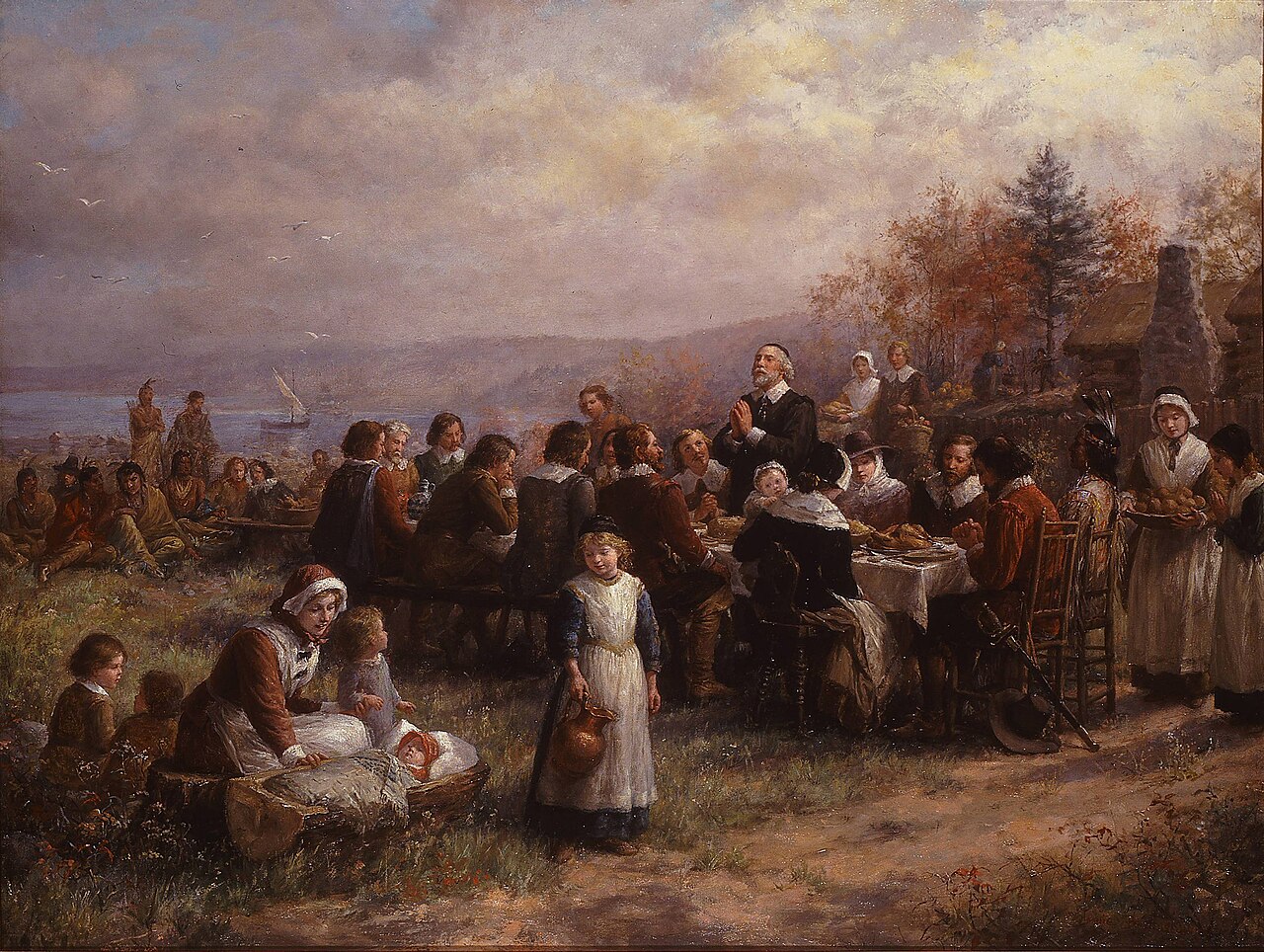
 Myth image
This narration is synthesised from the text; it is not the speaker’s own recording. The original videos are on the "In Their Own Words" page.
A Public Conversation About Thanksgiving
Before You Read: Three Things That Must Be Said First
First, this text does not attribute speech to individual speakers.
The conversation had several participants — one host and two speakers from the museums. But the automatic transcript we worked from contains no speaker separation: it is a single unbroken stream of text with no punctuation, no paragraphs, and no name tags.
So this text uses unattributed narration. We write "the conversation noted,"
"the host asked," "the answer went on to say" — not "so-and-so said."
We name a speaker only where the transcript itself contains a clear internal cue,
such as a person introducing themselves.
Wherever we could not avoid pointing at a specific person and the cue was not solid,
we mark [speaker unverified].
This is not excessive caution. On this subject, putting a sentence in the wrong mouth causes real harm. An Indigenous speaker and a non-Indigenous speaker do not stand in the same place, and who says a thing changes what the thing means.
Second, this is not a verbatim record.
The source is automatic speech recognition. The recognizer drops words, mishears proper names, and breaks sentences where no one paused. We have rewritten it into readable prose, which means no sentence here should be quoted as anyone's actual words. If you need a quotation, return to the video, verify it by ear, and cite a timecode.
Third, Thanksgiving is flagged ⚠️ DISPUTED in this project.
We treat it on two tracks: the traditional narrative and the scholarly revisionist narrative are presented side by side, and we state plainly that Wampanoag people have observed a National Day of Mourning since 1970. We do not summarize on anyone's behalf, and we reach no conclusion.
Name Corrections: ASR Misspelling → Correct Form
Automatic recognition fails on proper names at a very high rate.
Below are our corrections, checked one by one.
Anything we could not confirm is left marked [?]. We do not guess.
People
| As transcribed | Correct form | Note |
|---|---|---|
| Yeti Bay Evans | Yatibaey Evans | Host; creative producer of Molly of Denali |
| bran musas Lopes / Brad musk withas Lopes | Brad Lopes | The Wampanoag name embedded in the transcript is unreadable, [?] |
| Tom Begley | Tom Begley | Transcribed correctly by chance |
| Masa soet / Masasoit | Massasoit | A title, not a personal name |
| usamin | Ousamequin | The personal name |
| Edward wiso | Edward Winslow | |
| Alexander young | Alexander Young | |
| Sarah Joseph halil / a hail / AEL | Sarah Josepha Hale | |
| Josiah → John winth / winr | John Winthrop | The speaker corrects himself on the recording |
| Frank wam suda James | Frank "Wamsutta" James | |
| Frank Don Roosevelt | Franklin Delano Roosevelt | |
| Chris NES / Chris new | Chris Newell | |
| Wayne Newell | Wayne Newell | |
| Danielle Green Deere | Danielle Greendeer | |
| Linda kums | Linda Coombs | |
| daras | Darius Coombs [?] |
Inferred from context, unconfirmed |
| Melissa | Malissa Costa [?] |
Inferred from museum staff records, unconfirmed |
| Martin frobisher | Martin Frobisher | |
| quaak (brings popcorn) | Squanto | Refers to a piece of folklore |
Peoples and Places
| As transcribed | Correct form |
|---|---|
| Plymouth pit / plym pit | Plimoth Patuxet Museums |
| wamp / Wong / wadang / Wampa dog / wamp on | Wampanoag |
| pocano / Pocono / pokeon noit | Pokanoket |
| aquinna / quinna / Aqu quinna | Aquinnah |
| mashby | Mashpee |
| the historic pic community | the historic Patuxet community |
| massachusett | Massachusett |
| npmk nip muck | Nipmuc |
| Herring Pond Community | Herring Pond Wampanoag |
| wabanaki | Wabanaki |
| Mass Bay Colony | Massachusetts Bay Colony |
| pequa homelands | Pequot homelands |
| theask | [?] unconfirmed; possibly Nemasket |
Works and Organizations
| As transcribed | Correct form |
|---|---|
| Go's ladies book | Godey's Lady's Book |
| if you lived in Plymouth dur Thanksgiving | If You Lived During the Plimoth Thanksgiving |
| kipu monk / kapuna monk | Keepunumuk ("the time of harvest") |
| the colonization in the story | Colonization and the Wampanoag Story |
| The Gatherings | The Gatherings (transcribed correctly) |
| Zen education | Zinn Education Project |
| you are the historian | You Are the Historian: Investigating the First Thanksgiving |
| a scoa squash | askutasquash [?] |
One Deliberate Non-Correction
The transcript contains the names of several audience members who asked questions. These are private individuals, and their names are almost certainly misheard. Throughout this text we write "an audience member asked" and do not repeat those names.
1. Opening: A Land and Water Commitment
The event was hosted by the public media organization GBH under the title "the real Thanksgiving story." The host identified herself at the top: Yatibaey Evans, creative producer of the children's series Molly of Denali. This is one of the few places in the transcript where identity is unambiguous — she gives her own name and role.
The event opened with a land acknowledgement. The host honored the Massachusett and Nipmuc peoples, whose ancestral lands underlie GBH's studios, bureaus, and transmitter, and stated plainly that acknowledgement is only a starting point: the commitment is to move toward action, learning from, including, and elevating Indigenous perspectives, voices, and languages.
Then came a land and water commitment from the museums' side. Here the speaker identifies himself within the text: Brad Lopes, from Aquinnah on Martha's Vineyard, Director of Indigenous Interpretation and Training at Plimoth Patuxet Museums. He greeted the audience in Wampanoag before switching to English.
He said that the land and waterways where they gathered are the homeland of his people, the historic Patuxet community, and a long line of ancestors since time immemorial. He mentioned the Herring Pond community nearby, who have carried traditions into the present, and whose kinship ties to Aquinnah and Mashpee still hold.
Then came the hardest sentence in the passage. He asked listeners to acknowledge the genocide and the ongoing process of colonization this land has witnessed. Like the water, he said, they continue to flow. He asked listeners to commit to healing the land, to building shared community and respect with Indigenous nations, and to honoring tribal sovereignty, agency, and self-determination — because without Indigenous voices, history remains incomplete.
📎 Knowledge Extension
The following is not from the conversation. It is our addition, from museum sources and the historical record.
✅ VERIFIED — What "Patuxet" means The museums' on-site interpretive panels give the meaning as "at the little falls." The town of Plymouth was built on Patuxet. This place had its own name long before it was called Plymouth.
✅ VERIFIED — Why the museum changed its name In 2020 the institution was renamed from Plimoth Plantation to Plimoth Patuxet Museums. The colonial associations of the word "Plantation" were among the central reasons. Old and new signage coexist on the grounds — this is a public change of historical position, not a typo.
✅ VERIFIED — Staff at the Homesite are called historians At the Patuxet Homesite the museums call their staff historians. The panel explains: for Indigenous people, historians are the keepers of stories, traditions, and culture. "Interpreter" is used at the English Village. The difference in wording is deliberate.
2. How the Holiday Became a Holiday
The host's first question: this story has long been told from one perspective — the Anglo perspective. How has it changed over the years?
The answer began with a frame: today's holiday is built around an event in the fall of 1621. That autumn, the English colonists at Plymouth — the people we know as the Pilgrims — and the Pokanoket and other Native people of the region came together at harvest time.
Then a leap of a couple of hundred years. As the United States was being founded and people looked back at their history, they connected that moment to a tradition that was already alive, particularly in New England. That connection rejuvenated a fall-time observance and spread it out of the region and across the nation. That is where the origins of the national holiday lie.
The answer stressed that the holiday has since been used and flexed over time for different purposes: it was used to introduce new immigrants to the American story; it was used to convey certain values to a new citizenry in the early Republic; and it was used, simply, by families continuing a tradition of pausing and reflecting on the year.
Then the observation most worth holding onto: for some people, the holiday has also been part of romanticizing the past. So understanding it today means working through all these different components and how each has changed over time.
And underneath the components, this: two cultures came together in the same place at the same time, each building on thousands of years of actual gratitude and reciprocity, and spent about three days there — feasting, tending to other things, and learning.
📎 Knowledge Extension
Not from the conversation. Our addition.
⚠️ DISPUTED — What that gathering was called at the time This project calls the 1621 event a harvest gathering. In seventeenth-century English usage, "a day of thanksgiving" meant a religious occasion — preaching and prayer, often with fasting — a categorically different thing from the feasting and games of 1621. "First Thanksgiving" is a later name, applied retrospectively.
✅ VERIFIED — There is only one primary account The sole contemporary record of the fall 1621 gathering is a passage in Edward Winslow's letter of 11 December 1621, published in Mourt's Relation (London, 1622). A national holiday rests on that paragraph.
3. From 1841 to 1941: The Holiday's Two Real Architects
An audience member asked: Lincoln established Thanksgiving as a national holiday as a day of thanks in August, and it later moved to November. When did the holiday merge with the event among the Pilgrims?
The answer noted that Lincoln gets most of the credit because he was president, but that the museums prefer to talk about two other people.
The first is Alexander Young, a New England historian. Looking back at the primary sources the English colonists had written down, he published a compilation in 1841, and noticed that the passage in Winslow's letter, published in 1622, was the only account of that gathering. He called it the harvest festival of New England, and pointed out that they would have been eating turkey.
That moment matters because Young was connecting what happened in 1621 to a tradition he had grown up with in New England — recognizing that what had been going on around him since childhood traced back to those roots.
The second is Sarah Josepha Hale, editor of Godey's Lady's Book, a very popular and influential magazine of its day. Beginning in the earlier nineteenth century, she ran a letter-writing campaign for several decades — writing to presidents and to state governors, calling for a fall-time day of thanksgiving. She was a New Englander herself, so she was drawing on the same traditions Young was referencing.
In 1863, Lincoln called for two days of thanksgiving. The August one followed the Union victory at Gettysburg — a thanksgiving in the classic sense, a religious ceremony from the English and more broadly European perspective: giving thanks to God for victory in battle, for a good harvest, for whatever providence had brought.
The November one was closer to the New England style of harvest-time gathering: coming together after difficult times to recognize gratitude and give thanks for whatever station in life you were in.
Hale had been calling for the last Thursday of November. She wrote to Lincoln, and Lincoln's first proclamation set aside the last Thursday of November as a day of thanksgiving. That set the national pattern.
But it was not yet what we know. For years afterward a president still had to proclaim the day — with two exceptions — for it to happen. And note: it was the last Thursday then; today it is the fourth.
In 1939, the last Thursday of November fell on November 30, which left a very short shopping season. Coming out of the Depression and on the doorstep of the Second World War, Franklin Delano Roosevelt moved it to the fourth Thursday. Two years later Congress passed a law establishing it as a permanent holiday. So it has looked like this only since 1941.
The conversation did the arithmetic: Sarah Josepha Hale's vision was fully realized some fifty or sixty years after her death.
The host drew out two threads in response: that a woman was advocating this in that period, and that some of the decisions were made around consumerism.
📎 Knowledge Extension
Not from the conversation. Our addition.
✅ VERIFIED — The 1841 footnote Alexander Young was a Unitarian minister and historian. The footnote he attached to Winslow's passage in Chronicles of the Pilgrim Fathers was the first time in history the 1621 gathering was called "the first Thanksgiving." The name postdates the event by two hundred and twenty years.
✅ VERIFIED — The first event actually called a thanksgiving in the primary sources is the one in summer 1623, a religious day of thanksgiving for rain after drought. That one fits the seventeenth-century English definition. The 1621 gathering does not.
4. The Most Common Falsehoods
An audience member asked: what are the biggest falsehoods frequently shared about Thanksgiving in 1621?
There are many, the answer said, and new ones surface every year. They fall roughly into two categories.
The first is close to silly. Someone will say that Squanto brought popcorn to the first Thanksgiving.
The second is far more serious. Some people claim the Mystic events of 1637 — what took place in Pequot homelands — were the origin that Alexander Young, Sarah Josepha Hale, Lincoln, and others were looking to when they established Thanksgiving.
This, the answer said, comes from a historiographical error: that thanksgiving has been attributed to William Bradford, when in fact it was called by John Winthrop — the speaker corrects a name he had just gotten wrong, on the recording. Winthrop was in charge in Boston, a governor in the Massachusetts Bay Colony. By the 1630s Massachusetts Bay had arrived on the scene and had already begun, for lack of a better word, to bully Plymouth Colony — let alone Native people.
Winthrop did call a thanksgiving after Mystic. But as the conversation had already established, the English did this quite frequently. In their practice a thanksgiving was a religious ceremony, usually for surviving battles, usually for surviving terrible conditions. Read the primary sources and you will see thanksgivings referenced constantly, because they were part of the English religious worldview of the period.
Mystic happened sixteen years after 1621, so it is not the origin of the holiday. It is just that internet meme culture perpetuates things faster than historians can catch up.
As for whether 1621 was the first Thanksgiving at all, the answer given was: "we say yes and no."
There were certainly prayer ceremonies called by colonists beforehand — the Spanish, the English, the French all had their own. Those belonged to the Christian tradition of calling a religious day of thanksgiving, in some cases simply for making it across the Atlantic Ocean and falling on the beach the day you arrived. But those were one-off prayer ceremonies that were then forgotten and never made into a tradition.
The Plymouth harvest gathering connects differently. It was more in the spirit of celebrating the harvest, of diplomacy between different groups of people, of celebration after extremely difficult periods for both the English and the local people — of having survived a year. All of that came together to form the basis for the reenactments and the feasting, the kernels that still serve as the basis for the holiday today.
📎 Knowledge Extension
Not from the conversation. Our addition.
⚠️ DISPUTED — Whether the Wampanoag were "invited" The primary sources do not say. The Smithsonian's National Museum of the American Indian notes that the roughly ninety Wampanoag men came to investigate after hearing the English fire their guns, and were incorporated into the feast afterward. The sources are silent here; both readings are inferences.
❓ UNRESOLVED — What those three days actually looked like The pumpkin pie, the turkey imagery, and the hand-in-hand pictures of the modern holiday are almost entirely nineteenth- and twentieth-century additions.
5. The National Day of Mourning
The host asked directly: my understanding is that you do not celebrate Thanksgiving but recognize it as a National Day of Mourning. Could you share something about that decision?
The answer: on the day many people are celebrating Thanksgiving, some people recognize — the speaker corrects his own word "celebrate" mid-sentence — a National Day of Mourning. It is a day to hold space and ceremony for all the people who have been lost, the land that has been lost, and the history that led up to this moment.
He said that the reason he recognizes that day, and holds a harvest feast at a different time, is largely because of Frank "Wamsutta" James — a man from Aquinnah, from his own community.
Frank James was invited to give a speech at the 350th anniversary of the Pilgrims' landing. He was not allowed to give it: the speech was considered too controversial. And all Frank was doing was offering his perspective as a man. His text says so, literally, at the start.
The answer called it a speech everyone needs to read. When teaching in a classroom, he sometimes placed it next to Martin Luther King Jr.'s "I Have a Dream" — because they fall roughly in the same civil rights period, the sixties and seventies.
So for many, that day is about separating themselves from what is going on elsewhere, so they can engage in ceremony and remember those who have been lost; and also about thinking forward — how do we move on, how do different communities and cultures come together and live well in this society.
The host followed up: could you share what that ceremony, or parts of it, might look like? And what can audiences do if they want to recognize the day?
The answer was candid: there is only so much that can be shared publicly about ceremony. What can be said is that it is a time of remembrance — ceremony is about remembering those who have passed, remembering elders — and also a time for a cleansing of sorts for oneself, with several practices falling into that category.
He said he is thirty-one, and that many people in his age range have begun moving away from some of the assimilated colonial behaviors that some of their elders grew up with — elders whose lives made that possible for this generation.
He suggested this is also a good moment for families to consider creating traditions of their own, if they no longer wish to continue certain practices.
He closed by quoting an elder of his, to the effect:
"I have no problem with people celebrating or recognizing a good harvest feast, because that is exactly what anybody anywhere in the world would be doing at that time of year."
📎 Knowledge Extension
Not from the conversation. Our addition. This is the project's core ⚠️ DISPUTED topic; both tracks follow.
✅ VERIFIED — The facts of the National Day of Mourning Since 1970, Indigenous people have gathered at Cole's Hill in Plymouth at noon on Thanksgiving Day for the National Day of Mourning. The origin: Frank "Wamsutta" James, a Wampanoag man, was invited to speak at the official 350th-anniversary dinner. Organizers reviewed his text and demanded cuts — one point of contention was his description of colonists taking corn the Indigenous people had buried. James refused to revise, and delivered his speech beside the Massasoit statue instead. The observance is organized by the United American Indians of New England (UAINE). In 1998 the Town of Plymouth placed a bronze plaque on Cole's Hill formally recognizing the day.
⚠️ DISPUTED — Two narratives held side by side Track A — traditional: In 1621 the Pilgrims and the Indians shared a harvest; this was America's first Thanksgiving, a symbol of friendship and coexistence. Track B — scholarly revisionist: That gathering was not called a thanksgiving at the time; the label is a nineteenth-century product; most of the modern holiday's imagery was layered on later. We summarize for neither side and offer no verdict.
✅ VERIFIED — What the plaque says The Cole's Hill plaque states that for many Native people, Thanksgiving is a reminder of the genocide of millions of their people, the theft of their lands, and the relentless assault on their culture.
6. What Was on the Table: 1621 Food and Today's Table
An audience member asked: how can we honor the true story of Thanksgiving in the food we serve?
The answer began with a general principle: start with the Indigenous people of your region. New England has what New England has, but your area has its own. Since Indigenous food made up such a large part of the 1621 menu, look at the Indigenous people where you are, find the Indigenous foods local to your region, and consider putting them on your table.
In New England, what was being celebrated in 1621 was, in particular, the successful corn harvest. Corn is an Indigenous plant. Indigenous people taught the English how to grow and cultivate it. That year it did very well, and so it was celebrated.
Another voice added the local view.
For Wampanoag people, one of the most enjoyable things to tell people about is
berries — how good it would be to have a berry-based dish; or squash.
Then an etymology: the word "squash" itself comes from an Indigenous word
(transcribed as a scoa squash; correct form [?]).
Which is to say: these harvest foods
take their very names from the people who cultivated them for thousands of years.
On corn: it is like a tree of life for Wampanoag people — but it did not start here. It originates in central Mexico, through the ingenuity of Native people. Bringing that story to the table is itself a way to teach.
Here the conversation offered something like a method: food is a surface cultural feature. It is very easy to see and relatively easy to interact with — and precisely for that reason it is an excellent entry point into the finer details of a culture, and into building human relationships. For a non-Native person who wants to learn more and move forward in a healthy way, building authentic human relationships is the most important thing you can do.
Then a specific inventory of the 1621 table, grounded in the sources, with the uncertainties stated:
- Corn — Winslow's passage tells us the harvest was gathered in. He did not write "we had lots of corn," but the harvest was successful, so corn is the real basis of the table.
- Venison — this we do know. Ousamequin sent men out, and they brought back five deer for the feast.
- Fowl — Winslow records that they went hunting birds and gathered enough to feed the company for a week. He did not list which birds.
- Turkey — this requires one step of inference. William Bradford, the colony's governor and its longtime historian, recorded in that period a detailed list of the kinds of food in the area, including turkeys, and specifically noted a plentiful store of turkeys in the region at that time of year. So turkey was, in the conversation's phrasing, all but guaranteed among the birds hunted that week.
- Shellfish — part of the standard interpretation, potentially including lobster.
- Berries and cranberries — "perhaps cranberries around the table," but not cranberry sauce.
- Squash — a seasonal autumn plant here.
The host then spoke about food and land: understanding traditional foods builds not only relationships between people but a relationship with the land and environment, because you become aware of where your food comes from and when the best time of year is to harvest it. She gave an Alaskan example: June is one of the best times for salmon; the fall is berry season here. She added that she has learned many traditional foods are considerably healthier for our bodies.
The answer took this toward something more structural: learn about food sovereignty efforts — taking back control of where our food comes from, how it is tended, how it interacts with the land, and that process of reciprocity.
The host closed the section on that word. Reciprocity is about relationship — with one another, and with our land, animals, and plants: what are we doing to take care of and be stewards of our environment.
📎 Knowledge Extension
Not from the conversation. Our addition.
✅ VERIFIED — Where "five deer" comes from This detail also comes from Winslow's letter of 11 December 1621, published in Mourt's Relation (1622). The entire primary record of the gathering is that one passage.
❓ UNRESOLVED — Whether turkey was actually on the table Bradford's record establishes that turkeys were plentiful in the region at that season, but no primary source states that turkey was eaten in 1621. The binding of "turkey" to "that gathering" comes chiefly from Alexander Young's 1841 association and the pictorial tradition that followed.
7. The Agreement of March 1621
An audience member asked about the frequently stated thesis that the Wampanoag and the Pilgrims joined in a mutually beneficial alliance. What did the Wampanoag get out of it?
The answer began by correcting the wording. The phrase the museums generally use is "mutual defense pact," because the language of the document often resembles military, defense-based pacts between communities and cultures.
The terms were worked out between Ousamequin (whose title was Massasoit) and the then-governor of Plymouth Colony, John Carver, who died not long afterward.
The agreement set out a series of terms: if someone broke the law, if someone did something harmful within Plymouth Colony itself, that would be dealt with in Plymouth Colony — and vice versa in the Wampanoag homelands.
Here the answer offered a piece of reasoning worth keeping: Ousamequin must have thought carefully about the reciprocity of those terms. What does it mean to agree to come to the defense of the colonists at Plymouth if attacked? It also means that they must come to his defense if he is attacked.
Afterward, Ousamequin was able to use his influence with those who had consented to his sachemship. We know of at least nine other sachems within his sphere who came to Plymouth and agreed to the same mutual defense pact. So many people came to visit that it noticeably taxed Plymouth's resources.
The answer gave an image to close it: if you could time travel, you would likely see Wampanoag people at Plymouth every day, if not every other day.
The significance of the agreement is that it provided a mechanism for these two cultures to begin a relationship in a truly political way, rather than merely a social one.
The answer was equally clear about its fragility.
It was tested right away — many would argue within the first month,
if not the first year, in events at Nemasket [?] and elsewhere.
It was constantly tested. But it was also constantly revisited.
And here a crucial cultural difference: revisiting relationships is itself part of Wampanoag tradition. It is not usually a one-off; relationships always need to be returned to, in a continual process of revisiting and reciprocity.
Some of the Pilgrims, the answer suggested, began to understand this. They traveled to Pokanoket, Ousamequin's primary home and settlement, to see him. They spent time there. They even slept there — definitely outside their comfort zone. They did it because they realized there was a reciprocal aspect to the relationship they had to maintain.
What really began to strain all of this was the 1630s: English settlement into Massachusetts Bay Colony, and people from Plymouth beginning to spread beyond it. The problem is that you are then moving into territories where Ousamequin has no actual authority — you are stepping into a place the mechanism cannot address.
Another voice tied this back to Thanksgiving. After the moment in March 1621, the English sources show the traveling, the diplomacy, and the relationship-building: they write about going to Pokanoket, the going back and forth, and they remark on how they get to know one another.
So the fall gathering of 1621 can also be seen in that context: a moment when those relationships came together again after months of getting to know each other and living around each other. That is the multi-layered aspect of the "first Thanksgiving" — not just a harvest feast, but also a moment of diplomacy, a moment of relationship continuation.
And, as noted, it did not last forever. It lasted for a while — mostly as long as Ousamequin and William Bradford were both around, holding the relationship they had built over the years.
📎 Knowledge Extension
Not from the conversation. Our addition. This section is also a two-track topic.
✅ VERIFIED — Six articles, and one absence On 22 March 1621 (Old Style), John Carver and Ousamequin concluded a six-part agreement: neither would injure the other; offenders would be surrendered and punished; anything taken would be returned; each would aid the other if unjustly attacked; neighboring confederates would be notified and included in the peace; and both sides would leave weapons behind when visiting. The original written treaty does not survive — every surviving text comes from English works. We have only one side's record. The museums state this plainly.
⚠️ DISPUTED — The motive for the alliance Track A — traditional: Ousamequin, out of goodwill and hospitality, concluded a peace that held for more than fifty years. Track B — scholarly revisionist: The historian David J. Silverman (This Land Is Their Land, 2019) argues that Ousamequin's people had just been devastated by the epidemic of 1616–19, while the rival Narragansett moved to exploit that weakness and press them into tributary subjection; he sought the English as a counterweight. Silverman also notes that from the beginning a substantial portion of Wampanoag people opposed the alliance. Both are presented. We do not adjudicate.
❓ UNRESOLVED — Whether the terms were accurately conveyed The negotiation ran through interpreters (Tisquantum, Samoset). No primary evidence confirms that the terms were accurately translated to Ousamequin.
📌 A note on wording This project renders alliance as 同盟 (alliance/league) in Chinese, never as "friendship." This is not fussiness: calling a mutual defense pact a friendship quietly swaps geopolitical calculation for a sentimental story.
8. The Great Dying: Background the Conversation Did Not Open
The conversation touched both sides of the 1621 gathering — "the English had survived an extremely difficult period" and "so had the local people" — but did not open up the catastrophe itself. We add it here, because without it the calculations in the previous section have no ground to stand on.
📎 Knowledge Extension
This entire section is our addition and is not from the conversation.
⚠️ DISPUTED — The Great Dying Between 1616 and 1619 an epidemic swept the New England coast. Per the museums' on-site panel language, it took 70–90% of the region's population. The cause remains unresolved — the surviving descriptions are not sufficient to support any single diagnosis, and the various identifications proposed (plague, leptospirosis, viral hepatitis, and others) are all conjectural. In Chinese this project always calls it 大死亡 ("the great dying").
✅ VERIFIED — Patuxet stood empty When the English landed in 1620, Patuxet had already been emptied by that catastrophe. The cleared ground they built on was not ground they had cleared.
✅ VERIFIED — Self-government predates 1620 The museums' panel states: "Patuxet is one of many Indigenous self-governing communities." The tradition of self-government on this land did not begin in 1620.
9. Canadian Thanksgiving, and "Big T / Little T"
An audience member in Toronto asked whether there is any correlation between American and Canadian Thanksgiving.
A great question, the answer said — they had been curious themselves. The conclusion: there does not seem to be a connection, beyond the sense that it is another time for people to have gratitude, come together, and reflect.
As far as can be understood, the origin of Canadian Thanksgiving similarly goes back to a thanksgiving ceremony of colonial times, sometime in the early 1600s (transcribed as "160 something") — a European coming into the region held one of those religious ceremonies. The reference is to Martin Frobisher.
Here the answer offered a pair of concepts the museums use:
Big T and little T. Big T is the capital-T Thanksgiving, the holiday itself. Little T refers to the Christian traditions and Indigenous traditions of giving thanks, which are far more broadly known.
Frobisher's moment was one of the little-T ones that became a big T for Canada, and got wrapped into the Canadian tradition.
Then the widest-angle passage in the conversation. If you look at both states, the answer said, they are both what many academics today call settler colonial states: settled by colonial populations, and those populations have tended over the long run to have pretty rough relationships with the Indigenous populations there.
Hence the judgment: settler colonial states have identity issues, and these holidays help you define what your identity is — how you understand yourself as a nation state.
The host replied that who we define ourselves as, based on what we celebrate and acknowledge, is a genuinely important part of who we are as people.
10. Whose Mouth It Comes From: Read Indigenous Authors
Earlier in the conversation the host had asked: what is the most important thing we can share with our children as we share the truth about Thanksgiving?
The answer said this is deeply personal — the speaker went to school to be a teacher. And the core of the answer is: include more and more Indigenous voices.
The museums deliberately stock books written by Indigenous authors that match the relevant grade levels and learning levels. Several titles were named, with reasons.
Later, another audience member asked to hear the story of the actual event from their perspective, not ours — meaning, the answer took it, the Wampanoag perspective.
That is what a lot of people want, the answer said: a different voice.
The resources recommended:
- If You Lived During the Plimoth Thanksgiving, by Chris Newell. The speaker described Newell as someone he looks up to a great deal, who has worked closely with elders in his community and elsewhere. It is a resource for when you are unable to bring a Native person or Native voice into your classroom.
- Keepunumuk, by Danielle Greendeer and others. Greendeer is from Mashpee — in the speaker's words, "my sister community." Keepunumuk means, quite literally, the time of harvest. That season has been important historically, is important now, and always will be. The book tells a harvest story from an Indigenous understanding.
- Colonization and the Wampanoag Story, by Linda Coombs, newly out. Aimed at roughly middle-school readers. Coombs is a Wampanoag elder, tribal council member, and historian. What the speaker liked especially: the book has built-in discussion questions for use with children or any audience.
Between the recommendations came a passage worth setting out on its own. Winslow's account says only that Massasoit — that is, Ousamequin; Massasoit is his title, not his name — arrived with ninety men, "amongst others."
Who are the others?
The answer: when they discuss this at the museums, they usually say those were most likely Wampanoag women, possibly Wampanoag children or adolescents. And then, immediately, the line that carries the most weight in the whole conversation:
"There are a lot of unknowns. As a Wampanoag person I still think about it a lot, contemplate it a lot. We can begin to explore it — but I also don't want to accidentally create history."
Reading those very short primary-source sentences and trying to understand the event from the perspective of those who showed up (people who did not necessarily live right there) is, he said, a good thought experiment in itself — and better still alongside the books above.
📎 Knowledge Extension
Not from the conversation. Our addition.
📌 A distinction in naming Massasoit is a title, not a name — closer to "great leader," the Wampanoag honorific for their highest council leader. Four hundred years of English writing has used it as a personal name, which means it has been calling a man by his job. His name was Ousamequin. The museums have increasingly used Ousamequin in recent years.
✅ VERIFIED — Who Linda Coombs is An Aquinnah Wampanoag historian, long associated with Plimoth Patuxet, who has publicly questioned the Crown's and the Council's authority to assign Wampanoag land.
11. The Classroom Problem: Pageants and Columbus Day
An audience member said her son's elementary school still holds a pageant with Pilgrims and Native Americans. She had not yet spoken up, and wanted guidance on how to approach the school — and on Columbus Day, and what resources to share.
That is always tricky, the answer said. It still happens in schools a lot, and he understands the discomfort: as a Native student, he experienced it directly.
But he also said: you don't know what you don't know. Often people do not know that this can be harmful — that for Native children it can cause psychological harm and identity-development problems — and that it also sets false ideas in place for non-Native children, and even for Native children.
His approach: have the conversation with your local school community. Consider inviting in someone like themselves, or someone from the tribal communities, to come speak. Because — and this is the core of the section —
"Our culture is not a costume."
That is a program, or a talk, the museums have developed; other Native groups have addressed the same thing. And there are cultures all around the world dealing with the same problem of being turned into costumes.
On Columbus Day, the answer said there is a lot of research supporting the shift away from it. Its origins resemble those of some other holidays: a lot of people moved into the country wanting to find pride in their own identity, and unfortunately chose Christopher Columbus. For many Native people he is not someone we really want to talk or think about; and for many others around the globe, the mere mention of the name sends a chill up the spine.
He pointed to resources such as the Zinn Education Project, which help people move away from Columbus Day, or at least begin educating in that direction.
Another voice added an in-house resource: "You Are the Historian: Investigating the First Thanksgiving." It works well for classrooms because it is an interactive game — history, and genuinely fun. Children can explore the events discussed in this conversation in their own time and at their own level, and get into real depth.
The pageant format, meanwhile, is based on an outdated style; there are far more ways now to engage this history, richer and more nuanced and at age-appropriate levels.
The section ends on a figure and a judgment: about 90 percent of the literature, and much of the other material seen in classrooms, is not by Native people. So this is also about involving Native people in these conversations — because if you don't know, you can't do better; it is about getting the "know" factor in.
The host answered from her own experience: in Alaska she took part in many such conversations among parents and educators in her school district, about what would be appropriate there, how to acknowledge the Indigenous people of that land, and how to work together. Those conversations, she said, often started with Halloween — with the sentence that our culture is not a costume, our regalia is not a costume — and spread from there into broader questions.
📎 Knowledge Extension
Not from the conversation. Our addition.
✅ VERIFIED — Regalia is not a costume The museums are explicit: traditional dress is regalia; never "costume." The "Mindful Interactions" sign at the entrance to the Patuxet Homesite also states: do not describe structures or cultures as "primitive" or "uncivilized"; do not use slurs or stereotyped terms; do not comment on staff members' appearance. The same sign actively invites questions: "If you have questions, please ask us!"
📌 A stronger alternative If you want to avoid making people sound "primitive," the strongest move is not a politer adjective but the actual name: those houses are wetuash — Wampanoag houses. Naming is stronger than describing.
12. How to Be an Ally
A question submitted before the event asked: what can non-Native allies do these days to help our coexistence in peace?
The answer was specific.
First, support tribal sovereignty. Support Native nations being sovereign, and support that sovereignty being protected. The figure given: 573 federally recognized tribes, plus many state-recognized groups, unrecognized groups, and smaller communities. Which means there is an enormous amount of Indigenous culture sitting in what we now call the United States, Canada, and Mexico.
Second, learn.
Third — the sharpest image in the conversation:
"Part of being an ally is to know how to build stages, but not how to fill them."
Native communities, he explained, often lack the infrastructure or the generational wealth even to better themselves. So the question becomes: who does have resources, and how can they help us build stages? And then it is about knowing when to step off the stage and provide a microphone or a spot for a Native person, a Native voice, for them to carry it. That is about agency — and in the long term about building up infrastructure in those communities.
Fourth, support legislation. Even at the state level, you can support legislation that helps Indigenous people — around education, around mascots, and the like.
Fifth, back to relationships. It comes down to building those authentic relationships, which often happen through the things above.
Another voice added a passage from a different position.
The speaker here identifies himself within the text as
"a non-Native historian" — but the transcript gives no name at this point,
so: [speaker unverified].
He said that one of the things he has most enjoyed about working
at an organization like this, at the living history sites,
is the opportunity to listen, and the opportunity to learn.
Working with people like Brad, and with his colleagues Linda Coombs,
Darius Coombs [?], Malissa Costa [?], and everyone he has worked with
over the years — they paved the way for the program and the content
being shared that day.
Being able to learn and to have conversation
is one of the great benefits of being a historian at such an organization.
He then turned it to the audience: you are all attending this event — that is part of it too.
He also mentioned a book: "The Gatherings." He could not recall the lead author, but knew Wayne Newell was involved — Chris Newell's father. The book is about settler and Native communities coming together and holding a series of conversations like this one.
His closing:
"It is about having the courage to be vulnerable in these situations, and recognizing that we both need to have these conversations, because we both need to learn."
The host returned to her own position at the end. As an Indigenous person, what she thinks matters is creating those spaces — those stages — and opportunities for Indigenous people and people of color to have a voice and share their thoughts and perspectives. The key to cross-cultural communication, she said, is being a good listener, asking questions, staying curious, then advocating and creating opportunity in our fields of work and in the education systems.
And a line that could stand as the whole conversation's landing point: many of our institutions were not built with Indigenous people at the core of their creation, and we are now living in a period in which we have to function within them, though they do not always represent our values or our ways. That is why these deep conversations matter — so that we can move forward in a good way.
There was one last brief exchange, about museums themselves. The host relayed something she had heard from a man who works at a museum on the west coast, speaking about being an Indigenous person in a museum setting: we do recognize that museums can be very colonial-like — many of their collections came through conquest, and so on. But that does not mean that museums today and in the future have to be defined that way.
As we learn more about where our artifacts come from, the host added, acknowledging those histories and traumas and then doing our best now to foster healing is important. And one of the pieces of healing is in the education system: sharing the truth, and not perpetuating the stereotypes about Indigenous people or about what happened at Thanksgiving.
The event ended with far more questions than time.
📎 Knowledge Extension
Not from the conversation. Our addition.
⚠️ DISPUTED — The figure "573 tribes" This is the number stated during the conversation. The count of federally recognized tribes changes as new recognitions occur. When citing, use the current list published by the U.S. Bureau of Indian Affairs; do not treat a number spoken in one conversation as a permanent fact.
📌 How to read that number Federal recognition and state recognition are two different legal statuses, and many communities have neither. "Unrecognized" does not mean "nonexistent" — which is part of why the conversation emphasized supporting tribal sovereignty.
Appendix: Method and Limits
What we did. We took a roughly nine-thousand-word automatic transcript — no punctuation, no paragraphs, no speaker labels — and reorganized it thematically into twelve sections of readable prose. We corrected proper names one by one, and appended a knowledge extension to each section as a blockquote. The body says what the conversation discussed; the blockquote says what we added. Typographically they never mix.
What we did not do. We did not decide whose mouth any sentence came from. We reached no conclusion on Thanksgiving. We did not dress up our reconstructed sentences as verbatim quotations.
Limits.
- Evidence grade of the source: UNAUDITABLE (automatic speech recognition output).
- To quote, return to the video, verify by ear, and cite a timecode.
- Names marked
[?]are unconfirmed. Please do not propagate them as established. - Where
[speaker unverified]appears, the speaker's identity has not been established.
Sources for the extensions: Winslow's letter in Mourt's Relation (1622); Bradford, Of Plymouth Plantation; Plimoth Patuxet Museums on-site interpretive panels and public education resources; Pilgrim Hall Museum; Smithsonian NMAI; UAINE (uaine.org); David J. Silverman, This Land Is Their Land (Bloomsbury, 2019).